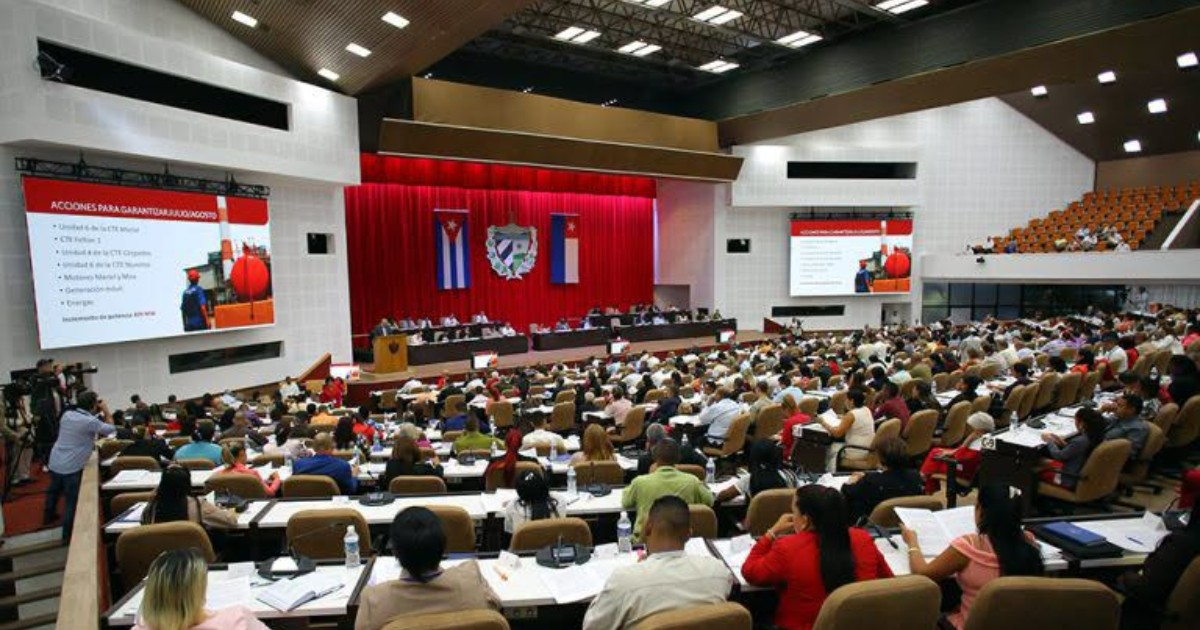
The National Assembly of People's Power of Cuba will reconvene on December 17, amid a deep economic and energy crisis, with the expectation of examining the 176 measures for economic and social transformation promoted by the Government during 2026, although their discussion is not explicitly mentioned in the official agenda.
Esteban Lazo, President of the Parliament, called for the Eighth Ordinary Session of the X Legislature, scheduled for December 17 at the Palace of Conventions in Havana.
According to the state agency Prensa Latina, it is expected that the deputies will focus the debate on the 176 economic and social transformations that the regime promoted throughout 2026, a package presented as the greatest attempt at structural reform since the Special Period of the 1990s.
The official announcement, published on the Parliament's website, only confirms the date, the start time — 9:00 a.m. — and the review of the accountability report from the Ministry of Labor and Social Security.
The rest of the agenda outlined by official and regional media is not formally confirmed: Prensa Latina indicates that the parliamentarians will also address the impact of the U.S. embargo, which the government describes as an "energy blockade," but it does not specify whether this point is included in the approved agenda.
It also mentions the possible approval of a new Foreign Investment Law —aimed at reducing bureaucracy and strengthening legal security— and an Education Law that would update the regulatory framework in place since 1959, although neither of these projects has been confirmed in the official announcement.
The session comes at a time of acute crisis for the Cuban population. This Friday, the Electric Union reported a maximum impact of 1,630 MW, with only 1,075 MW available against a demand of 2,100 MW.
During November, daily deficits ranged from 1,706 to 1,941 MW, with outages in some areas lasting up to 24 consecutive hours.
Cuba recorded eight total collapses of the electrical system in 2026, while units from the thermoelectric plants in Santa Cruz, Felton, Nuevitas, and Renté remained out of service.
Around 2.6 million Cubans suffered water supply interruptions in November, with over 60% directly attributable to power outages, according to the National Institute of Hydraulic Resources.
In addition to that situation, CUPET suspended the national supply of liquefied gas at the end of September due to depleted inventories, forcing thousands of families to cook with charcoal.
In that context, the 176 measures approved in an extraordinary session in June —organized into 23 axes and including authorization for private banking, partial dollarization, and increased openness to foreign investment— have not resulted in visible improvements for the population.
Miguel Díaz-Canel himself acknowledged it on November 17, when he admitted that the reforms "have yet to produce the expected results" and demanded to accelerate their implementation.
A parliamentary review held on November 11 was even more direct: it noted that "the approval of laws and resolutions had not automatically resulted in more food, salary recovery, or a reduction in power outages."
At the conclusion of that review, 172 out of the 176 measures had approved policies and procedures, leading to the creation of 231 legal norms, of which only 131 had been published in the Official Gazette.
It was Lazo himself who, after the Seventh Ordinary Session held in July, pointed out that all the laws passed would only work "if the population understands them and participates in their implementation," a phrase that encapsulates the gap between the regime's legislative activity and the daily reality of Cubans.
Related videos:
Filed under: