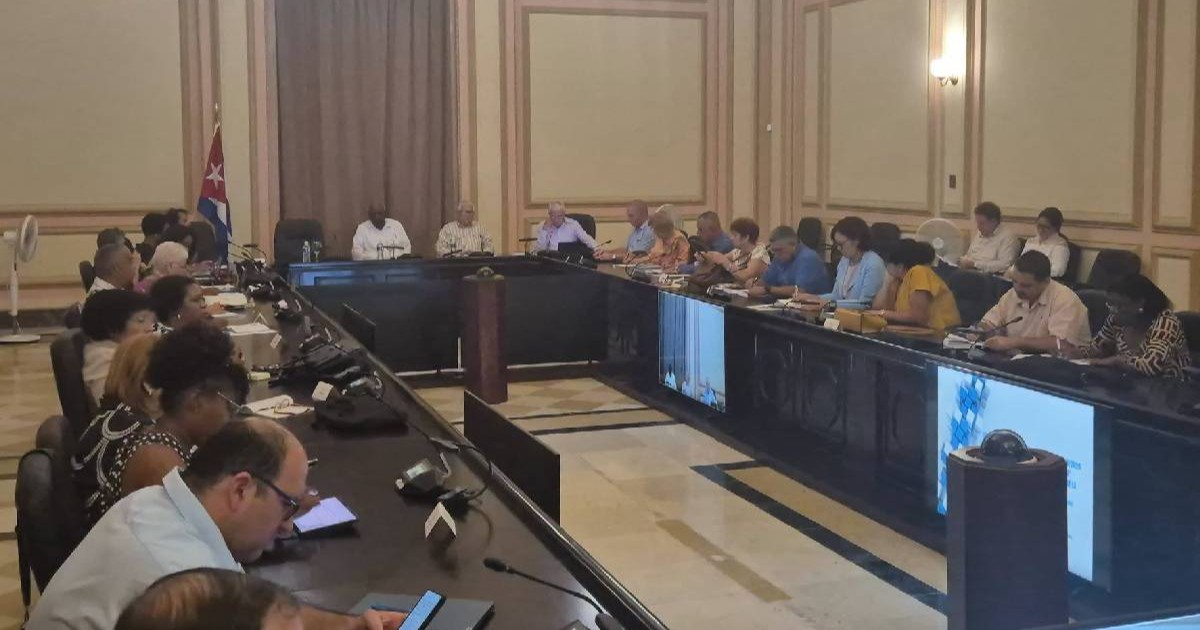
The parliamentary commissions of the Asamblea Nacional del Poder Popular met this Wednesday to review the progress of the agreements adopted in previous sessions, with an eye on the upcoming Ordinary Period of Sessions of the X Legislature, scheduled for December.
According to the official announcement from the Cuban parliament on Facebook, the meeting was led by Esteban Lazo Hernández and included participation from ministers, deputies, and other authorities.
The main focus of the event was to assess the impact of economic and social transformations on the Cuban business system, both in the state sector and in the non-state sector.
This review is part of the follow-up to the package of 176 Economic and Social Transformations (TES) that the parliament itself approved in an extraordinary session on June 18 and 19, 2026, presented by the regime as the largest set of structural reforms since the Special Period of the 1990s.
According to official reports released earlier, 172 of the 176 measures already had approved policies and procedures, and the process had resulted in 231 legal norms, of which 131 had been published in the Official Gazette
The Prime Minister Manuel Marrero Cruz had warned from the beginning that implementing the package would require modifying more than 148 legal provisions, repealing existing regulations, and approving 32 new ones, including bills, laws, and decrees.
The reforms of the business system include greater autonomy for state-owned enterprises in terms of wages, investments, and the allocation of profits; the elimination of the 100-worker limit for micro, small, and medium-sized enterprises (mipymes); and the possibility for state-owned companies to become commercial corporations.
The parliamentary oversight arrives, however, at a moment of unprecedented economic crisis. ECLAC projects a contraction of the Cuban GDP of 10.3% in 2026, the worst in Latin America and the Caribbean.
The official year-on-year inflation reached 28.44% in September 2026, while the prices of food and non-alcoholic beverages rose by 42.66%.
The official minimum salary remains at 3,210 pesos per month, equivalent to less than five dollars at the informal exchange rate, while a study by economist Javier Pérez Capdevila estimates that a person needs around 96,000 pesos per month to cover their basic needs.
The Cuban Observatory of Human Rights estimated in August 2026 that 94% of the population lives in extreme poverty and that eight out of ten Cubans have gone without food at some point due to lack of money or resources.
In that context, it also emerged this Wednesday that President Miguel Díaz-Canel acknowledged that the Cuban population expects “fewer blackouts and more food”, an admission that contrasts with the triumphant tone with which the regime has presented its reforms.
The Eighth Ordinary Session of the X Legislature, scheduled for December, will include the evaluation of the accountability report from the Ministry of Labor and Social Security.
Related videos:
Filed under: