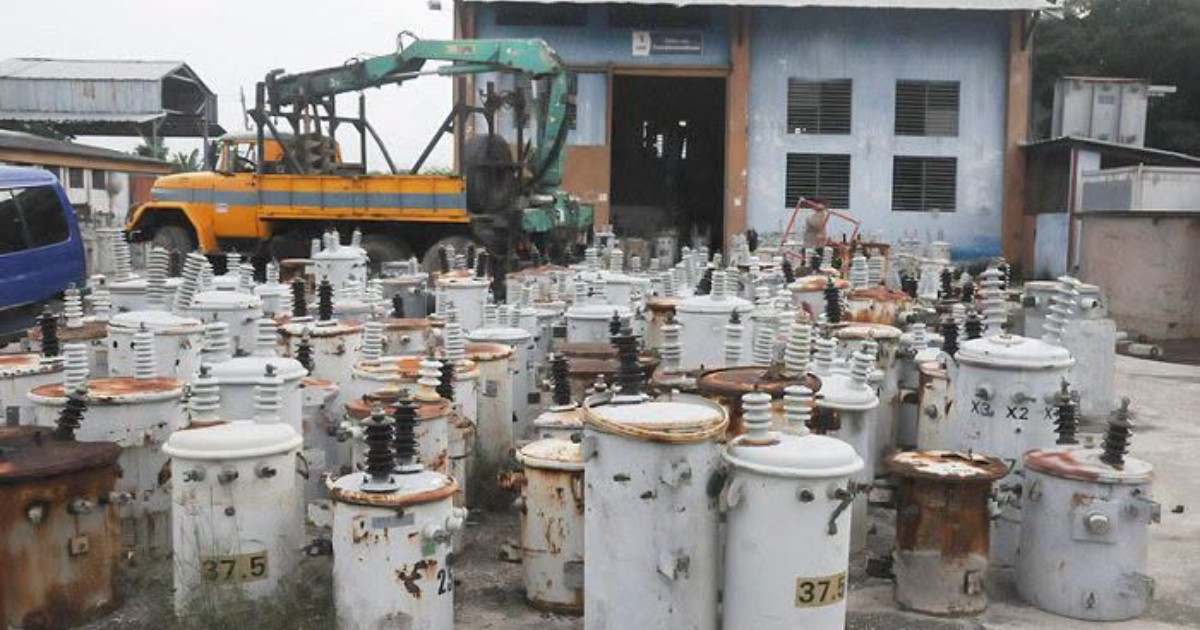
The province of Guantánamo has 52 electrical distribution transformers out of service, a number that leaves over a thousand customers without electricity, many of them since July in the municipalities of Maisí, Niceto Pérez, and Baracoa, as the official media Venceremos acknowledged this Friday.
The engineer Edel Aldana Villar, technical director of the provincial Basic Electric Organization, identified overloading as the main cause of the failures, a phenomenon that technicians refer to as "coincidence factor."
Aldana Villar explained that the problem arises when the population, after long hours without service, reconnects all their devices at the same time: "Electrical surges occur due to what is technically called the 'coincidence factor,' which arises when the population, after long hours without service, connects all their devices simultaneously, disrupting the supply-demand balance."
To that cause is added the proliferation of devices that Cubans have adopted to cope with power outages: EcoFlow, motorinas, and rechargeable batteries which, according to the official, "cause overheating of transformers and lead to explosions in those power distribution equipment," as they were not included in the original design of the networks.
A third source of overload is the practice of neighbors who, as described by Aldana Villar, "out of solidarity, provide service from one energized area to another in blackout through backyards and between blocks, at the cost of damaging the transformer they will later miss."
Of the 52 damaged teams, 13 were rendered useless due to theft of dielectric oil, with documented cases in Maisí, Niceto Pérez, El Salvador, and Manuel Tames.
This crime has spread throughout the island: nationally, the Ministry of Energy and Mines reported 479 thefts of dielectric oil until August 2026, with over 460 criminal investigations opened.
The authorities have begun to treat these incidents as sabotage, a crime that carries penalties of up to life imprisonment or death penalty in the most serious cases.
Regarding the recovery, Aldana Villar specified that "both the province and the country depend on three major workshops in Havana, Villa Clara, and Manzanillo," while Guantánamo is undertaking minor repairs at an approximate cost of 70,000 pesos per unit, which since October has allowed for the recovery of 20 units.
The recovery alternatives also involve the sugar company Argeo Martínez, which provides its furnaces for these operations, and non-state managers who supply the necessary materials.
The deterioration in Guantánamo has been gradual throughout 2026: in June, there were only eight broken transformers, but even then, the Electric Union acknowledged that there were no available replacement units.
By October, the situation had deteriorated to the point that the provincial Electric Company announced a supply of only two hours per day per customer, resulting in up to 22 consecutive hours without electricity.
A partial sigh of relief came this week from Havana: the Latinas factory of the Electric Union resumed the production of transformers after receiving dielectric oil, the shortage of which had temporarily halted the plant.
The Electric Union plans to manufacture or recover 10,000 transformers in 2026, compared to just over 5,500 available the previous year.
Related videos:
Filed under: