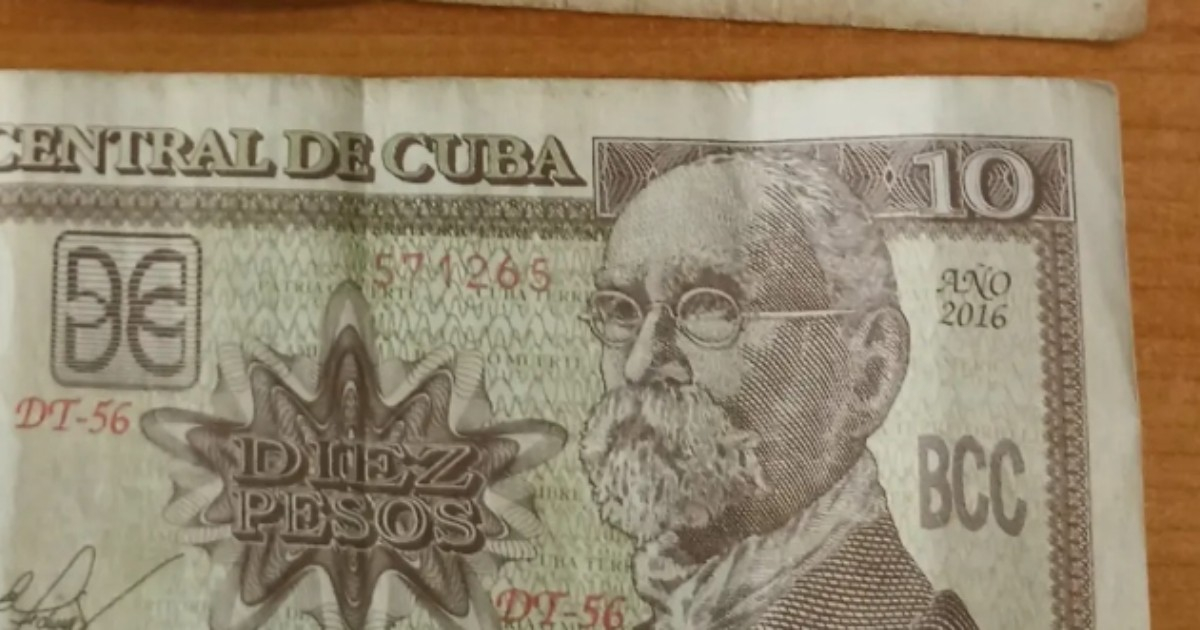
A retiree from Matanzas reported this week on Facebook that the BANDEC branch located at the corner of Jovellanos and Milanés, in the city of Matanzas, tried to pay him his pension and that of his mother exclusively in 10 and 20 Cuban peso bills, denominations that most private businesses refuse to accept.
Jorge René Arencibia Dulzaides reported in his Facebook post that he arrived early at the bank, where the staff collected cards and identity documents around 8:15 in the morning and started calling the retirees around 8:40.
When it was almost her turn, around 9:15, she noticed a woman arguing heatedly with an employee: the bank was issuing all pensions solely in low-denomination bills.
Arencibia Dulzaides requested to speak with the branch manager and presented two direct questions.
The first one: "How is it possible that they pay the entire pension in 10 and 20 peso bills, which the vast majority of businesses do not accept?" The director's response was that "those are the bills they have in stock."
The second point: why didn’t they inform the citizens in line, from the moment the bank opened, that they only had those denominations available, so that those who did not want to accept them could leave without wasting hours waiting? The director responded that the institution "is not obligated to provide that information to the public."
The complainant concluded his account with a question that encapsulates the indignation of thousands of Cubans: "Gentlemen, is this really the fault of the Yankee blockade? Who answers to the people? I truly felt as if they were telling me: if it's convenient for you, great, and if not, leave without compensation."
The case is not an exception. Throughout the island, similar situations occur: a 74-year-old retiree in Santa Clara attempted to buy bread with 100 five-peso bills and was refused; in Holguín, a business returned 300 pesos in 20-peso bills even though the total purchase amounted to 18,000 pesos; in Santiago de Cuba, the elderly line up since the night before and wait between four to eight hours to collect their pension.
The situation worsens because rejecting legal tender is an offense. BANDEC warned in July that this practice could lead to fines of up to 42,000 pesos and even the permanent closure of the business, yet private businesses continue to reject smaller denominations because they cannot use them to pay their suppliers.
The Central Bank issued banknotes of 2,000 and 5,000 pesos in April 2026 and 10,000 and 20,000 pesos in September, but their distribution has not reached the branches uniformly.
Meanwhile, the rejection has even extended to the 50 peso bills, with some businesses imposing arbitrary limits on payments using that denomination.
More than 1.7 million retirees in Cuba depend on pensions with a minimum of 4,000 pesos per month since September 2025, which is equivalent to less than seven dollars at the informal exchange rate.
The government has promoted the "Caja Extra" mechanism, regulated by Resolution 74/2026 of the Central Bank, which allows private businesses to pay pensions in cash and receive bank reimbursement within 72 hours.
In Guantánamo, more than 27,000 retirees are already receiving payments this way, which accounts for 54.4% of the beneficiaries with magnetic cards in that province.
However, the scarcity of high-denomination bills at the branches remains the norm, and retirees find themselves trapped between a bank that pays out bills nobody wants and a commerce that rejects them.
Related videos:
Filed under: