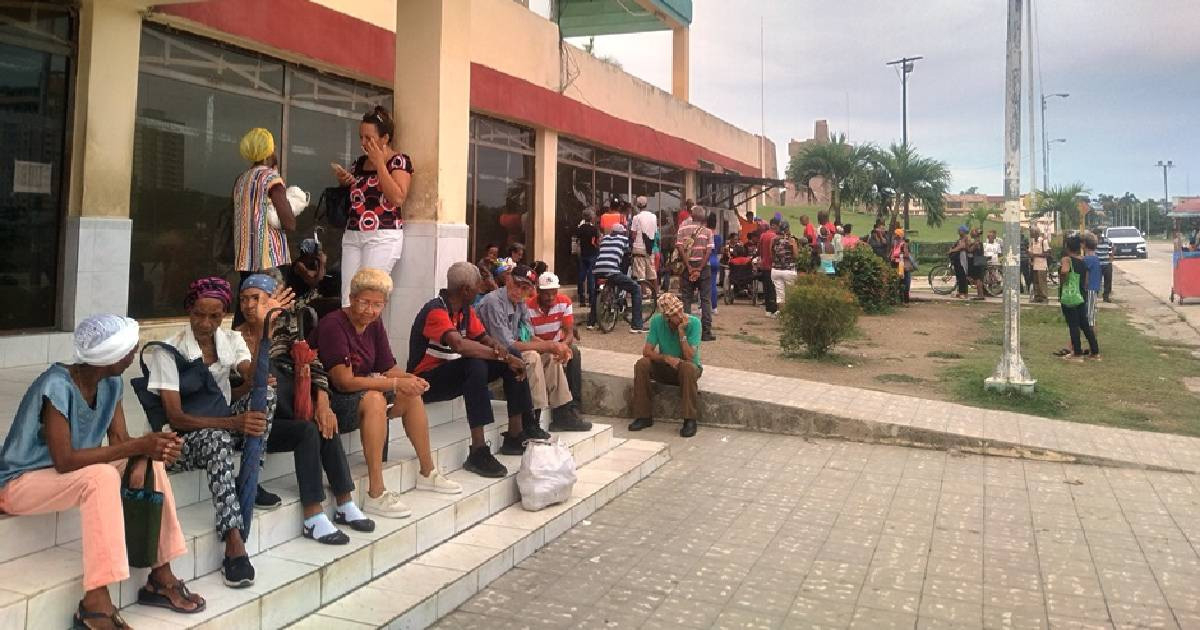
Guantánamo has increased the number of retirees and pensioners receiving their payments through economic actors to over 27,000, a figure that represents 54.4% of those who have a magnetic card in the province.
The provincial director of Labor and Social Security, Oscar Mendoza Pérez, emphasized this Saturday that the territory has 1,462 contracts signed with private businesses, cooperatives, and state entities, in coordination with the Credit and Commerce Bank (Bandec) and the Popular Savings Bank (BPA).
"Through agreements with the bank, the region has increased to 1,462 contracts with economic actors, benefiting 27,119 retirees and pensioners, which represents 54.4% of the total who currently hold a magnetic card, an area that requires ongoing efforts," stated the official during the program "In Frequency With the People" broadcast by the provincial station Radio Guantánamo.
The growth has been rapid. In September, there were 1,056 contracts and 18,344 beneficiaries, representing 37% of the total in the province. In August, only 113 private businesses were covering payments for just over 3,000 retirees.
Imías leads the implementation, with about 90% of its retirees receiving payments through this system. In contrast, Salvador, Maisí, Baracoa, and the provincial capital still show delays that the authorities acknowledge as pending resolution.
The mechanism stipulates that economic actors receive a payroll with the names of the beneficiaries and the corresponding amounts, deliver the cash to the pensioners, and have 72 hours to submit the documentation to the bank and obtain reimbursement.
The scheme was formalized by Resolution 74/2026 of the Central Bank of Cuba, effective from July 20, and is part of the eighth pillar of the package of 176 economic and social transformations approved in June by the National Assembly.
The authorities describe it as an alternative to prevent elderly individuals from spending hours in bank queues, even from the night before, to collect their pensions.
However, the expansion of this model also reflects Bandec's liquidity challenges in Guantánamo. In September, the institution was capturing just over 34% of the nearly 15 million pesos it needed to receive daily.
In July, the official newspaper Venceremos acknowledged that the banking situation in the province "has ceased to be a banking difficulty and has turned into a social problem".
The limitations of the system are compounded by the low amount of pensions. The average payment made through this mechanism in Guantánamo is 3,256 pesos per month, which is below the national minimum of 4,000 pesos and far from the estimated cost of the basic basket, which several economists place above 50,000 pesos per month.
The Cuban economist Elías Amor has raised concerns about transferring pension payments to private businesses. The expert warns of liquidity risks, potential delays in reimbursements, and the bureaucratic burdens shouldered by the participating establishments.
According to official figures, the eastern province has about 68,000 retirees or pensioners, of which around 18,000 receive cash payments through the postal service, while the others receive their payments via card.
Provincial authorities have set a goal for 70% of all Guantanamo retirees with a magnetic card to receive their payments through economic actors.
Related videos:
Filed under: