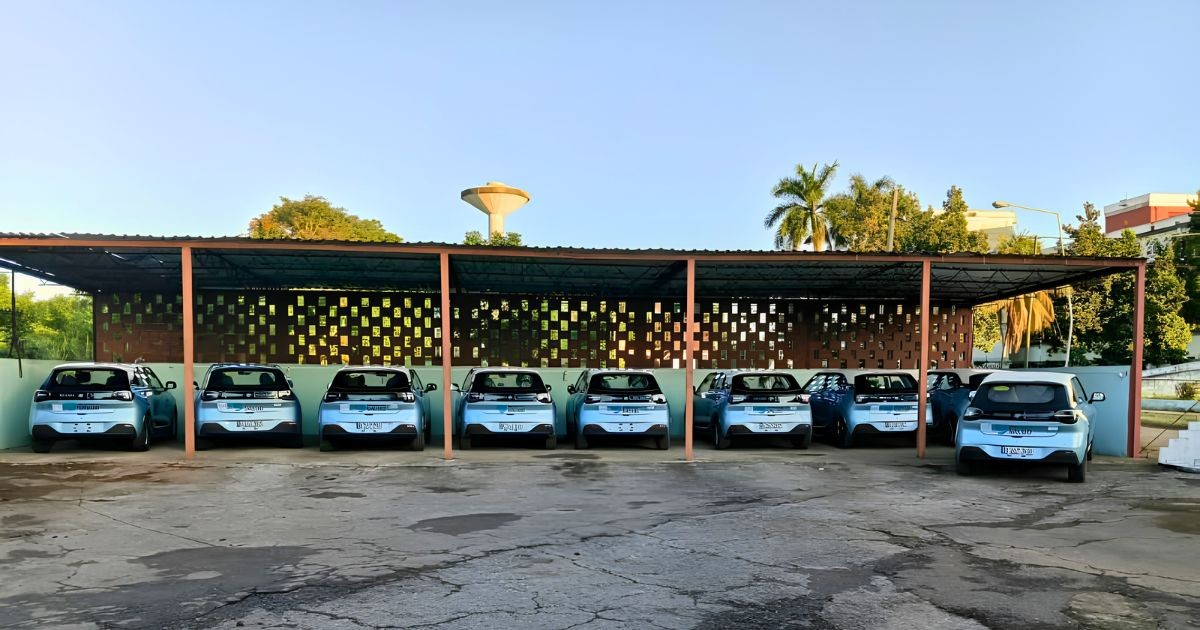
Ten electric cars from the Company Taxis Cuba have started operating in San Cristóbal, a municipality in the province of Artemisa, to transport patients from the hemodialysis unit of the Comandante Pinares Hospital, as reported on Thursday by the state newspaper el artemiseño.
The vehicles, acquired by the Ministry of Transport and assigned to Taxis Cuba, are provisionally installed at the hospital itself while the company's municipal base prepares the photovoltaic charging stations necessary for their permanent operation.
Yolany Torres Hernández, director of the Comandante Pinares Hospital, explained the purpose and funding scheme of the service: "These are vehicles purchased by the Ministry of Transport and assigned to Taxis Cuba, for the transportation of hemodialysis patients, a service funded by the Municipal Public Health Directorate, as is commonly done with traditional taxis and buses that have been responsible for this patient transportation service."
Regarding the temporary placement of the cars at the hospital, the director added: "It was necessary to position them in this healthcare center to ensure the conditions for charging and protection, until the relevant photovoltaic charging stations are installed at the municipal base of Taxis Cuba. They requested our cooperation, and here they are."
In addition to electric taxis, the Provincial Health Directorate assigned two electric tricycles to the hospital for the transportation of supplies and equipment, due to the ongoing fuel shortage on the Island.
Artemisa thus joins the provinces that had already received their units as part of a national plan for 200 Dongfeng Box 01 electric vehicles announced in May 2026 for the transportation of dialysis patients throughout the country, marking the first phase of a program that includes a total of 400 units.
The distribution was staggered: Havana received 40 units, Guantánamo 20, Granma 15, the Isle of Youth five, and each of the other provinces 10. Villa Clara was the first to receive its vehicles in June; Las Tunas, Matanzas, and Pinar del Río incorporated them in July; Santiago de Cuba and Guantánamo received theirs in August.
The plan emerged in response to a healthcare transportation crisis that endangered the lives of thousands of kidney patients. Around 3,000 patients with chronic kidney failure rely on regular hemodialysis sessions at 57 units spread across the country, and since early 2026, a lack of fuel has halted the prioritized taxis designated for their transportation in multiple provinces.
In Pinar del Río, out of 181 patients on hemodialysis, 108 were hospitalized close to treatment centers to reduce fuel consumption and ensure attendance at the sessions. In other provinces, some patients paid up to 2,000 Cuban pesos per trip to avoid missing their treatments.
The arrival of electric taxis in Artemisa is a small improvement within a collapsing healthcare system. More than 96,000 patients are waiting for a surgical intervention in Cuba, nearly 80% of locally produced medications are out of stock, and hospitals have been operating with power interruptions of up to 20 hours a day.
The Minister of Public Health, José Ángel Portal Miranda, admitted at the beginning of November to shortages of medications and equipment, as well as issues with elevators, boilers, water systems, and generators, although he maintained that no healthcare facility had closed.
In Camagüey, patients went almost a week without hemodialysis due to a lack of acid concentrate and bicarbonate; in Santiago de Cuba, the shortage of supplies forced a reduction in session lengths from approximately four hours to two, a reality that contrasts with the occasional relief provided by the ten electric cars now circulating in San Cristóbal.
Related videos:
Filed under: