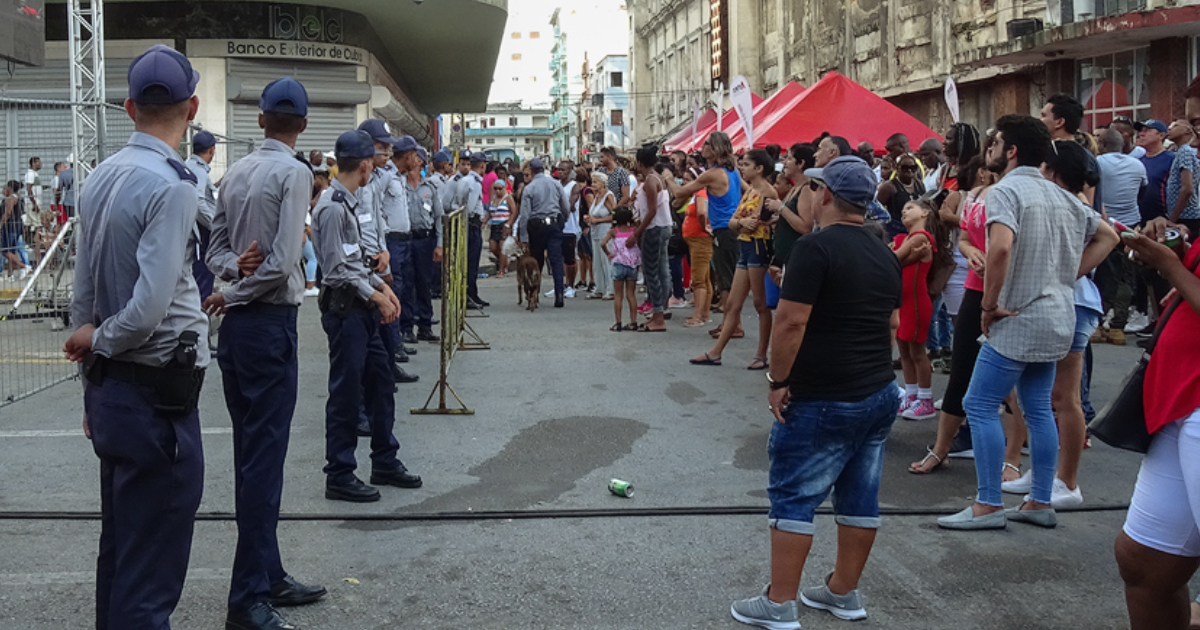
The Cuban dictatorship ranks first in the repression of the freedom of association among the eight countries analyzed by the Global Association Index (GAI), with a score of 95.5 out of 100, the highest —and most repressive— in the study, placing it in the category of "total repression or de facto prohibition."
The report, titled "Legal Barriers and Criminalization of the Freedom of Association", was prepared by the Cuban researcher and activist Carolina Barrero and her team, and published this month by the organization Ciudadanía y Libertad.
The index assesses 13 dimensions of an organization's life cycle—from its creation and registration to accessing funding, public activities, sanctions, dissolution, and access to justice—using as a reference the legislation and its documented application up to September 4, 2026.
After Cuba, Nicaragua scored 94.7 points and Russia 86.1, taking second and third place respectively.
The core of the Cuban repressive system described in the report is the Law 54 on Associations of 1985 and its regulations from 1986, rules that impose a system of prior authorization under the control of the Ministry of Justice instead of a simple notification regime.
Among its most restrictive requirements, the law mandates a minimum of 30 founders and a favorable report from a state "relationship body," which may also attend the internal meetings of the entity once it is established.
The regime can also deny a registration request if there is already an official organization with "identical or similar" purposes, a clause that is crucial because in areas such as labor unions, women's rights, students, or culture, there are already organizations controlled by the State operating.
The report cites as a paradigm example the refusal to register the Cuban Legal Association, to which the Ministry of Justice communicated that its purposes coincided with "functions assumed by the State."
The regulation also excludes from the permitted categories associations with political, religious, or human rights advocacy purposes.
The registration process can take up to 150 days, and if the application is rejected, the only recourse available is to the Minister of Justice himself, without any independent judicial body to review the decision.
The administrative barrier is complemented by the criminal dimension: the Criminal Code of 2022 classifies unauthorized association in its article 274, imposing penalties of up to two years in prison and confiscation, while the Law 88 of 1999 allows external funding to be treated as a punishable conduct, with penalties in the most serious cases reaching up to 20 years.
This legal framework has concrete and documented consequences: the authorities repressed the humanitarian campaign "Save Cuba," promoted by UNPACU in Santiago de Cuba, confiscating food and cooking equipment, detaining activists, and threatening beneficiaries with losing their pension and food rationing card, all under the pretext of "lack of legal authorization."
The pattern is consistent with the data from Cubalex, which reported 1,894 violations of human rights in the first half of 2026 —more than ten incidents daily— with 58% of those against members of independent civil society.
The report makes a distinction among the three countries with the lowest scores: while Cuban regulations hinder the very formation of independent organizations, Nicaragua has chosen to cancel the legal statuses of organizations en masse—over 5,600 organizations legally dissolved by 2026—and Russia has expanded its "foreign agents" laws to encompass any entity with external funding and political activity.
The text concludes that Cuba is not an anachronism but a reference model for other authoritarian governments: "The Associations Law of 1985 ceases to appear as an isolated anachronism and reveals itself as the perfected form of a technique that other governments are currently experimenting with in parts."
Freedom House, in its report Freedom in the World 2026, assigns Cuba a score of 0 out of 4 on the freedom of association indicator and 9 out of 100 in its overall score, classifying it as "Not Free."
Related videos:
Filed under: