
Related videos:
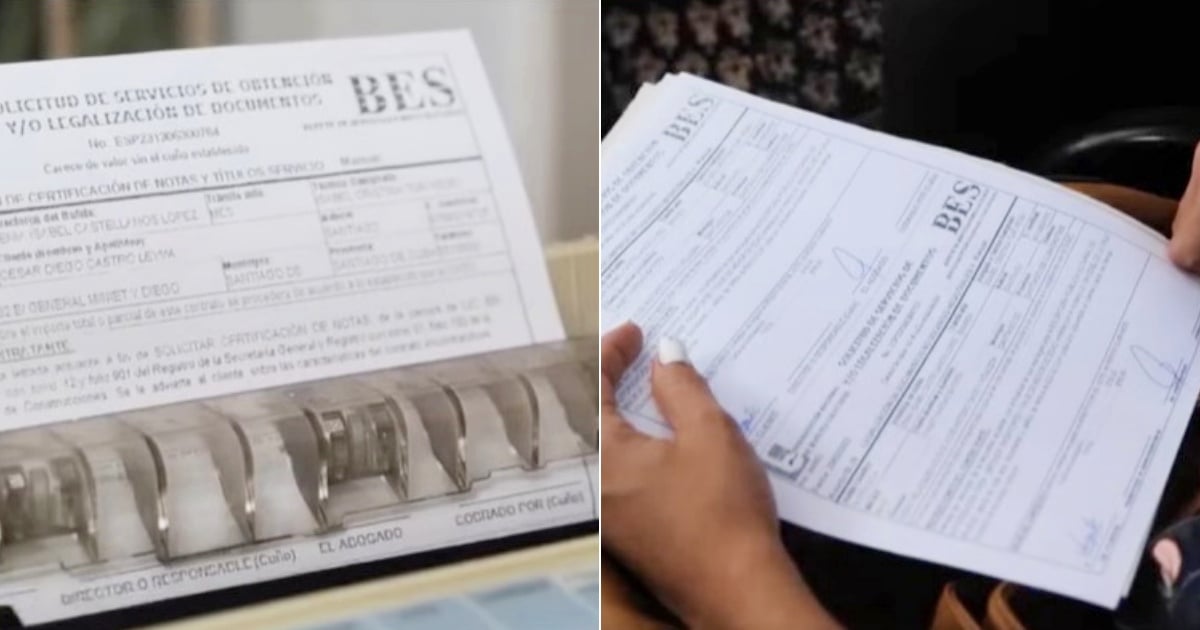
Since this Monday, February 3rd, the Ministry of Foreign Affairs (MINREX) has ceased to provide the service of document legalization for use abroad and within the national territory.
From now on, this function will be taken over by the Ministry of Justice (MINJUS), with the reasoning that the process will be expedited.
"This transfer is carried out with the aim of integrating all phases of the document legalization process that takes place through the registration entities, law firms, and consultancies, as well as the new legalization unit being created for this purpose in the Ministry of Justice," wrote MINREX in a statement.
The entity specified that, together with the Ministry of Justice and the International Law Firms Group "Servicios Legales S.A", they have adopted "the necessary measures to ensure the continuity of this process without interruptions in the legalization service and in compliance with the established deadlines, with the quality and efficiency required by the population."
Ana Teresita González, Director General of Consular Affairs and Assistance to Cubans Residing Abroad, indicated on X that more than 1,500,000 documents were legalized in 2024.
The official emphasized that "since May 2024, there have been no delays at MINREX in the services provided to accredited entities," and that the recent transfer of functions is being carried out with the aim of continuing to optimize this activity.
How will the new system work?
From now on, those interested in legalizing documents must go to the collective law firms, which will be responsible for managing the process with MINJUS.
However, the procedure will continue to go through the same previous channels, including the International Office and the stamps of MINREX.
Documents that already have the stickers and stamps from MINREX will remain valid, so it will not be necessary to repeat the legalization process.
Rates and payment methods
The fees for legalization services will remain unchanged, as stipulated in Extraordinary Official Gazette No. 23 of March 30, 2022:
Civil Registry Certificates (birth, marriage, death): 400 CUP.
Criminal record certificates, acts of last will, and declarations of heirs: 1,250 CUP.
Certification of legal capacity: 2,500 CUP.
Certification of divorce decrees: 3,750 CUP.
For the legalization of documents, the costs are:
Registration and notarial documents for individuals: 375 CUP per document.
Teaching documents in central organizations: 2,500 CUP per document.
Payments can be made using stamped seals, which have been scarce in physical format but are available digitally through Transfermóvil and Enzona.
Doubts and criticism about the change
The government assures that the measure will not bring about additional complications or delays in the processes. However, the efficiency of the new system will depend on its ability to handle the high demand for legalization in the country.
Some citizens view the restructuring with skepticism and hope that "everything is well computerized."
"I don't think it's for the better; I still don't see anything being done that shows any improvement. But well, we have to wait and live the experience. Hopefully, it gets better," stated a user on social media.
In April of last year, the MINREX acknowledged a backlog in the legalization of documents due to the increased demand for that service.
Ernesto Soberón, who at that time served as the General Director of Consular Affairs and Cubans Residing Abroad (DACCRE), explained that, compared to the previous year, the increase in demand was 16%.
In light of the increasing volume of procedures, the Cuban government has considered the possibility of adhering to the Apostille Convention.
This international agreement would simplify the validation of documents for use abroad, eliminating the need for additional legalizations in up to 60% of cases.
Although this option is still under consideration, it would represent a significant solution to expedite the legalization processes.
Filed under: