
Related videos:
The Cuban regime will allow access to university degrees and higher technical training programs for students who fail the entrance exams or even for those who do not take the tests.
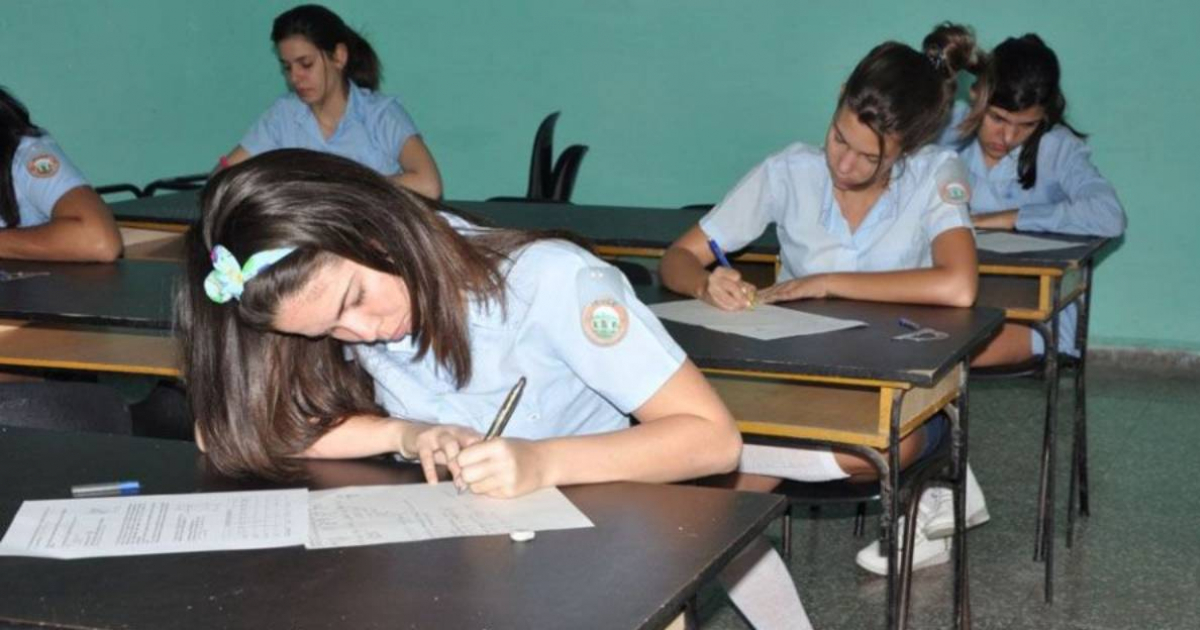
According to the official newspaper Granma, the entrance exams for Higher Education for the 2025-2026 school year will be held on May 6, 9, and 13, for the subjects of Mathematics, Spanish, and History of Cuba, respectively.
However, achieving a minimum of 60 points will not be an essential requirement to gain admission to a university position.
At a press conference, René Sánchez Díaz, Director of Income and Labor Placement at the Ministry of Higher Education (MES), explained that the assignment of careers will be done in stages.
The spots will be allocated in four phases: first to those who pass the exams, then to those who fail, thirdly to those who do not show up in the year of their graduation, and finally to students from technical education, pre-university students from previous years, and other categories defined by the provincial commissions.
Sánchez confirmed that more than 100,000 places will be offered, which theoretically ensures space in higher education for all applicants, although he warned that this does not necessarily mean that every student will have access to the career of their choice.
It was also announced that the experimental model implemented in Pinar del Río, Villa Clara, and Holguín would be extended to the rest of the country—excluding Havana—as part of an income scheme aimed at linking available positions with local development interests and vulnerable groups.
Although the official claimed that the process "maintains rigor and transparency," the measure highlights the devaluation of academic merit and the contradiction between the official discourse of "training requirements" and an admission policy that removes the necessity of passing exams as a quality filter.
This relaxation of university access occurs in a context of mass migration of young people, economic crisis, and academic disengagement, highlighting the deterioration of the education system.
Recently, the Cuban regime announced that pre-university students who wish to pursue a degree in Medical Sciences will not even have to take entrance exams, further relaxing the requirements for access to higher education.
A post from the University of Medical Sciences of Holguín indicated that by simply having completed the tenth grade with an average of 90, and achieving the same score in the first semester of eleventh grade, students will be able to take the last year of high school at the University of Medical Sciences and gain direct entry into their chosen career.
Frequently asked questions about access to higher education in Cuba without passing entrance exams
How will the new system for accessing university programs work in Cuba?
The new system will allow students who fail the entrance exams or do not attend to access university programs. Spots will be allocated in stages: first to those who pass, then to those who fail, followed by those who do not attend, and finally to other categories defined by provincial commissions.
How many university places will be available for the 2025-2026 academic year in Cuba?
More than 100,000 university spots will be available in Cuba for the 2025-2026 academic year. These will be distributed across 113 university degrees and 65 short-cycle training programs, although not all students will be able to access the course they desire.
What is the objective of the new admission scheme for higher education in Cuba?
The scheme aims to link the available positions with local development interests and vulnerable groups, although it shows a devaluation of academic merit and contradicts the official discourse on educational requirements.
What are the main criticisms of the elimination of entrance exams in Cuba?
The measure is criticized for devaluing academic merit and eliminating the quality filter that the entrance exams represented, amid an economic crisis and academic demotivation affecting the country.
Filed under: