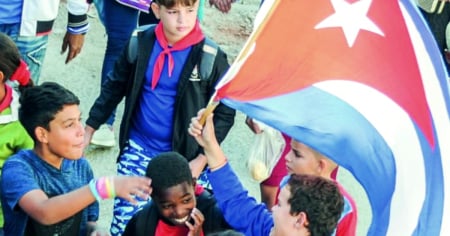
The publication of an article in the state-controlled media, subtly threatening to revoke custody from mothers and fathers who do not instill "love for the Fatherland" in their children, has sparked a storm of reactions among Cubans, both on the island and abroad.
Under the headline "What is the responsibility of mothers and fathers regarding their minor daughters and sons?", published this Monday, May 12, on Granma, the Cuban regime once again threatened mothers and fathers that they could lose custody of their children if they do not fulfill what it defines as their duty to instill “patriotic values.”
The note published this Tuesday in CiberCuba regarding this reflected a massive, emotional, and deeply critical rejection of what many consider yet another form of extreme ideological control and family repression.
More than 3,000 comments on the Facebook page of this outlet reflected, in less than 24 hours, the overwhelming aversion of Cuban civil society towards practices and legal codes with which the regime seeks to strengthen its control during a period of “continuity” that employs “patria,” “revolution,” and “socialism” as credentials to legitimize its totalitarian power in its transition towards a state capitalism without democracy.
From testimonies of parents raising their children alone in precarious conditions to messages from exiles denouncing the forced separation from their families, Cuban voices have made their frustration clear regarding what they perceive as an abuse of state power.
"My children do not belong to the State."
Among the most repeated phrases in the reactions is a definitive statement: "My children are mine".
A mother wrote: “I didn't ask anyone for permission to bring them into the world... I don't ask anyone for anything to support or care for them, so please, use common sense.” Along the same lines, another stated: “My children are mine. Down with the dictatorship!”
Hundreds of internet users rallied with parental dignity against an official narrative that, under the pretext of patriotic duty, suggests that the State holds the moral and legal authority to determine how individuals should be educated and feel within the family structure.
"We love the homeland, not the dictatorship."
The concept of "love for the Homeland" was harshly challenged by many users, who agreed that it cannot be confused with loyalty to the system. A father commented: "Children can be taught to love the homeland, but a homeland free from communism."
“According to them, love for the homeland translates to love for the government and believing everything without questioning it. That is not love for the homeland; that is indoctrination,” added a user.
In an even more direct manner, an internet user declared: “The first ones who have no love for the homeland are themselves. They only love dollars.”
"What love is there if there is no milk or bread?"
Everyday precariousness was one of the most prominent themes in the comments. Many parents responded with irony and pain to the state's demand to instill love for a country whose government does not ensure even the basics and restricts the individual freedoms necessary for fostering prosperous societies.
A Cuban wrote: “Which homeland could children love if they have no cinema, no park, no toys, and not even a simple candy?” Another added: “They should take care of their own children and not those of others! They better find out how a child is fed when he doesn't even drink milk.”
In that regard, a user summed up the pain of many mothers: "Where are they going to take those children? To the hospitals and schools where they are dying of hunger?".
"This is emotional repression."
Other comments focused on the emotional and psychological manipulation that this measure would imply. One user remarked: “Threatening to revoke custody from those who do not indoctrinate their children is not love for the homeland: it is abuse of power, emotional blackmail, and totalitarianism.”
In that same tone, a mother wrote: "We should not threaten anyone, especially our parents, to love our homeland. Wherever we are, we will love it. What we cannot love is the government that is destroying it."
"Children are not foolish."
Many internet users defended the intelligence and autonomy of Cuban children, even from a young age.
“If one feels that they have a homeland, no one needs to instill anything in them. Children can draw their own conclusions based on the reality they experience,” said a Cuban.
“Let’s see, which one of them had a cesarean twice to bring my children into the world? Who sweats it out with a cardboard during the blackouts? Let them raise them, let’s see how it goes for them!”, protested another mother.
This ironic response echoed as a reflection of a country where maternal sacrifice runs deep and is often silenced.
"Children love what cares for them, not what oppresses them."
One of the most shared comments stated: “Right now, if you conduct a survey, I assure you that most children will say they want to leave the homeland that saw them born. Focus on giving them a dignified life first!”
For her part, a mother warned about the possible consequences: “If a father who cares for, feeds, and protects his child is separated from him, that child will be the first enemy of the Revolution”.
"It is not the homeland: it is the system."
A recurring argument in many messages is the distinction between homeland and government. A Cuban pointed out: "Let’s not confuse love for the homeland with love for the government. Homeland is where you were born, your friends, your people. The government is not the homeland."
A fellow citizen was even more direct: “SORRY! If they take away the milk at 7 years old, and WE parents come up with tricks to provide them breakfast. What love for what homeland are they talking about?”.
A town that does not remain silent
The reactions to this measure reveal the accumulated discontent of a society that not only survives but also resists. Amidst pain, indignation, and humor, Cubans have raised their voices to make it clear that family is sacred, and that the bond between parents and children cannot be conditioned by ideologies.
What was meant to be a legal reminder of patriotic duty ended up being, for many, yet another affront from the regime. But this time, the response was unanimous and powerful: “Our children are not yours. Homeland yes, dictatorship no.”
Some highlighted comments:
- "I didn't ask anyone for permission to have them, nor is anyone supporting me. So nobody is going to take them away from me."
- "My children are mine, not any code or any government’s."
- "You can love Cuba and not the government."
- "Children can be taught to love their homeland, but a free homeland, not one subjected to communism."
- "They are not the homeland; they are the ones who destroyed it."
- "Homeland is our people, our streets, our memories... not those who fill their pockets while the people go hungry."
- "Love for the homeland is being able to have breakfast, have electricity, and not be kept awake by mosquitoes."
- "First ensure food, medicine, transportation, and safe schools. Then talk about love for the homeland."
- “This is not love for the homeland; it is ideological control from the cradle.”
- “It is repression disguised as education in values.”
- "If you disagree, they threaten to take away your most valuable possession: your children. There is no greater cruelty than that."
- "Children don’t need anyone to tell them anything; they can see for themselves that there is no food, no electricity, and that their parents cry out of helplessness. That also educates."
- "Seeing their parents fight every day to put food on the table teaches them more about love than any slogan."
- "Cubans remain silent out of fear of being imprisoned and leaving their children alone, but if they take away their children, what follows is a revolt."
- "Getting involved with our children is the limit. That's not going to end well."
- “Homeland is loved, but it is loved from the truth, from freedom. Not from imposition or fear.”
- "True love for the homeland is wanting to see it free, just, and prosperous. Not silenced, threatened, and broken."
- "From the most universal of all Cubans: ‘Homeland is humanity; it is that portion of humanity that we see most closely and in which we happened to be born; and we shall not allow the deceit of the holy name to defend useless monarchies, bloated religions, or shameless and greedy politics.'”
Filed under: