
Related videos:
The death of the painter Humberto Calzada, a prominent figure of the exile community, at the age of 81 in Miami, was announced this Sunday and sparked a wave of sadness in the island's intellectual world.
For the artist and dissident Camila Lobón, “If Cubanidad exists, Humberto Calzada is its living embodiment; he displayed the best of his charisma and virtues while exposing with delightful sarcasm the worst of his vices and flaws.”
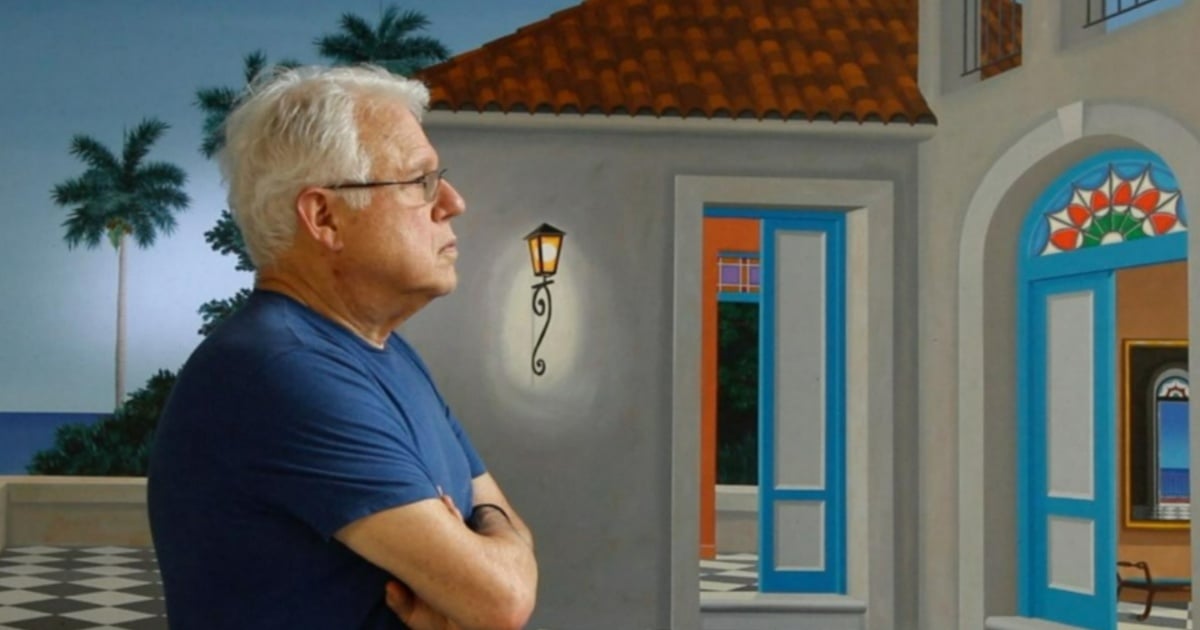
"That’s how he felt, like Cuba, like a home. He created a Cuba in his house that he remembered, far from the longing for what we lost, or the idealization of what could have been, the one we have always wished to inhabit," said Lobón, referring to a work that, according to Rialta Magazine, recaptures the Cuban family architecture that was devastated after decades of Castro's regime.
The writer Enrique del Risco also mourned the death of the painter, who “obsessively reproduced in his paintings his lost childhood and, with it, the memory and dream of a country.”
"The architect who created the house of his dreams and lived in it. The eternal young man who laughed at old age and death. The friend who welcomed you as if he were the whole city. They have all gone, but something of each of them remains with us," he said, referring to the various facets of Calzada's artistic personality, who was also known for hosting intellectual gatherings in his home.
The filmmaker Eliecer Jiménez Almeida released his documentary To Build Another House on social media, “which I created to delve into the universe of Humberto Calzada.”
"In its canvases, Cuba rose again many times," he said.
The opposition figure Anamely Ramos stated that "when I arrived at Humberto Calzada's house, it felt like a game of mirrors."
"His paintings almost magically expanded the visual universe of what it means to be Cuban. Then, just a minute of conversation with Humberto was enough to understand that effect as something not only material but also spiritual (...) The future is unknown to anyone, but I always hope to at least build such a generous and abundant space as the one Humberto created," he added.
According to Rialta Magazine, Calzada's work draws inspiration from the colonial architecture of his childhood in Havana and his engineering studies at the University of Miami, following his family's exile in 1960.
"Nationalist metaphysics, muted existential angst, the aseptic melancholy of resistance, erected in the continuous present of matter, upon the physical certainty of linearity," reads the obituary of this independent Cuban media outlet.
Frequently asked questions about Humberto Calzada and his artistic legacy
Who was Humberto Calzada and why is he a reference for the Cuban exile community?
Humberto Calzada was a prominent Cuban painter known for his work inspired by the colonial architecture of his childhood in Havana. After exiling himself in 1960, he studied engineering at the University of Miami. His art reflects an idealized Cuba, a place he longed to inhabit, and he became a cultural symbol of the Cuban exile. Calzada was also known for hosting intellectual gatherings in his home, creating a space for reflection and dialogue among exiles.
What was the impact of Humberto Calzada's death on the Cuban community?
The death of Humberto Calzada generated a wave of sadness in the Cuban intellectual world, both on the island and abroad. Artists, writers, and dissidents mourned his passing, remembering him as a symbol of Cuban identity and cultural resistance. His work, which revives the architecture and spirit of a Cuba prior to Castro's regime, will continue to inspire future generations.
How do those close to Humberto Calzada describe his personality and legacy?
Humberto Calzada is remembered by his friends and colleagues as an eternal youth who laughed at old age and death. His work is viewed as an embodiment of Cuban identity, featuring a style that combined charisma and virtues. He stood out for his ability to recreate a desired Cuba through his art, which was both material and spiritual. Furthermore, his home in Miami served as a gathering place for intellectual and cultural discussions.
What elements characterize the pictorial work of Humberto Calzada?
Humberto Calzada's work is characterized by its focus on Cuban colonial architecture. His paintings often reproduce his lost childhood, evoking the memory and dream of a Cuba different from the current one. According to critics, his art reflects a "nationalist metaphysics" and a subtle melancholy, symbolizing the cultural resistance of the Cuban exile against the Castro regime.
Filed under: