The Santiago native Elías Navarro, known on social media for daily reporting on the issues facing the people of his city, shared a video loaded with sarcasm and denunciation on Wednesday regarding the shortage of water and electricity in Santiago de Cuba.
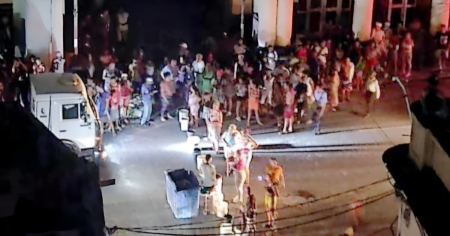
“A new episode of the series 'Waiting for Columbus' with the hope that Christopher Columbus will provide us with running water. Here is Santa Rita street,” said Navarro in the recording, where neighbors are seen carrying containers from a truck set up on the street.
The comment, with an ironic tone, reflects the desperation of families who have to improvise ways to store the precious liquid.
Accompanying the video, Navarro wrote: “Cuba, August 28, 1942, 15th century, 68 days until the arrival of Admiral Christopher Columbus in the Antilles. We hope the admiral comes with a supply of drinking water and electricity. We eagerly await the sighting of some of the canoes (skulls) that transport the visitors.”
Its expression is a metaphor indicating that the population lives like indigenous people waiting for the arrival of a supposed savior.
The images depict dozens of people emerging from their homes with any available container to collect water, in scenes reminiscent of the frantic behavior of ants as they gather food before a disaster.
A graphic reflection of the precarious conditions in which the people of Santiago live, suffering not only from drought but also from daily power outages, inflation, and increasingly deep shortages.
Navarro's sarcasm, far from being an isolated joke, adds to the numerous complaints from citizens who portray the harshness of life in Santiago de Cuba on social media, where waiting for water and electricity has become an endless routine.
The irony of Elías Navarro regarding the lack of water and electricity in Santiago de Cuba reflects a crisis that has been worsening for months.
The supply system is practically collapsed, amid an extreme drought that has left entire neighborhoods relying on water trucks to meet their basic needs.
In recent weeks, the regime itself acknowledged that the drought has driven up water theft and diversion, further exacerbating the precariousness of families, who are forced to resort to any means to access this vital resource.
By July, Santiago was experiencing a desperate situation, with bleak forecasts and entire neighborhoods going weeks without service. Images of people carrying containers of all kinds have become a common sight in the city.
The crisis is not limited to the east. In Central Havana, residents took to Reina Street to protest after growing tired of living with water cuts and blackouts, an example of how desperation is starting to manifest in public displays of discontent.
Even in central provinces, the problems are evident: in Sancti Spíritus, residents received water infested with larvae, which sparked outrage over the lack of hygiene and the negligence of the authorities.
Frequently Asked Questions about the Water and Electricity Crisis in Cuba
What is the current situation of the water supply in Santiago de Cuba?
The water supply situation in Santiago de Cuba is critical, with large areas that have not received water for over 60 days. Distribution relies almost exclusively on tanker trucks due to the Quintero system's inability to adequately supply the city.
How does the energy crisis impact the water supply in Cuba?
The energy crisis severely limits the operation of pumping equipment, reducing their functioning to just four or five hours a day, which is insufficient to ensure a stable water supply. This also causes the equipment to take hours to stabilize once the electric service is restored.
What alternatives exist for access to water in Santiago de Cuba?
The only visible alternative is water distribution via trucks, although this solution is insufficient and faces logistical and distribution challenges, in addition to not guaranteeing equitable access for the entire population.
How does the lack of water and electricity affect daily life in Cuba?
The lack of water and electricity disrupts daily life, forcing people to improvise solutions for basic needs such as cooking, storing food, and maintaining hygiene, which results in significant emotional and physical strain among citizens.
Filed under: