
Related videos:
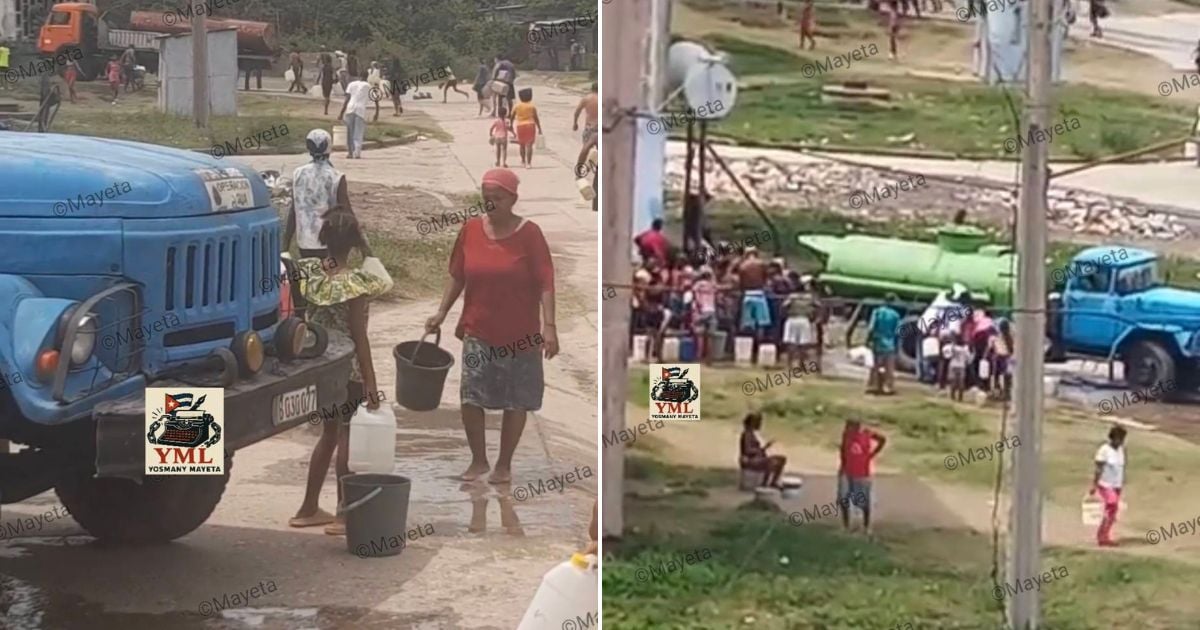
The desperation for potable water has turned the streets of Santiago de Cuba into scenes of daily chaos: mothers with children in their arms, elders, and men with tanks on their shoulders run after a water truck as if it were an ambulance in a full-blown emergency.
In a city where turning on the tap has become a luxury, access to water is no longer a basic right but a race for survival.
The complaint was made on Facebook this Thursday by independent journalist Yosmany Mayeta Labrada, who described the heart-wrenching scene as part of the "agonizing reality" that thousands of people in Santiago face every day.
“Chase a pipe or die of thirst,” Mayeta wrote on her profile, thus summarizing the severity of a crisis that the regime is trying to silence while the people suffer it firsthand.
Neighborhoods such as Sueño, Altamira, Micro 9, Agüero, San Pedrito, and Mariana de la Torre have reported more than 20 consecutive days without receiving a single drop of water.
The only visible "solution" is the trucks, which do not give warning, do not reach everyone, and do not guarantee fair access: they do not service buildings, do not prioritize those in vulnerable situations, and are often distributed based on political criteria or favoritism.
Tall buildings have become prisons of despair: elderly individuals, pregnant women, and those with reduced mobility must carry buckets up dark and dangerous stairs, exposing themselves to accidents due to a lack of proper infrastructure.
The cisterns are dry, the pumps are broken, and the authorities are absent, summarized the communicator, one of the critical voices of the regime who usually highlights the hardships of the people of Santiago.
This adds to the health risk, as without viable alternatives, the water that is sometimes stored is often in used paint buckets, rusty tanks, open plastic bottles, and other improper containers. This has resulted in cases of intestinal diseases, outbreaks of dengue, leptospirosis, and other conditions already reported in local medical centers.
"This is not a drought or a coincidence; this is a crime due to negligence," accused Mayeta, who also denounced the contrast between the suffering of the people and the privileges of the leaders: "Santiago is drying up, but the bosses take baths. The people fall ill, but they toast."
In the midst of chaos, a phrase shouted by a woman encapsulates the feelings of many in the eastern city: "Turn it up, Mayeta, because if the water doesn't flow, at least let the truth flow."
A truth that the regime conceals, yet it spreads, like people chasing after a pipe. Because today in Santiago de Cuba, life is not lived: it is a race for water, dignity, and truth.
The province of Santiago de Cuba is experiencing one of the worst droughts in recent years, with severe impacts on water supply, particularly in the main municipality, where large areas have gone more than two months without receiving this vital resource.
The situation was reported by the state newspaper Sierra Maestra, which included statements from Ludmila Rodríguez Barroso, the general director of Aguas Santiago, who acknowledged that “there is no water and there is no forecast” for when the service might stabilize.
According to the explanation, the Quintero system — responsible for supplying more than 80% of the city — has significantly reduced its capacity due to the drop in flow from the main sources, including Gota Blanca and Gilbert.
Since July 7, the Gota Blanca station has completely halted operations, and the Gilbert has reduced its supply, resulting in only one of the five conduits in the Quintero system being operational.
This has limited the water intake to only 900 or 1,000 liters per second, far below what is needed to maintain a stable distribution cycle.
Sectors such as Altamira, Van Van, Versalles, El Caney, Boniato, and El Cristo are among the most affected.
Some areas have gone over 60 days without receiving piped water service, relying exclusively on water truck deliveries.
Rodríguez Barroso pointed out that even with these reinforcements, it is not possible to guarantee regular access to the entire population: "We are over 20 days, and the most critical areas exceed 60 days."
However, the issue of drought and water supply, far from being a local concern, affects a million people across the country.
The president of the National Institute of Hydraulic Resources (INRH), Antonio Rodríguez Rodríguez, acknowledged that this problem is rooted in the energy crisis, a lack of material resources, and a persistent drought.
Frequently Asked Questions About the Water Crisis in Santiago de Cuba
What is the current situation of the water supply in Santiago de Cuba?
The water crisis in Santiago de Cuba is severe, with many areas facing more than two months without regular supply. The issues stem from a prolonged drought, failures in the supply system, and deteriorating infrastructure. Many communities rely on water trucks, which are insufficient to meet the demand.
What measures have the authorities taken to address the water crisis?
The authorities have implemented emergency measures such as the use of solar-powered pumping equipment and the repair of damaged systems. However, these actions have not effectively resolved the crisis, and access to water remains limited. Water tankers have been deployed, but they are not enough to meet the widespread demand.
What are the health consequences of the lack of water in Santiago de Cuba?
The lack of drinking water has led to serious public health issues, including outbreaks of intestinal diseases, dengue fever, and leptospirosis. Storing water in unsuitable containers such as paint buckets and rusty tanks increases the risk of contamination and disease spread.
How is the water crisis affecting the daily lives of people in Santiago?
Water scarcity has transformed daily life into a constant struggle for access to this essential resource. Residents must chase after tanker trucks to obtain water, and those living in high-rise buildings face extreme difficulties transporting the liquid. The situation has also impacted personal hygiene and public health.
Filed under: