
Related videos:
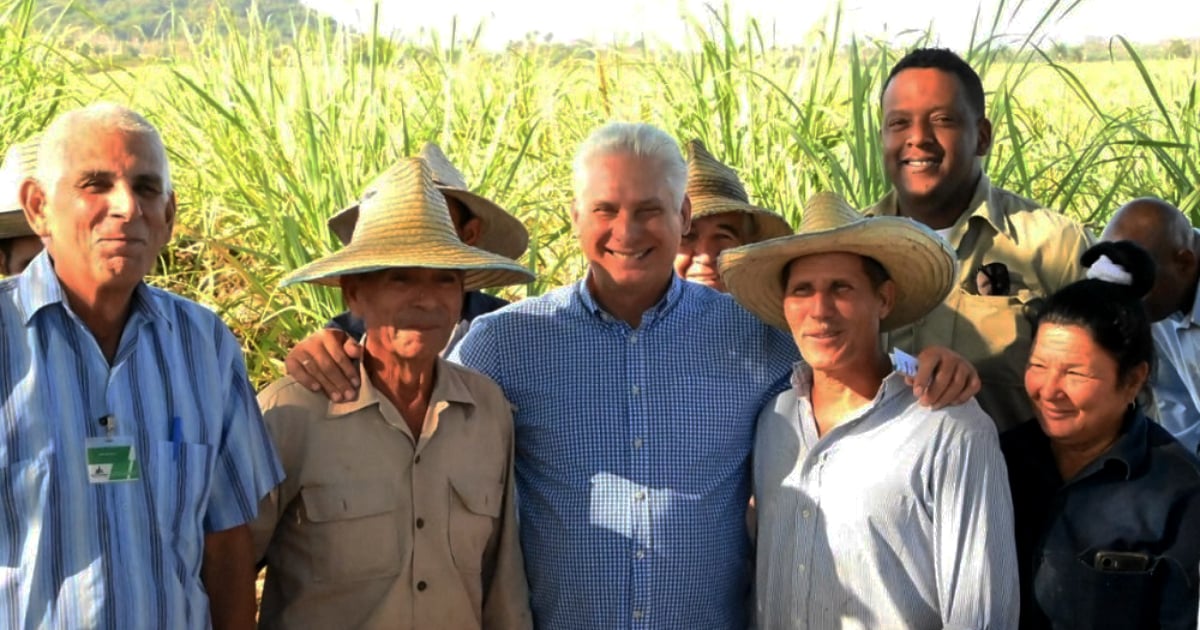
The Cuban leader Miguel Díaz-Canel posted a message on his official X (formerly Twitter) account celebrating Sugarcane Workers' Day, with words that soon went viral due to their obvious disconnect from the country's productive reality.
"Today is Sugar Workers' Day, a date that commemorates the signing in 1960 of Law 890, through which the Revolutionary Government placed over a hundred mills into the hands of the country. Congratulations to the members of this important sector, who are aware of the great challenge they face," said the leader of the so-called "continuity" this Tuesday.
The seemingly harmless text provoked a flood of satirical reactions, criticisms, and anger among those witnessing the irreversible collapse of an industry that, in the 2024–2025 harvest, produced less than 150,000 tons, the lowest figure in over a century.
The unusual "congratulation" that sparked mockery
Díaz-Canel's message was described as absurd by analysts and citizens: congratulating something that practically doesn't exist. In the comments on his post, a wave of criticism and mockery toward the leader emerged.
"Another achievement of socialism: a sugar-producing country without sugar," expressed a user. "Have a little shame: Cuba in 1960 was the largest sugar producer. Today it has to import sugar," another reminded him. "No sugar, no salt, no fish... no life or future under your rule," concluded a third.
The irony was the common response: to congratulate the "sugar sector" in a context where the industry is dying, the mills are falling apart, and a large part of the country consumes imported sugar.
A user recalled the past: “152 sugar mills to be more precise. Today, there are no more than 15 operational, and you are so cynical that you talk about an ‘important sector.’”
The post also reignited criticisms of the official discourse, which in many cases celebrates symbolic figures without backing in reality. Users reminded Díaz-Canel of his recent meeting with sugar industry entrepreneurs from China, hoping to rescue the beleaguered national sugar agro-industrial sector with the help of foreign investment.
The voice of Rocío Monasterio: Sugar heritage and current critique
Among the most notable comments was that of Rocío Monasterio, a Cuban-born politician from Vox:
"They have no shame. They have ruined the sugar sector. The mills have ridiculous production levels, remain outdated, and are falling apart. And what is even sadder is the Cuban people suffering like never before," criticized the Spanish representative.
Monasterio, of Cuban origin and with family ties to the old sugar business on the Island, reacted with evident anger to the publication by the Cuban ruler.
According to documented evidence, Monasterio's paternal ancestors owned the Atlantic Gulf Sugar Company and the Manuelita mill, which were listed on the New York Stock Exchange, until they were expropriated following the so-called "Cuban Revolution," of which Díaz-Canel considers himself a "continuity."
The ideological storm: To congratulate or to hide failures?
The incongruity of greeting a dying sector was interpreted by many media outlets and independent voices as a propaganda maneuver: using historical dates to project a sense of normalcy where none exists. Someone defined it this way: "It's like rewarding a terminally ill person for their health."
Some commentators warned that these types of gestures reflect a government that can no longer sustain real achievements and resorts to ritualistic gestures to maintain the illusion of a functional national industry.
"Talking about Sugar Workers' Day when you destroyed the sugar industry is an insult. You nationalized it to 'rescue it' and ended up burying it. No sugar, no mills, no shame," a Cuban woman exclaimed. "Today, sugar is glaringly absent, but well, celebrate with an imaginary guarapo, which is the only thing that's left," she added.
Others noted that this discursive policy is part of the strategy to control the narrative: to celebrate even what does not exist so that the State does not lose legitimacy among its own base of supporters.
In essence, the collective response was clear: what falls is not praised, it is corrected. However, the State continues with its symbolic gestures, disconnected from the tangible reality of the country.
Filed under: