
Related videos:
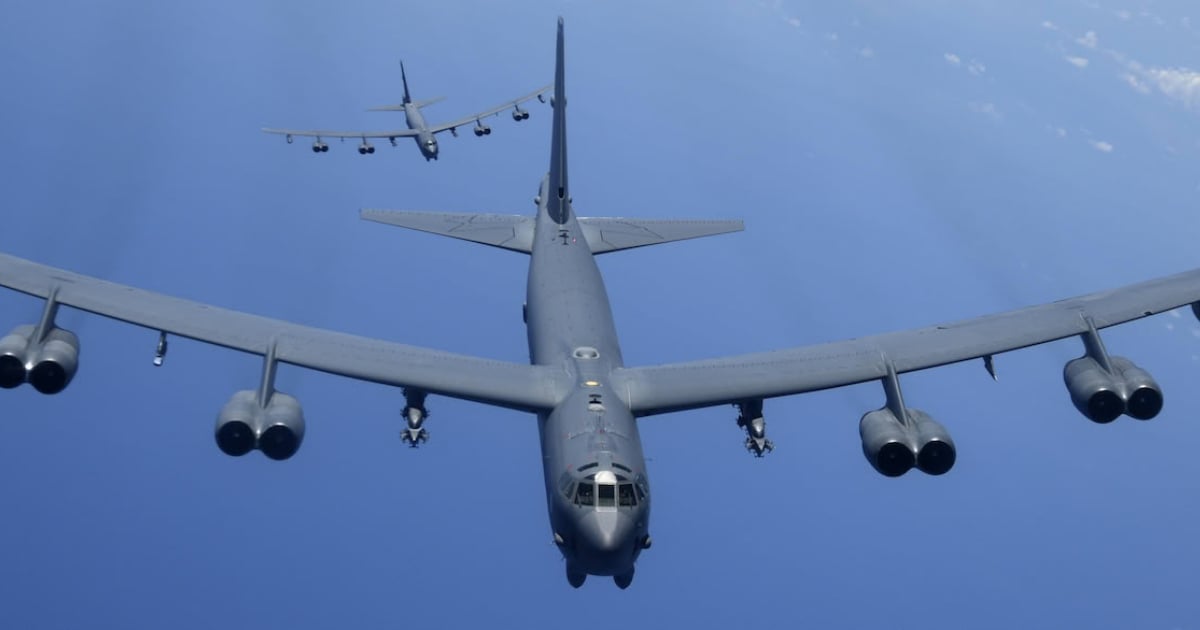
Two B-52 strategic bombers from the United States Air Force flew over the Caribbean Sea off the coast of Venezuela, as part of anti-narcotics military maneuvers coordinated by SOUTHCOM, reported U.S. official sources on Wednesday.
The aircraft, known for their cargo capacity and intercontinental range, were integrated into the joint exercises of the USS Iwo Jima Amphibious Readiness Group, alongside AH-1Z Cobra and UH-1Y Venom combat helicopters from the 22nd Marine Expeditionary Battalion, deployed in the region as part of the U.S. mission to "disrupt drug trafficking and protect national territory".
According to a statement from Southern Command, the operations are being conducted in coordination with the Department of Defense and under the strategic priorities of President Donald Trump, who has ordered an enhancement of naval and air capabilities in the Caribbean during his second term.
Public records of aerial tracking show that the aircraft remained at all times within international airspace, without entering Venezuelan territory.
However, the flight path—visible on monitoring platforms—sparked speculation on social media due to the apparent shape traced off the coast controlled by Nicolás Maduro's government.
The aerial operation occurs in a context of rising tension between the United States and Venezuela, just 24 hours after President Trump announced a military operation against a vessel linked to drug trafficking in international waters near the South American country.
According to the president, the action, authorized under his executive prerogatives, resulted in the deaths of six individuals identified as members of a "designated terrorist organization."
Trump stated that the vessel was traveling a well-known route used for drug trafficking and that U.S. intelligence confirmed its connection with narcoterrorism networks.
“There were no casualties among the U.S. troops,” the president stated in a message shared through his official social media.
Washington has described the operations as part of a pressure strategy against the so-called "Maduro cartel", a criminal structure that, according to the White House, operates under state protection in Venezuela.
In 2020, the United States had already filed judicial charges for narcoterrorism against Nicolás Maduro and several high-ranking officials of his regime.
In response, the Venezuelan government described the U.S. maneuvers as an "armed aggression" and announced the deployment of the defense plan “Independence 200” in coastal and border areas, mobilizing troops, militias, and reservists.
The Minister of Interior, Diosdado Cabello, stated that Washington's operations seek to "impose a regime change and seize Venezuela's natural resources."
The state television channel Venezolana de Televisión broadcast images of internal military exercises, featuring messages of support for Maduro from the Bolivarian Armed Forces and representatives from allied countries of the Bolivarian Alliance for the Peoples of Our America (ALBA), including Cuba, Nicaragua, and Bolivia.
The Vice President Delcy Rodríguez described the attacks on vessels as “extrajudicial and summary executions” and demanded intervention from the UN Security Council.
Other countries in the region such as Colombia have also opposed the U.S. military presence in the area.
Filed under: