
Related videos:
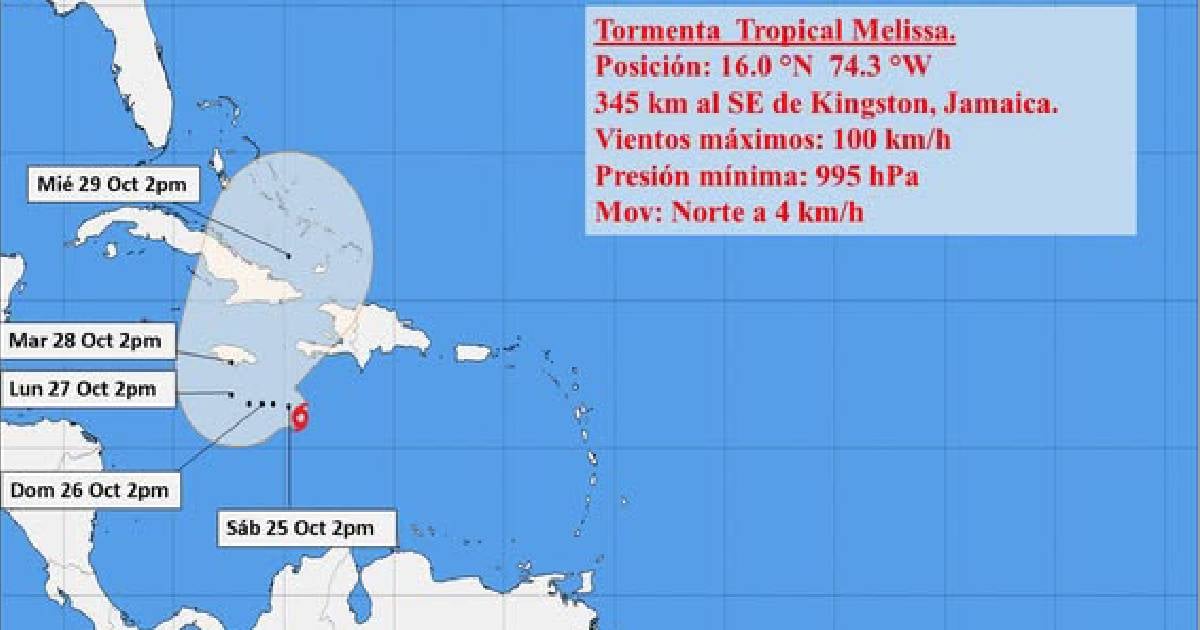
The tropical storm Melissa continues to strengthen over the central Caribbean Sea, where it has shown improved organization and an increase in intensity, with maximum sustained winds of 100 kilometers per hour and higher gusts, according to Advisory No. 8 from the Institute of Meteorology (Insmet) of Cuba, issued this Friday at 6:00 p.m.
The center of the system is located at 16.0 degrees North latitude and 74.3 degrees West longitude, approximately 345 kilometers southeast of Kingston, Jamaica, and is moving slowly to the north at only four kilometers per hour.
According to the forecast, Melissa will shift her path to the west in the next 24 hours and could reach hurricane status over the weekend.
The Insmet Forecast Center emphasized that the phenomenon "poses a potential danger to Cuban territory," urging everyone to closely follow official information.
The next notice will be issued at six in the morning on Saturday.
This Friday, the National Civil Defense Headquarters of Cuba declared the Informative Phase for the provinces of Guantánamo, Santiago de Cuba, Granma, Holguín, Las Tunas, and Camagüey starting at 2:00 p.m. today, so that the authorities can begin preparations for the meteorological emergency.
For its part, the National Hurricane Center (NHC) of the United States has warned of the possibility that tropical storm Melissa could experience rapid intensification in the coming hours.
The weather phenomenon could evolve to reach category 5, with maximum winds estimated at 250 km/h within 60 hours, supported by the strengthening of its central structure and the exceptionally high temperatures of the Caribbean Sea.
This evolution raises the threat to Jamaica and, at a later stage, to Cuba, whose territory could be affected toward the end of the forecast period.
In this regard, during this session, meteorologist José Rubiera warned that Melissa is “about to become a hurricane” and that Jamaica will face a severe impact from strong winds and catastrophic rain for several days, while the potential danger for Cuba increases in the first half of next week.
Even though it is still a tropical storm and located far from eastern Cuba, intense rainfall associated with the weather system has caused landslides in mountainous areas and the partial collapse of the main bridge in Quiviján, Baracoa, which has been rendered unusable for vehicular traffic.
Filed under: