
Related videos:
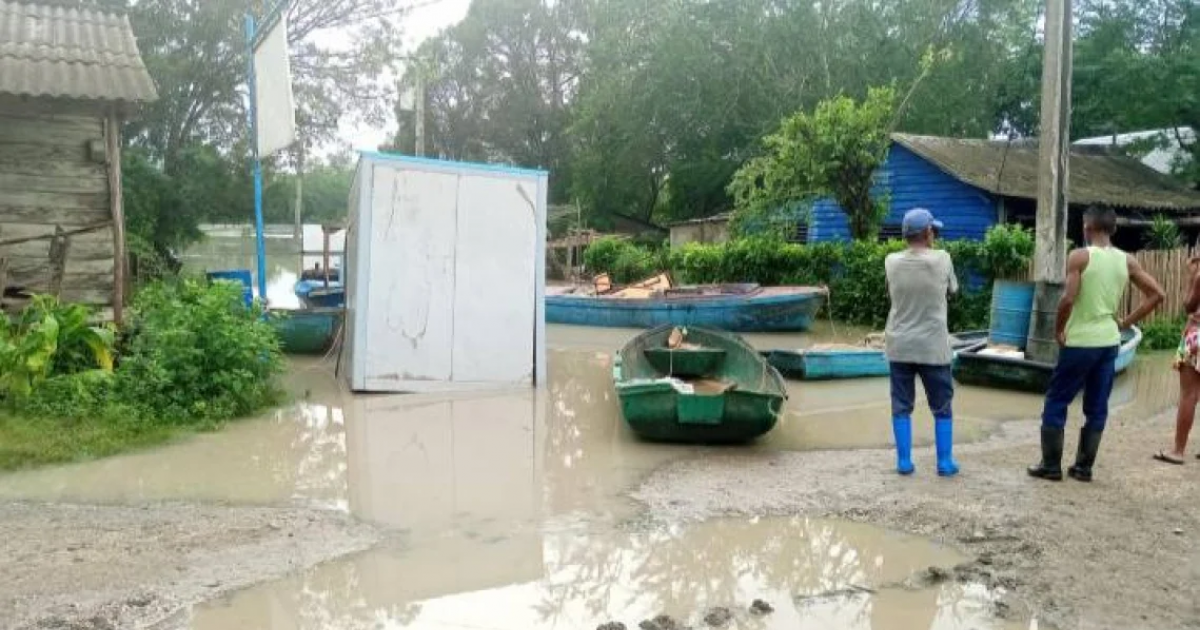
A group of residents from the town of Cauto del Paso in Granma has been trapped for hours on the roof of a store due to flooding caused by the overflow of the Cauto River after the passage of Hurricane Melissa, according to desperate reports shared on social media.
"Please, I ask you to share this. The father of my son called me desperately from Cauto del Paso; they are near the warehouse in that town, and his phone is at 13 percent. They were supposed to go get him, and so far no one has shown up; they are going to wait for the worst to happen," wrote Day Puty Figueredo Pino on Facebook, alerting about the lack of response from the authorities.
The message encapsulates the helplessness experienced by thousands of families in eastern Cuba, where persistent rains have led to the collapse of homes, flooded roads, and completely isolated communities.
The official version that contradicts reality
Despite the pleas for help and the images showing the extent of the disaster, authorities insist that the situation is under control.
On his Facebook account, José Manuel Rodríguez Valdivia from the People's Power of Río Cauto stated that, according to "experts in hydraulic resources," the Cauto del Paso dam does not pose a danger to the Río Cauto territory, although he acknowledged the existence of "potential risks."
"The real danger comes from the discharges of the Salado River, a tributary that carries water from Holguín to the Cauto River, along with other runoff from Las Tunas," he explained.
He added that "the Municipal Defense Council and its defense zones are activated, ready to make the most appropriate decisions," and that rescue teams "are already deployed at various locations."
However, the official text itself warns that "it is impossible to predict the behavior of nature," while blaming the victims for "personal negligence" for having risked their lives.
A common narrative from the regime that downplays its responsibility and diverts attention from the structural disaster and lack of foresight.
Dam at the limit and emergency evacuations
Images shared on Facebook by Marbelis Campos Busquet show the auxiliary spillway of the Cauto del Paso dam discharging at 150 m³ per second, evidence of the immense pressure to which the reservoir is subjected, accumulating water from several eastern provinces.
The intense rains associated with Hurricane Melissa, which struck Cuba on October 28, caused rivers to overflow and reservoirs to become saturated, worsening the situation for rural communities that were already on the brink of collapse.
During the early hours of Friday, more than one thousand residents of Guamo, in Granma, were urgently evacuated to the municipality of Jobabo, in Las Tunas, due to the imminent risk of flooding.
According to CNC TV Granma, the evacuees were moved to the Manifiesto Polytechnic in Montecristi, where "the necessary logistical conditions for their accommodation are ensured."
The official Yaidel Miguel Rodríguez Castro detailed that around 1,300 people were transported by train, and that the arrival of between 5,000 and 7,000 additional evacuees is expected throughout the day.
Rodríguez assured that the authorities acted "immediately," organizing a deployment of vehicles and resources, and even taking part of the bread meant for the population of Jobabo to provide breakfast for the displaced individuals.
"The water is already inside the houses."
While official media spoke of efficiency and control, testimonies on social media painted a much more dramatic picture.
Residents of Grito de Yara reported flooded homes, streets turned into rivers, and communities cut off from communication.
"The water is already inside the houses... we are without communication and without sleep," reported Day Puty Figueredo Pino in another post.
Others alerted about people trapped on rooftops and in trees, waiting for help that was not arriving.
In Cauto del Paso, where the most severe flooding occurs, residents claim that rescue teams have been unable to access several areas due to the strength of the current.
Natural disaster, political failure
Although the government tries to present the damage as an inevitable consequence of a weather phenomenon, the reality is that the country’s structural crisis has left Cuba without any real capacity to respond.
The lack of fuel, specialized equipment, resilient infrastructure, and effective coordination magnifies each tragedy and turns rainfall into national disasters.
The triumphalism of the regime contrasts with the suffering of thousands of families who have lost everything and today rely on neighborhood solidarity or luck to survive.
Meanwhile, officials merely issue statements and blame the U.S. embargo instead of acknowledging their own negligence and lack of foresight.
And throughout Cuba, thousands of people remain trapped—not just by the water—but by the indifference of a State that can no longer protect or feed its people.
Filed under: