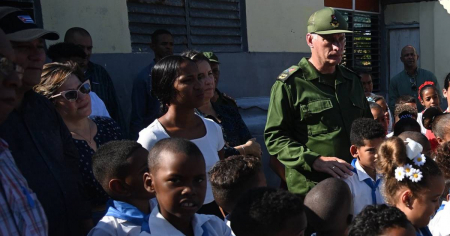
A private Spanish school in the Havana municipality of Playa showcases renovated facilities and international education, while thousands of Cuban students attend crumbling institutions.
The Spanish Educational Center of Havana (CEEH) posted images of its new transition classrooms and a recently renovated sports court on its Instagram account.
"This new school year, our school aims to create ideal spaces for our students, meeting their expectations and needs," the institution stated in another one of its posts.
The school, located at 5th Avenue B between streets 68 and 70 in Playa, offers education from preschool to high school following the Spanish curriculum.
According to Wikipedia, the center has two campuses located less than three kilometers apart and serves the children of Spanish citizens residing in Havana, as well as other foreigners, diplomats, and businesspeople.
On its social media, the school promotes international student exchanges and boasts facilities that starkly contrast with the reality of public schools in Cuba, where collapses, a lack of desks, and broken blackboards are commonplace.
On his part, Cuban content creator Elieser El Bayardo (@elieser_elbayardo) commented in a viral video that the school “operates with European standards, without leaks or propaganda, with fees of thousands of dollars and access only for the children of officials, families with foreign currency, or people with connections.”
Bayardo added that "while the system speaks of equality, this school demonstrates that privileges do exist and that quality only emerges when it does not depend on the Cuban state."
In comments on the center's posts, several Cuban users expressed their frustration over the educational gap.
How lovely it is to see a school without posters and indoctrinating propaganda everywhere, wrote a user.
Another commented, “We need more schools like this, that aren’t free but offer a real education.”
A user identified as Mercedes Denis Peláez stated that "more than 20 years have passed, and the CEEH continues to train wonderful students of an international level."
However, the controversy arose when Cuban parents asked if they could enroll their children by paying the admission fee.
"I would like to know if a native Cuban child can enroll in this center by paying the admission fee," questioned a user.
Another replied sharply: "Of course not, those schools are only for the children of the wealthy."
One user pointed out that the center's website lists being a foreigner residing in Cuba as the first requirement, although another commented that "if you are the child of Cuban parents with money, of course you can."
Users expressed outrage over inequality. "The school is very nice, but what about the other children who have none of those privileges? It's an illusion that only exists for a few, and what about the rest?" wrote a Cuban mother.
Another user recalled: "I have nothing against this, on the contrary, I hope they can raise many children with true values and knowledge, but it makes me very sad that there are millions of children who, like me, were given a cup of expired yogurt during recess."
The official account of the center responded to several comments: “As an international educational institution, we maintain a strictly academic approach that respects all realities.”
That diplomatic response did not ease the discomfort of those who see the school as a symbol of the inequality that the Cuban government claims to combat but actually perpetuates.
On August 19, 2024, the Official Gazette of the Republic published the Decree 107/2024, which updates the list of prohibited activities for micro, small, and medium-sized enterprises, non-agricultural cooperatives, and self-employed workers.
The regulation reaffirms the state monopoly on education and explicitly prohibits the issuance of licenses for private education businesses. No form of non-state management has legal authorization to provide educational services in Cuba, closing the door to private Cuban schools, academies, or institutes, while foreign institutions such as CEEH operate without restrictions.
"That is not Cuba nor the school for Cuban children and adolescents. God willing, all Cuban children and adolescents would have the right and the opportunity to study in schools like that," lamented a user.
While the CEEH promotes its renovated facilities and European educational standards, thousands of Cuban children continue to attend public schools where the roof leaks, the walls crack and political propaganda fills every corner.
Filed under: