
Related videos:
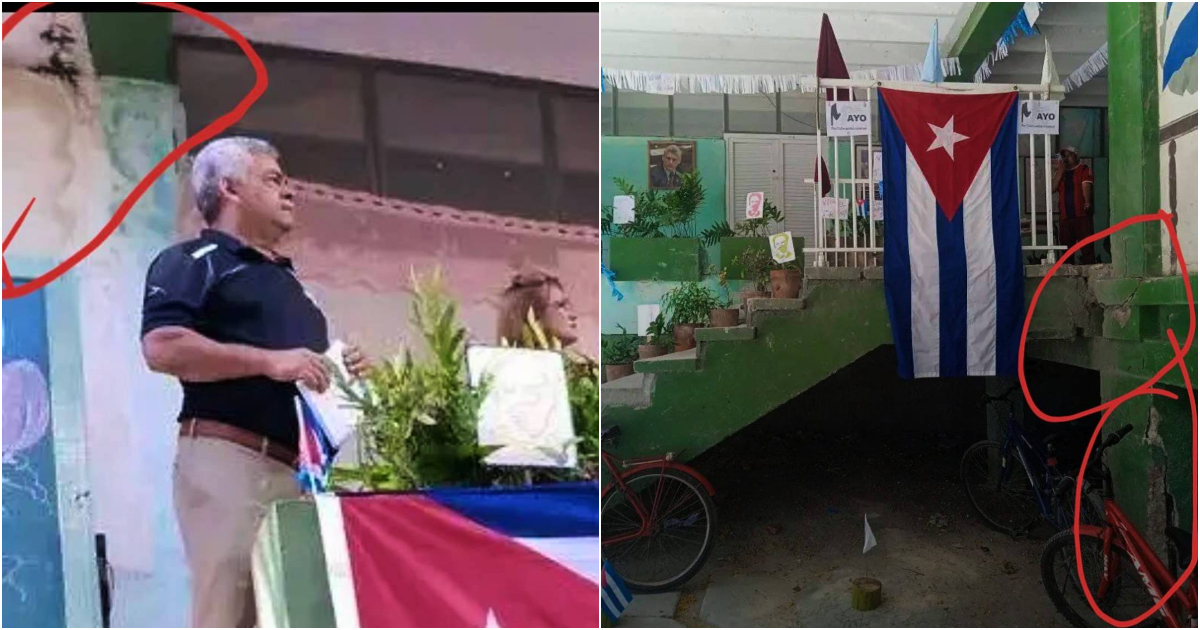
The Gilberto González Rojas basic secondary school in the municipality of Cacocum, in the province of Holguín, is in critical condition with balconies on the verge of collapse, deteriorated stairs, and unsanitary classrooms, while students and parents report the official neglect that puts the lives of hundreds of adolescents at risk.
The students describe an alarming situation: walls with leaks, bathrooms in a deplorable condition, and a school snack rated as poor quality.
The recreational area floods with every rain, preventing physical education classes from taking place, thereby depriving young people of essential spaces for their development, revealed the page on Facebook of the user La Tijera.
Instead of urgent repairs, the authorities have chosen to allocate resources to painting the walls to create the illusion of improvements.
The management prohibits approaching high-risk areas and places guards as a substitute for real solutions, a measure that does not eliminate the imminent danger, the source indicated.
In addition to material precariousness, the prohibition of mobile phone use complicates communication for students who travel long distances to attend a center where there is also a shortage of teachers and class schedules.
Many young people have to spend money on transportation and snacks to reach a place where motivation fades away.
"How do you expect us to want to attend school if we have no breakfast, lack study materials, and, above all, have no motivation?", questioned an eighth-grade student on behalf of his classmates, who ask not to suffer reprisals for speaking out.
On social media, parents and citizens have reacted with outrage. "Until a school doesn't crush children, they won't stop," warned one commentator.
Others are demanding to stop sending their children to classes until safety is guaranteed, and they are denouncing that institutions are spending millions on paint without addressing structural issues.
The student community demands concrete answers and immediate solutions to prevent what is a complaint today from becoming a tragedy foretold tomorrow.
Cuban families criticized the government for calling the start of the 2025-2026 school year “joyful”, while ordinary Cubans in the neighborhoods are facing power outages, a lack of resources, and precarious conditions in the classrooms.
The government acknowledged that only 2.2 million of the 3.6 million uniforms planned for this school year were produced, and only about 20% of students would receive new clothing. The rest would depend on inherited garments or the black market, where a uniform costs over 5,000 pesos.
Additionally, a “revised standard” was implemented that reduces the number of notebooks issued: three per child in primary school to cover six subjects. In secondary school, they must be divided in half. Those who cannot afford the 200 CUP price for a notebook in the informal market will simply not be able to take notes in their classes.
The issues also affect the teaching staff. In Matanzas, more than 2,000 teachers are missing, and the solution has been to fill classrooms with university students, hourly contracts, and unqualified personnel. The deficit is similar in provinces like Camagüey or Sancti Spíritus, which seriously compromises educational quality.
The Minister of Education, Naima Trujillo, emphasized that the reopening was made possible thanks to "collective effort," but she also acknowledged that many schools were only able to open after emergency repairs driven by parents, cooperatives, and local businesses.
Roofs with leaks, insufficient furniture, out-of-service restrooms, and dark classrooms continue to be part of the school landscape.
Recently, Cuban content creator @ledyhr92 visited what was once her school in Santa Clara. Thirteen years later, she returned to the Escuela de Iniciación Deportiva Escolar (EIDE) "Manuel Fajardo" in Villa Clara and what she found were ruins: weeds covering the hallways, broken floorboards, collapsed ceilings, and classrooms consumed by neglect.
Problems in Education and Infrastructure in Cuba
What is the situation of the Gilberto González Rojas basic secondary school in Cacocum, Holguín?
The Gilberto González Rojas basic secondary school is facing critical conditions with balconies on the verge of collapse, deteriorating stairs, and unsanitary classrooms. Students and parents are reporting official neglect, which jeopardizes the lives of hundreds of teenagers. These conditions are compounded by issues such as poorly maintained bathrooms and a school snack of terrible quality.
What measures have the authorities taken in response to the deterioration of the school in Cacocum?
Instead of urgent repairs, authorities have chosen to paint the walls to create the illusion of improvements. They have also prohibited access to at-risk areas and have placed guards as a security measure, which does not eliminate the imminent danger. Students and parents are demanding real solutions and not just cosmetic measures.
What is the impact of poor school conditions on student motivation?
The poor conditions of the school seriously affect students' motivation. The lack of breakfast, study materials, and adequate conditions causes many young people to lose their desire to attend classes. This situation is exacerbated by the lack of teachers and the long commutes required to reach the educational center.
How does the crisis in educational infrastructure at the national level in Cuba affect the situation?
The crisis in educational infrastructure is a nationwide problem in Cuba. Many schools face leaking roofs, insufficient furniture, and restrooms that are out of service. Additionally, there is a significant shortage of teachers, which compromises educational quality. This situation reflects widespread neglect and a lack of investment in the education sector.
Filed under: