
Related videos:
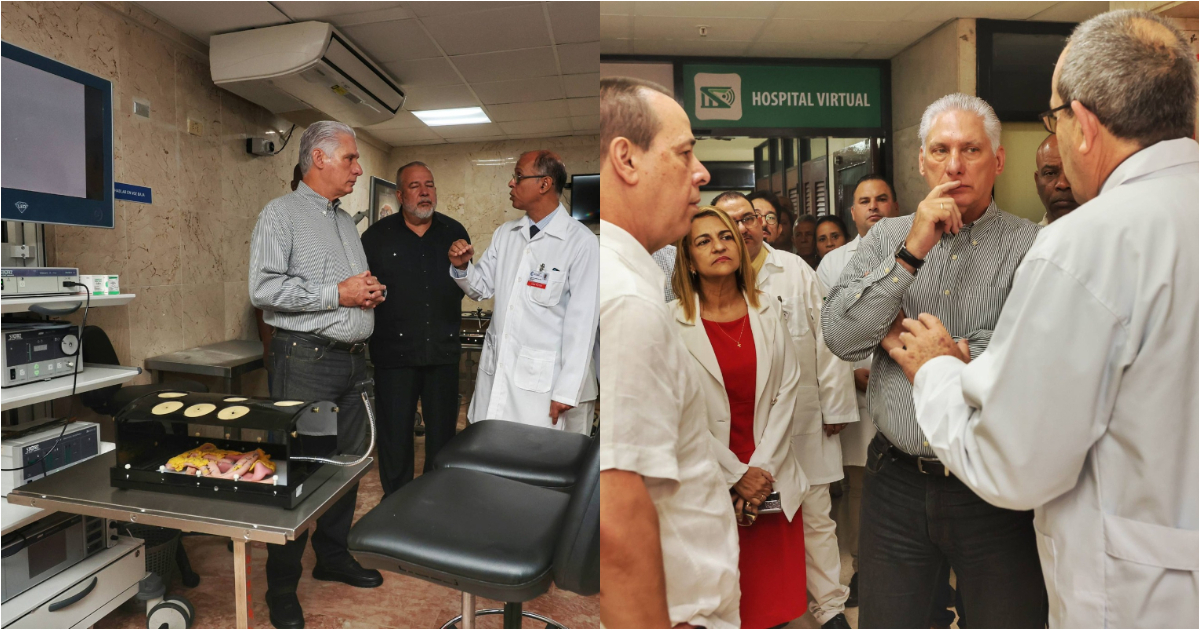
The governor Miguel Díaz-Canel visited the National Center for Minimal Access Surgery on Friday, located in the Diez de Octubre municipality, and the Hermanos Ameijeiras Clinical Surgical Hospital in Centro Habana, institutions that the Government presented as examples of the digital transformation of the Cuban health system.
According to the information provided by the Presidency on its Facebook account, the Minimally Invasive Surgery Center performs over 4,000 surgeries annually and has a faculty where more than 80% of the staff hold scientific titles of doctor or master's degree.
During the visit, the Minister of Science, Technology, and Environment, Armando Rodríguez Batista, explained the reasons why the institution received a special mention in 2024 for the quality of its services.
For his part, the director of the institution, Rafael Torres Peña, stated that the recognition represents a challenge to turn the center into a "smart hospital."
Official information highlighted that the institution succeeded in digitizing all processes related to consultations, interconsultations, and medical histories, as well as implementing quality management methods.
Accompanied by Prime Minister Manuel Marrero Cruz and the Minister of Public Health, José Ángel Portal Miranda, Díaz-Canel observed a live surgery and praised the team's work, considering it aligned with the digital transformation objectives that the Government seeks to promote in the country.
The tour also included the Hermanos Ameijeiras Hospital, where the president attended the opening of the first phase of a virtual digital hospital to manage medical flows and support staff training.
The Presidency highlighted that the institution provides care in over 40 specialties, maintains more than 1,000 residents in training, and has dozens of doctors of science and researchers.
In his account on X, Díaz-Canel stated that both institutions are “at the forefront” of the digitalization process and that the goal is to extend those experiences throughout the entire healthcare system.
However, the announcement sparked a strong critical reaction on social media.
Dozens of users questioned why visits are concentrated in hospitals for the elite, which, they pointed out, are not accessible to the majority of Cubans.
Various comments pointed out the deterioration of polyclinics and provincial hospitals, the lack of medications, basic supplies, hygiene, and antibiotics, as well as the degrading treatment of patients.
Others accused the Government of staging "theatrical performances" for official visits, while the daily reality of the healthcare system is marked by scarcity and collapse.
Several testimonies recounted personal experiences of surgeries without medication, hospital infections, and the obligation to buy supplies in the informal market.
There were also repeated complaints about the restricted nature of centers like those visited by the leader, described as spaces reserved for the privileged or tourists, disconnected from the reality faced by the everyday Cuban.
Critics emphasized that one or two reference facilities do not represent the real state of the Cuban health system, and called on authorities to visit common hospitals and polyclinics, where, according to users, the health crisis facing the country is more acutely expressed.
Filed under: