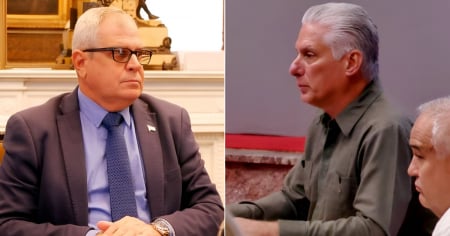
The Army General Raúl Castro Ruz made a public appearance again this Friday during the final session of the sixth ordinary period of sessions of the National Assembly of People's Power (ANPP), held against a backdrop of the economic and social crisis the country is facing.
According to a report from the Presidency of Cuba on the social network X, Raúl, whom the official narrative once again presented as "leader at the forefront of the Cuban Revolution," attended the final session of Parliament, where there were several visible signs that real power remains concentrated in his hands.
In a second message, the Presidency indicated that the elderly military leader arrived at the plenary session alongside the ruler Miguel Díaz-Canel and was applauded by the deputies after having been "informed throughout the day of the debates."
The scene reinforces the symbolic and political centrality of the former leader, despite having announced his retirement from formal positions in 2021.
The official site Cubadebate also highlighted its presence -via videoconference- in the first session of the Assembly.
The media has once again used the term "leader at the forefront of the Revolution," a phrase that has been repeated in recent months and highlights the influence that Raúl Castro still holds within the Cuban power structure.
During that parliamentary session, Díaz-Canel reported on significant changes in the country's institutional structure.
It was announced that, as part of a process of "natural renewal," the Council of State proposed to remove Rubén Remigio Ferro from his position as president of the Supreme People's Tribunal, and to appoint in his place the current Minister of Justice, Oscar Silvera Martínez.
For his part, the President of the National Assembly, Esteban Lazo, announced that the resignations of several deputies had been received: Homero Acosta Ávila, Secretary of the ANPP and the Council of State; Ulises Guilarte de Nacimiento, former General Secretary of the Central Workers' Union of Cuba; and Ricardo Rodríguez González, former President of the University Student Federation.
Raúl Castro's reappearance in the Assembly is not an isolated event; rather, it adds to a series of recent episodes that confirm his prominent role in the country's strategic decision-making.
Last week, it emerged that he was the one who ordered the postponement of the 9th Congress of the Communist Party of Cuba, initially scheduled for April 2026, due to the economic and social collapse that the island is experiencing.
The decision was announced by Díaz-Canel during the XI Plenary of the Central Committee of the PCC, when he read a letter signed by Raúl Castro.
In it, the general stated that postponing the Congress should not be interpreted as a setback, but rather as a necessary measure to concentrate the resources, efforts, and energy of the Party, the Government, and the State in addressing the current problems facing the country.
In October of last year, Raúl Castro, 94 years old, also presided over a session of the National Defense Council at the Ministry of the Armed Forces, where he was once again officially introduced as "the leader at the forefront of the Revolution."
On that occasion, he was escorted by his grandson Raúl Guillermo Rodríguez Castro, known as "El Cangrejo," and accompanied by Díaz-Canel to his right.
That presentation generated special attention, as it contrasts with what is established in the Cuban Constitution, which states that the National Defense Council must be presided over by the President of the Republic.
The information published by the official newspaper Granma confirmed that Díaz-Canel did not lead the body, which represents a direct contradiction to the constitutional text and reinforces the perception that effective control remains in the hands of the general.
Despite his formal retirement from political life, Raúl Castro maintains a decisive influence in the key structures of the State, particularly in the defense sector and in the GAESA business conglomerate, which is under military control.
The insistence on calling him "leader" or "head of the Revolution," rather than former president or historical leader, reinforces the idea that his power has not diminished.
Amid a profound economic crisis, prolonged blackouts, and growing social discontent, Raúl Castro's presence at the center of key decision-making spaces sends a clear message both inside and outside of Cuba: beyond formal positions and speeches about renewal, the political and military control of the country remains under the oversight of the Army General and the apparatus surrounding him.
Filed under: