
Related videos:
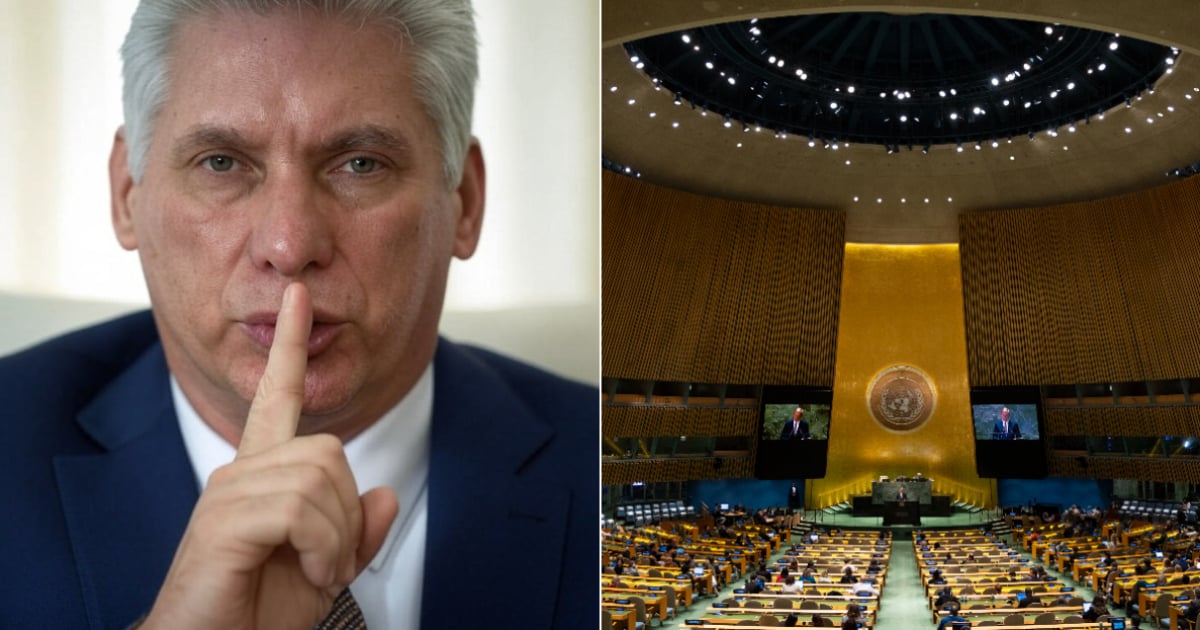
The official Cuban press opted for complete silence regarding a diplomatic event that, had it occurred in a different context, would surely have made headlines: Cuba's abstention in the recent vote at the UN General Assembly condemning the Russian invasion of Ukraine.
But the most striking aspect is not only the silence of the state media, but also the fact that, on this occasion, Havana's position at the UN coincided with the stance of the Donald Trump administration.
In the vote on February 23, the United States, under Trump's leadership, was one of the 18 nations that voted against the resolution, aligning itself with regimes such as that of Vladimir Putin (Russia), that of Kim Jong-un (North Korea), and that of Alexander Lukashenko (Belarus).
Meanwhile, 93 countries supported the condemnation of Moscow and 65 abstained, among them Cuba, China, Venezuela, and Iran. However, the alignment of the Cuban vote with the U.S. vote has been completely ignored by the official media on the island, such as Granma, Cubadebate, Trabajadores, or Juventud Rebelde.
This omission is even more striking considering the history of the Cuban state media, which seizes every opportunity to criticize Washington, especially when the U.S. government is led by a Republican administration that "tightened the blockade and imposed more than 250 measures."
Nonetheless, on this occasion, Havana has chosen to avoid any mention that could lead to questions about Cuba's diplomatic alignment and its contradictions in foreign policy.
This silence also contrasts with the previous coverage by these same media outlets, which have defended on multiple occasions Cuba's "sovereign and independent position" in the conflict between Russia and Ukraine.
In February 2022, for example, when the war was just beginning, Cubadebate and other media outlets aligned with the regime quickly rushed to justify the Cuban government's stance alongside Russia, while accusing the West of instigating the conflict.
Voting history in the UN on the Russian invasion of Ukraine
Since the beginning of the Russian invasion of Ukraine in February 2022, the United Nations General Assembly has held several votes to condemn Russia's actions and demand the withdrawal of its troops from Ukrainian territory.
The following details the main resolutions and positions adopted by Cuba and the United States, as well as the countries that have voted against or abstained:
1- Resolution ES-11/1 (March 2022): "Aggression against Ukraine."
- Voting result: 141 votes in favor, 5 against, and 35 abstentions.
- Countries that voted against: Russia, Belarus, North Korea, Eritrea, and Syria.
- Notable abstentions: China, India, South Africa, and Cuba.
- United States stance: Voted in favor of the resolution.
2- Resolution ES-11/4 (October 2022): "Territorial Integrity of Ukraine: Defending the Principles of the Charter of the United Nations."
- Voting results: 143 votes in favor, 5 against, and 35 abstentions.
- Countries that voted against: Russia, Belarus, North Korea, Nicaragua, and Syria.
- Notable abstentions: China, India, Pakistan, and Cuba.
- United States' stance: Voted in favor of the resolution.
3- Resolution of February 2025: "Principles of the United Nations Charter on which a general, just, and lasting peace in Ukraine is based."
- Voting results: 93 votes in favor, 18 against, and 65 abstentions.
- Countries that voted against: the United States, Russia, Belarus, North Korea, Eritrea, Hungary, Israel, and Syria, among others.
- Notable abstentions: China, India, South Africa, and Cuba.
- U.S. Position: For the first time, it voted against the resolution, aligning itself with Russia and other countries that oppose condemning the invasion.
It is noteworthy that, in the first two resolutions, Cuba chose to abstain, maintaining a neutral stance. In the third resolution, although it also abstained, the position of the United States changed dramatically by voting against it, resulting in an unexpected alignment with Russia and other countries that support or do not condemn the invasion.
This change in the U.S. stance has been the subject of analysis and criticism internationally, as it represents a significant deviation from its traditional position supporting Ukraine. But in the Cuban state media, the silence is palpable.
Moreover, the decrease in the number of votes in favor of the resolutions between 2022 and 2025 suggests a potential erosion of international consensus regarding the condemnation of Russia's actions in Ukraine.
Geopolitical factors, changes in government administrations, and strategic realignments may be influencing these variations in the voting patterns of the UN General Assembly, a topic on which the Havana regime remained silent this time.
The silence of the state-controlled press in this new scenario highlights its informational strategy: to emphasize what aligns with the government narrative while silencing any facts that could raise questions or discomfort within its own ranks.
Filed under: