
Related videos:
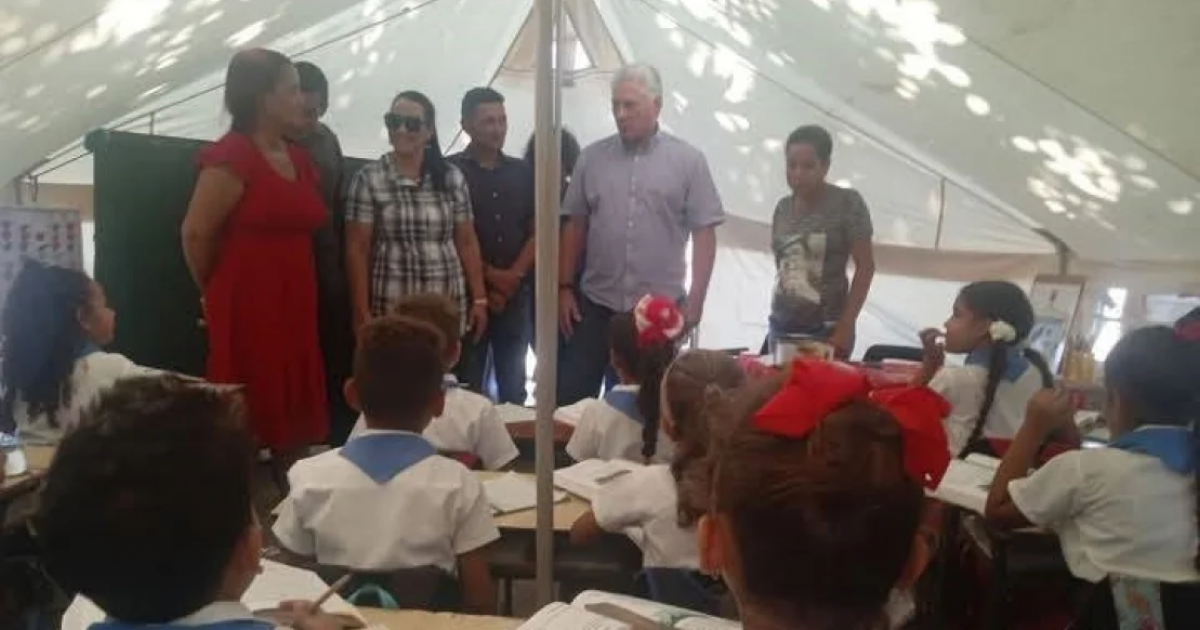
The leader Miguel Díaz-Canel visited the children in the municipality of Pilón, Granma, who have been attending classes in tents since last November, when two powerful earthquakes shook the region.
More than 530 preschool to sixth-grade pioneers from the semi-internado Augusto César Sandino have been receiving their classes for three months in a makeshift school set up at a military base. The new center has been named Amiguitos de las FAR.
It concerns tent houses donated by UNICEF, set up to fill the classroom deficit while they wait for the repair of their school, which seems to be taking longer than expected.
Díaz-Canel spoke with children and workers; he acknowledged their efforts for not halting the academic year despite the seismic activity of recent months and for contributing to training on how to act during natural events.
However, he refrained from informing whether restoration work is underway, nor did he venture to provide a return date for Augusto César Sandino. He only ordered to assign usage value to the premises to accommodate affected families and to allocate construction materials according to priorities.
The earthquakes that occurred on November 10 caused damage to 41 educational institutions, of which only 23 are currently in optimal condition to resume teaching, as explained by Amauri Torres Torres, General Director of Education in Pilón.
The slowness and limitations of the process keep hundreds of children in precarious educational conditions.
In addition to Pilón, Díaz-Canel toured the municipality of Niquero, escorted by a caravan of at least seven vehicles.
A video shared on Facebook by a witness showed the group's arrival in the community of Belic, where they were welcomed by a group of residents. The recording revealed an excessive security presence, contrasting with the official narrative that insists on the ruler's popularity.
Despite the official narrative that portrays these visits as a sign of closeness to the people, the images from the event reflect a different reality. The leader moves surrounded by an imposing security team, which is far removed from the austerity preached by the regime and the deteriorated transportation system faced by the population.
The allocation of resources for this type of visit generates recurring criticism in a country where citizens are grappling with a deep economic crisis, food shortages, and basic services in a precarious state.
Frequently Asked Questions about the Educational Situation in Pilón After the Earthquakes
Why are the children of Pilón receiving classes in tents?
The children of Pilón are attending classes in tents due to the damage caused by the earthquakes in November to the educational infrastructure in the region. These tents, donated by UNICEF, have been set up to address the lack of classrooms while necessary repairs are made to the affected schools.
What is the Cuban government doing to restore the damaged schools in Pilón?
The Cuban government has begun some restoration work, although the repair of damaged schools is progressing slowly. Of the 41 affected schools, only 23 have been repaired to date. No specific completion dates have been provided for the remaining work.
What actions has Díaz-Canel taken regarding the situation in Pilón?
During his visit to Pilón, Miguel Díaz-Canel acknowledged the efforts of educational workers, but did not provide details about the restoration works or timelines for the return to normal classrooms. He only directed the use of facilities to house affected families and prioritized the allocation of construction materials.
How has the community of Pilón been affected by the earthquakes?
Earthquakes have caused significant damage to the infrastructure of Pilón, affecting 3,752 buildings and forcing many families to live in precarious conditions, such as in tents. The community is facing a critical situation, characterized by uncertainty and a lack of basic resources.
Filed under: