
Related videos:
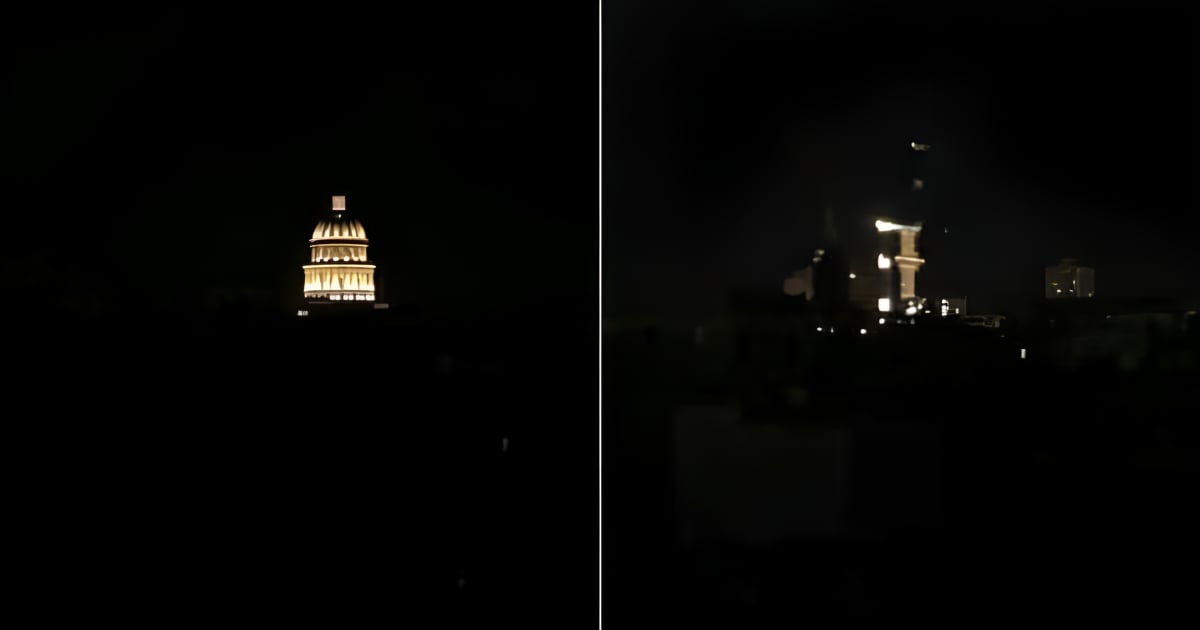
An unusual image of Havana has stirred up a buzz on social media: in the midst of darkness, only the Capitolio and the Hotel Torre K23 remain illuminated, while the rest of the city appears plunged into a blackout.
The photographs, shared on Facebook by CubaNet Noticias, triggered a wave of outrage and comments in which Cubans denounced the inequality in electricity supply and the daily hardships they face.
CiberCuba could not confirm the exact duration or extent of the power outage, but comments suggest that there were indeed electricity cuts in the corresponding blocks.
Images received at this newsroom confirm that around 7 PM, the buildings adjacent to the K23 Tower were without electrical service.
In the comments on the CubaNet post, many asserted that Havana does not usually experience long-lasting power outages, unlike other provinces where blackouts can last more than a day.
The reactions of citizens reflected a mix of frustration, resignation, and skepticism. "This is the biggest sham in this country, plenty of lights for tourists while the people are drowning in misery and darkness,” wrote one user, while another lamented: "For God’s sake, it’s incredible that even the capital is going dark.”
In the same vein, an internet user warned about the dangers of these blackouts in a city with poor street lighting: "Just imagine, traffic accidents are on the rise. The traffic lights aren't working and the signs, which were already nonexistent, can't be seen. That country is cursed!"
Other comments reflected the resentment of provincial residents, who denounce that the capital has historically been favored in the supply of electricity.
"It was about time Havana experienced its share of blackouts. Unfortunately, for all of Cuba, but provinces like Cienfuegos have been living in this agony for a while now, with blackouts lasting 20 to even 30 hours," said a user who received many responses to her comment.
Some internet users supported her opinion, while others criticized her stance. “If you feel relieved because others are being cut off from electricity, you are very mistaken. That won’t improve your life”, replied a user.
In the same vein, another expressed: "These simple-minded individuals who take pleasure in the fact that power is cut off elsewhere tire me. It's as if it's the fault of the people in Havana that you don't have electricity."
Some also rejected the image, suggesting that it might be a manipulation or an exaggeration. "I regret to inform you that the photo is a montage. At that time, there was no blackout. They want to make it seem like something it’s not…”, stated a commentator affiliated with the theory of "cognitive warfare".
On the other hand, some took advantage of the discussion to highlight the lack of citizen action in response to the energy and social crisis facing Cuba. "The people without electricity while they enjoy themselves", commented a Cuban, referring to the recent Habano Festival celebrated at the Capitol and the recent opening of the Hotel Torre K23.
“The same town enjoys all that masochism. If it were in another country, they would see how they fight against all those injustices of the government”, a third party reflected on the matter.
Another compared the current situation to the era of slavery in Cuba: “In the times of slavery, only in the owner's house were there all the luxuries. In the barracks, misery and hunger. What is the surprise? The owner does quite enough by allowing them to live; they deserve it.”
Beyond the authenticity of the image, the situation has reignited the debate about the energy crisis in Cuba, the collapse of the electrical system, and the government's lack of response. While some criticize the inequity in the distribution of the service, others are calling for action to demand profound changes in the country.
The energy crisis in Cuba has worsened in recent years due to the deterioration of thermal power plants, a lack of investment in infrastructure, and a decrease in fuel supply. In several provinces, power outages of more than 20 hours a day are a daily reality, while in the capital, although less frequent, they have become increasingly common.
Filed under: