
Related videos:
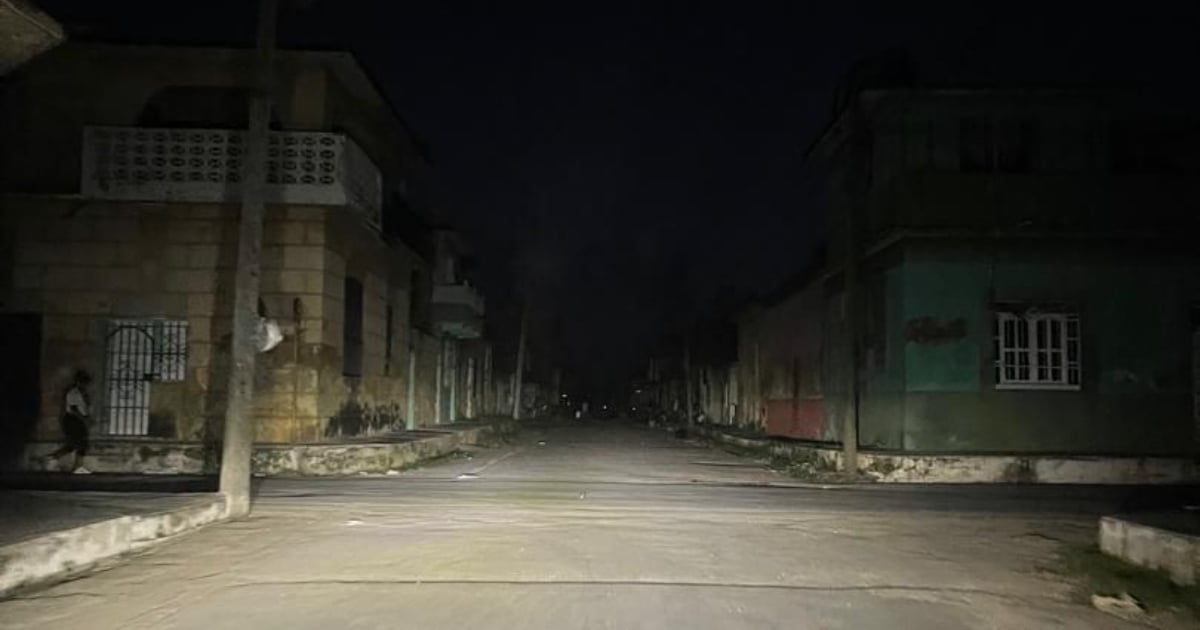
The Cuban Electric Union (UNE) announced this Thursday that it anticipates a slight reduction in the severity of power outages, following several critical days with widespread disruptions across the country. Despite this relative improvement, the generation deficit remains significant and will necessitate scheduled cuts in various provinces.
According to the official report from the UNE, on Wednesday the service disruption lasted for 24 hours, reaching a peak of 1,689 MW at 7:30 p.m., coinciding with the time of highest demand. The organization explained that the energy deficit persists due to a combination of breakdowns in several thermal power plants, scheduled maintenance, and fuel shortages.
As of Thursday morning, the availability of the National Electric System (SEN) was 1,630 MW, while the demand reached 2,480 MW, resulting in an impact of 872 MW. It is estimated that around noon the impact will rise to 1,100 MW and that during the nighttime peak, the deficit could reach 1,274 MW, with cuts of up to 1,344 MW across the country.
Malfunctioning thermoelectric plants and lack of fuel
The UNE reported that the Unit 5 of the Nuevitas Power Plant and the Unit 2 of the Felton Power Plant are still out of service, while maintenance continues on the Unit 6 of the Mariel Power Plant, Unit 2 of the Santa Cruz Power Plant, Units 3 and 4 of the Cienfuegos Power Plant, and Unit 5 of the Renté Power Plant.
Additionally, 82 distributed generation plants are out of service due to lack of fuel, resulting in a loss of 501 MW. This is compounded by 116 MW from the fuel plant in Mariel and 147 MW from the one in Moa, totaling 764 MW affected by this issue.
For the evening, the UNE anticipates the recovery of 100 MW in motors from distributed generation that are currently offline due to a lack of fuel, as well as the commissioning of 5 motors in Moa (80 MW) and 7 in Mariel (116 MW).
Scheduled blackouts in Havana
Due to a lack of generation, the Electric Company of Havana confirmed a program of rotating blackouts for this Thursday. According to a statement on social media, the outages in the capital will affect various blocks during the following times:
- 10:00 a.m. - 3:00 p.m.: Blocks #3 and #4
- 3:00 p.m. - 7:00 p.m.: Block #1
- 6:00 p.m. - 8:00 p.m.: Block #2
The company assured that its channels on Telegram, X (Twitter), and Facebook will continue to provide updated information on the state of the electric service. They also enabled the number 18888 to address inquiries from the public.
Critical days and uncertain outlook
Today's announcement reflects a slight improvement compared to Wednesday's situation, when the energy deficit exceeded 1,700 MW and there were widespread blackouts across the island. However, the crisis remains without a definitive solution.
Despite attempts to regain power, the lack of investment, the deterioration of thermal power plants, and the shortage of fuel have made blackouts a constant issue for Cubans. The UNE has not provided a forecast for when electricity generation might stabilize, so interruptions are expected to continue in the coming days.
Frequently Asked Questions about the Energy Crisis in Cuba
Why are blackouts happening in Cuba?
The blackouts in Cuba are primarily due to a deficit in electricity generation caused by malfunctions in thermal power plants, scheduled maintenance, and a severe fuel shortage. The country's electrical infrastructure is in poor condition, which exacerbates the situation and leads to prolonged and frequent power outages.
What are the main thermoelectric plants affected in Cuba?
The main thermoelectric plants affected include Unit 5 of the Nuevitas Power Plant, Unit 2 of the Felton Power Plant, and Unit 6 of the Mariel Power Plant, among others. These units are out of service due to breakdowns and maintenance, significantly contributing to the energy deficit the country is facing.
What measures is the Electric Union of Cuba taking to mitigate blackouts?
Cuba's Electric Union has implemented scheduled blackouts and is working on the recovery of distributed generation motors, as well as bringing thermoelectric units online when possible. However, these measures have been insufficient to resolve the energy crisis due to a lack of investment and resources.
How does the fuel shortage affect the energy crisis in Cuba?
The shortage of fuel is a critical factor in Cuba's energy crisis, as it has taken many distributed generation plants out of service, impacting hundreds of megawatts in the country's generation capacity. This lack of fuel further exacerbates blackouts and the instability of the electric supply.
Filed under: