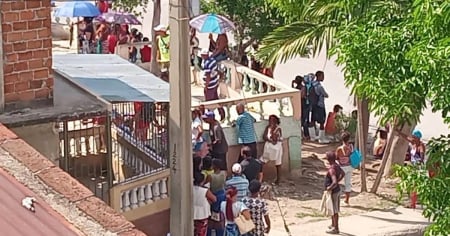
The Cuban opposition leader José Daniel Ferrer, head of the Patriotic Union of Cuba (UNPACU), reported that his home in Santiago de Cuba has been surrounded by agents of the National Revolutionary Police (PNR) and plainclothes officers to prevent his humanitarian work with vulnerable individuals.
According to Ferrer, this action aims to prevent the distribution of food that he and his team provide for the elderly and other low-income individuals.
"Agents in civilian clothes have been joined by uniformed PNR agents. They are tightening the noose around UNPACU to prevent us from providing assistance to those in great need. More arrests and attacks are expected," Ferrer denounced on his social media.
UNPACU collaborators have also reported being detained while going out to buy products for food preparation, which negatively impacts the beneficiaries of this initiative.
This situation arises after Ferrer recently reported that his team managed to distribute in a single day 1,061 food rations for 1,025 people, setting a new record in their effort to assist the elderly and those in critical conditions.
"Yesterday we attended to 871 people, and today the daily increase overwhelmed our capacity to meet the growing demand for assistance," explained the opposition leader last week, who has intensified his work since his release from prison.
Videos shared by UNPACU show dozens of elderly people waiting daily for a food ration on the sidewalk.
In addition, Dr. Nelva Ismarays Ortega, Ferrer's wife, has attended to more than fifty patients in recent days, reflecting the magnitude of the healthcare and social crisis on the island.
Ferrer has emphasized that this humanitarian work has been made possible thanks to the solidarity of exiled Cubans, who contribute resources to support humanitarian aid.
However, it has reported that the initiative has been targeted by the Cuban regime, which seeks to disrupt the distribution of food and assistance to those in greatest need.
Frequently Asked Questions about the Situation of José Daniel Ferrer and Repression in Cuba
Why is José Daniel Ferrer's house surrounded by police in Santiago de Cuba?
The Cuban police have surrounded the home of José Daniel Ferrer to prevent his humanitarian work, which involves distributing food to vulnerable individuals. Ferrer, the leader of the Patriotic Union of Cuba (UNPACU), has reported that this action aims to hinder support for the elderly and low-income individuals, and that there have been arrests and attacks against his collaborators.
What acts of repression has José Daniel Ferrer reported in Santiago de Cuba?
José Daniel Ferrer has reported a repressive siege that includes the presence of agents from the National Revolutionary Police (PNR) and State Security forces, who harass individuals attempting to visit his home. He has also highlighted death threats, arbitrary detentions, and a disinformation campaign against him. The Cuban regime employs these tactics to hinder his solidarity efforts and socially isolate him.
How has José Daniel Ferrer managed to continue his humanitarian work in Cuba?
Ferrer has been able to continue his work thanks to the support of exiled Cubans, who provide the necessary resources for the distribution of food and medicine. Despite governmental harassment, Ferrer and his team have managed to assist hundreds of people daily, although they face constant restrictions and threats from the authorities.
What is the impact of José Daniel Ferrer's work in Santiago de Cuba?
Ferrer’s initiative has had a significant impact on the community, successfully distributing more than a thousand food rations in a single day and assisting dozens of patients thanks to the collective effort of his wife, Dr. Nelva Ismarays Ortega, and other collaborators. However, this work has been subject to attacks from the regime, which seeks to disrupt aid to those in greatest need.
What has Ferrer reported about the conditions of political prisoners in Cuba?
Ferrer has denounced the deplorable conditions in which political prisoners in Cuba find themselves, highlighting hunger, disease, and a lack of basic resources. He has called on the international community to coordinate efforts and provide effective support to these prisoners, emphasizing the importance of unity among opponents to confront the repression of the Cuban regime.
Filed under: