
Related videos:
The United States and Argentina reaffirmed on Tuesday their joint commitment to confront authoritarianism in the region, with particular emphasis on the regimes of Cuba, Nicaragua, and Venezuela, according to a statement issued by the State Department.
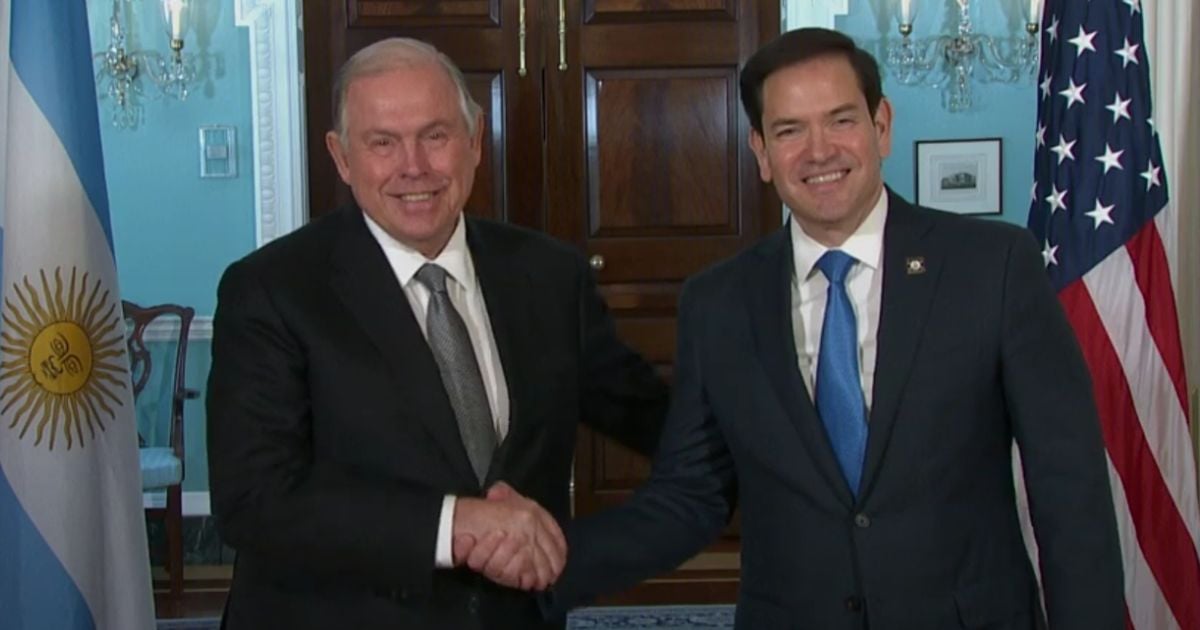
The U.S. Secretary of State, Marco Rubio, held an official meeting with the Argentine Foreign Minister, Gerardo Werthein, during which they emphasized the need to continue countering regimes that—according to Washington—threaten the national security of the United States and the stability of the Western Hemisphere.
"Both leaders emphasized their support for the brave Cuban, Nicaraguan, and Venezuelan people, who continue to defend their fundamental freedoms and confront the oppression of authoritarian regimes and the malignant influence of external actors," states the text released by State Department spokesperson, Tammy Bruce.
Rubio thanked the Argentine government for its ongoing collaboration on shared economic issues and advocated for strengthening bilateral cooperation in strategic sectors.
The statement concludes with a reaffirmation of mutual interest in "deepening the diplomatic ties between the United States and Argentina, based on shared values and common objectives.”
The explicit mention of Cuba as one of the focal points of regional concern occurs in a context marked by increasing international diplomatic pressures against the Havana regime, which has been repeatedly accused by international organizations of systematic human rights violations and repression of dissent.
In September 2024, Argentine President Javier Milei made a significant international impact following his speech at the 79th General Assembly of the UN, where he referred to the governments of Cuba, Venezuela, and Iran as "bloody dictatorships."
In his speech, he harshly criticized the inclusion of these countries in the organization's Human Rights Council, questioning their legitimacy and denouncing the contradiction of their participation in bodies that claim to defend fundamental freedoms. Milei's position marked a break from his country's traditional diplomacy and was met with mixed reactions both in Argentina and abroad.
Subsequently, in November of the same year, the Argentine president announced the expulsion of all diplomats from the Foreign Ministry who supported the vote in favor of lifting the U.S. embargo against Cuba at the UN.
The president described the officials who, in his words, acted against the foreign policy he establishes from the Casa Rosada as "traitors to the homeland." This decision led to an immediate reshuffle in the diplomatic leadership, including the dismissal of then-chancellor Diana Mondino, and strengthened the alignment of the Argentine government with the United States and Israel in its policy towards the Cuban regime.
Finally, in March 2025, the Cuban leader Miguel Díaz-Canel expressed his support for the popular protests in Argentina against the reforms promoted by Milei. During an event in Havana, Díaz-Canel stated that “we all have to go out” to defend just causes, in a clear reference to the demonstrations in the South American country.
The statement sparked criticism for its contrast with the harsh repression that the Cuban government exercises against any attempts at internal protest. The paradox was widely pointed out on social media and independent media, highlighting the double standard of the Cuban regime regarding freedom of expression and citizens' rights.
Frequently Asked Questions about the Dialogue between the U.S. and Argentina regarding Cuba
What is the objective of the dialogue between the U.S. and Argentina regarding Cuba?
The goal of the dialogue between the U.S. and Argentina is to combat authoritarianism in Cuba, as well as in Nicaragua and Venezuela. Both countries seek to confront the regimes they consider a threat to the security and stability of the region.
Why is Cuba a cause for concern for the U.S. and Argentina?
Cuba is a source of concern due to accusations of systematic human rights violations and repression of dissent. Additionally, the Cuban regime is viewed as a threat to U.S. national security and regional stability.
How does U.S. foreign policy towards Cuba under the Trump administration affect the situation?
Under Trump's administration, the foreign policy towards Cuba has been marked by a more stringent and restrictive stance. This includes the reactivation of certain punitive measures, such as Title III of the Helms-Burton Act, and the tightening of sanctions.
What role does Argentina play in its diplomatic relationship with Cuba?
Argentina, under the government of Javier Milei, has taken a critical stance towards the Cuban regime, condemning human rights violations and authoritarianism on the island. This is reflected in its policy of not appointing ambassadors in Cuba and in its participation in international forums.
Filed under: