
Related videos:
At just 31 hours old, Carlos Manuel Fajardo Hernández, a baby from Cienfuegos, was urgently transferred to the José Luis Miranda Pediatric Hospital in Villa Clara after being diagnosed with a congenital malformation called esophageal atresia, which prevents the normal connection between the esophagus and the stomach.
Just admitted to the Neonatal Intensive Care Unit, the medical team assessed the severity of the case, reported the official journalist Oscar Salabarría on his Facebook profile.
The surgical intervention had to be performed without delay to save his life. It was then that a multidisciplinary team of specialists, led by Dr. Abel Armenteros García, head of the Pediatric Surgery department at the hospital, undertook the challenge.
According to the surgeon, it was a "large and invasive" surgery, not only due to the patient's age and fragility but also because of the anatomical complexity of the case.
The esophageal fistula did not drain where it usually does, which forced the surgeons to perform unusual maneuvers.
"It was a quite complicated case," acknowledged the specialist, who detailed that the esophagus anastomosis was successfully performed, meaning the ends were reconnected to allow for normal function.
"It's a surgery where you sweat a lot. Decisions need to be made on the spot. It's stressful, but it's also a specialty that one falls in love with," said Armenteros, who also leads the regional newborn surgery service.
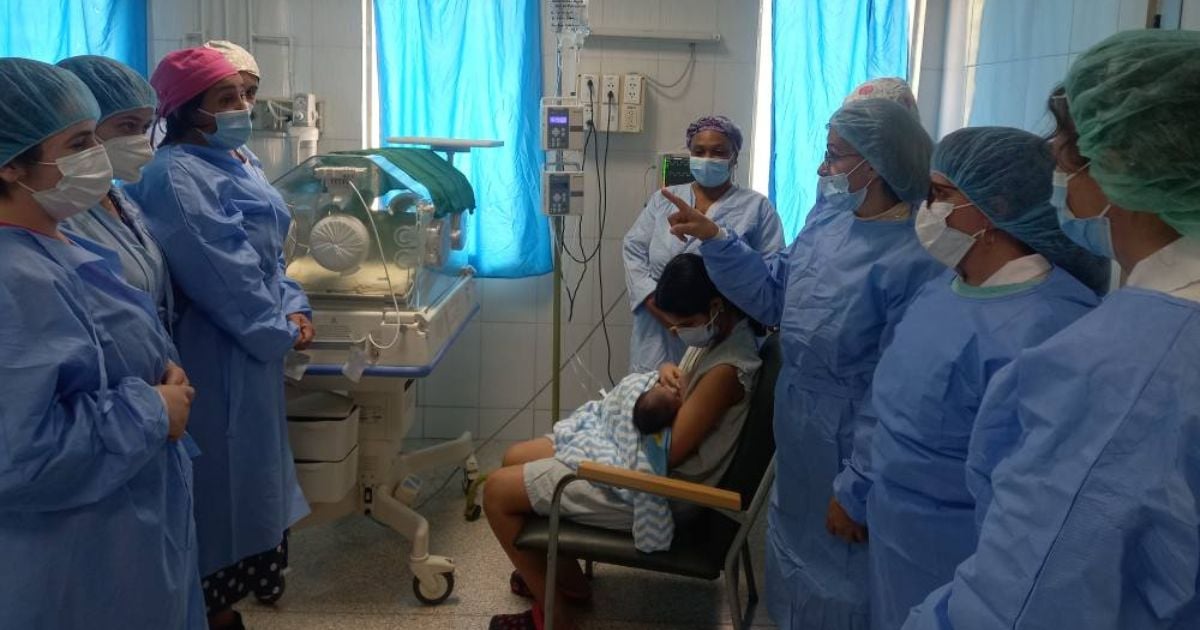
Currently, a little more than two weeks after that procedure, Carlitos is eating orally, progressing favorably, and preparing to return to his home in Cienfuegos.
"The child is healthy and recovered, he will lead a normal life, he will get vaccinated like everyone else, he will run, and he will play baseball like any other child," the doctor assured.
Dr. Isnaida Izquierdo Milián, a first-degree neonatologist and one of the main figures in this story, explained that the baby is now 16 days old and has been post-operative for 15 days.
"It has shown good progress; we are on the verge of being able to transfer him to his province. It is a joy to see the mother happy and the child eagerly demanding his nourishment. For us, that is the greatest satisfaction in the world," he expressed with emotion.
For the parents of the little one, Leannedi and Carlos, it has been an emotional rollercoaster: from the initial despair to the current relief.
"When we arrived, he was very ill. They had to rush him into surgery, and now he is fine. What I feel right now is a love that can't be explained," said the father.
The story of Carlitos is also the story of many Cuban families who face unexpected medical challenges in a country where material difficulties often hinder the occurrence of miracles.
Amidst the uncertainty, anguish, and fear that often accompany diagnoses such as esophageal atresia, this little one from Cienfuegos has achieved the most important thing: holding on to life.
And with her strong cries, her stable recovery, and the warmth of her parents, she leaves a testament of faith, resilience, and love that endures even through the most challenging early hours.
In the midst of an unprecedented health crisis in Cuba, where hospitals are facing an alarming shortage of medical supplies, essential medications, and basic equipment, extraordinary stories of childhood survival are emerging in an adverse context.
In 2024, a newborn was
The procedure was performed at the José Luis Miranda Pediatric Hospital in Villa Clara, the same center that has handled other complex cases. Despite the precarious conditions, the medical team was able to stabilize the young patient and save his life.
Another case that captured national attention occurred last January when a child underwent emergency surgery after swallowing a watch part. Thanks to a delicate surgical maneuver, the child was rescued from a potentially fatal situation.
Finally, in February, doctors in Santiago de Cuba performed an emergency operation to remove a tumor from a young patient. The procedure was described as risky due to the tumor's location and the usual logistical challenges, including the lack of optimal conditions in the operating room.
Frequently Asked Questions about Emergency Surgery for Newborns in Cuba
What is esophageal atresia and how did it affect the baby from Cienfuegos?
Esophageal atresia is a congenital malformation that prevents the normal connection between the esophagus and the stomach. In the case of the baby from Cienfuegos, Carlos Manuel Fajardo Hernández, this condition meant that his esophagus was not properly connected, necessitating emergency surgery to correct the issue and save his life.
How was the surgery that saved the baby in Villa Clara?
The surgery to correct Carlos Manuel's esophageal atresia was a "large and invasive" procedure due to his young age and the anatomical complexity of his case. A multidisciplinary team led by Dr. Abel Armenteros García performed the esophageal anastomosis, reconnecting the ends to allow for normal function. This procedure was crucial for saving the baby's life.
What is the current condition of the baby after the surgery?
After just over two weeks since the operation, Carlos Manuel Fajardo Hernández is evolving positively and is preparing to return to Cienfuegos. He is already eating orally, and the doctors assure that he will be able to live a normal life, engage in activities like any other child, and receive the necessary vaccinations.
What challenges do Cuban hospitals face in pediatric emergency cases?
Hospitals in Cuba face serious limitations in resources and personnel, which complicates medical attention in urgent cases. The story of Carlos Manuel is an example of how, despite these difficulties, health professionals strive to save lives. However, the lack of supplies and the precarious conditions of the healthcare system are constant challenges that affect the quality of medical care in the country.
Filed under: