
Related videos:
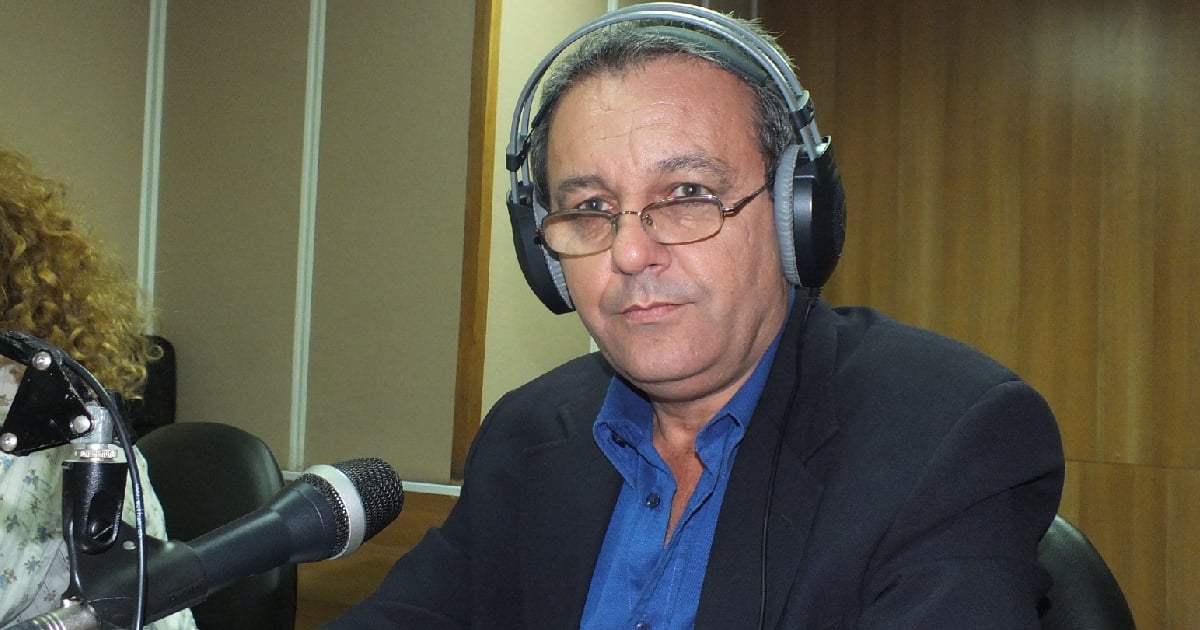
A voice, a style, a narrative... a special, kind, and honest human being! He shared with me a few years (I wish there had been more) in the sports newsroom of Cuban Television. Today, CiberCuba is honored to have the presence of José Luis Basulto, journalist, storyteller, broadcaster, writer, and Cuban sports commentator.
We haven't seen you on Cuban television or radio for years. What has become of your life, dear friend?
It is a great joy for me to talk to you, Julita, after such a long time. I have been living in Mexico since April 2019, when I was in charge of press at the Pan American Cycling Confederation. I arrived here invited by a friend to work at an online tourism company and, at the same time, I had been invited by two universities to give lectures on radio oral communication.
I have done many things here, some unimaginable before arriving in this great country. I was a writer and director of a newsletter for a coaching academy and for an online television channel. Additionally, I continue to write books about life stories whenever the opportunity arises. I also create content for undergraduate and graduate programs and worked as a professor of political journalism and communication at the Universidad Autónoma de Nuevo León and at the Instituto Superior de Computación.
A few years ago, I realized an objective reality: there are increasingly fewer job options for people my age, not just here in Mexico. That’s why I bought my first car at 62. That vehicle has become my work tool, as I currently work as a driver for Uber and Didi.
Here I live with my wife Sonia, who has been with me for almost 10 years. My son from my first marriage lives in the United States.
Beginnings in your hometown of Camagüey.
This country boy was born 63 years ago in the rural municipality of Najasa in Camagüey, where I lived until I was 13 years old. My foster parents then moved to the outskirts of the city of Camagüey and, can you believe it?, despite my love for sports, nature did not bestow upon me the slightest talent to excel in any, which is why my true aspiration has always been to be a sports commentator.
Do you have an inheritance?
No. Perhaps it stemmed from my reading and listening habits, even though we didn't have a radio at home. I remember that almost every day I would ride my horse to my uncles' house to listen to Radio Reloj, Radio Rebelde, Radio Progreso, and Radio Cadena Agramonte, the provincial station of Camagüey.
I used to narrate imaginary baseball games, my greatest passion. I was fascinated by listening to Eddy Martin, Bobby Salamanca, Pity Rivera, Héctor Rodríguez, and René Navarro, who broadcasted on Radio Progreso and Radio Rebelde, as well as other provincial announcers.
When did you first step up to a microphone?
That happened in the middle of 1983, when I was reading the movie listings in a magazine from Cadena Agramonte. I had just been discharged from the General Military Service, during which I met Franco Carbón. A friend took me to his house and gave me a newspaper to read aloud. When I finished, Franco told me, "You have the most important thing a broadcaster needs: you read very well."
From that point on, he started giving me voice training classes until they were interrupted in August 1983, when I was demobilized and had to return to Camagüey. At 21, I began reading newspapers aloud on the porch of my house. Under these circumstances, another friend took me to Cadena Agramonte, where I expressed my willingness to work in any capacity, whether it was cleaning the floors or anything else.
I joined a training course for editors and audio operators as an auditing student, and my perseverance, eagerness to learn, and deep desire to work at a radio station were such that, upon completing the course, I ranked among the top students, now officially recognized, with the best grades.
At that time, I was going through a difficult family situation. My adoptive parents, now advanced in age, were caring for four younger siblings. My father was in prison, serving a 20-year sentence for political reasons, and my mother had long since distanced herself from us.
When the station director, Josefa Bracero, learned about this situation, she indicated that I should be given a position as a workshop assistant at Radio Cadena Agramonte. That’s how I was able to fulfill my dream of joining a radio station.
Shortly after, the station began broadcasting 24 hours a day, and I was assigned a position as an audio operator for the central master. It was at that time that I also started my voice training, reading three-minute bulletins during the early morning hours.
At the same time, I approached the sports commentators Pepe Cardoso and Carlos del Canto, to whom I expressed my desire to be a sports commentator. They gave me a recorder and recommended that I go to the Cándido González stadium at night to record two or three innings in a booth adjacent to the ones they used during their broadcasts.
My on-air debut as a baseball commentator took place in February 1985, during a series between the Isla de la Juventud and Camagüey teams. I didn't commentate the first game for Cadena Agramonte, but rather for Radio Caribe.
How do you get to the TV?
I want to share that my first steps in that great field were taken at Televisión Camagüey.
I was one of the graduates of a training course for broadcasters that took place before the inauguration of the local channel Televisión Camagüey. During that time, I hosted informational magazines and was among the first to make reports for Revista de la Mañana.
When I moved to Havana in July 1998, it was with the intention of working at Radio Rebelde. However, upon arriving there, there were no available positions; for that reason, I started as a broadcaster at COCO, until the vacancy left by Walfrido Castro became available after his retirement.
Thus, I began at Radio Rebelde as a sports commentator for the program "Haciendo Radio," where over time I started to fill in as the host of the show, a role I held for seven years.
Thanks to Radio Rebelde, I had the opportunity to leave Cuba for the first time in 1999 when I was sent as a journalist to the World University Games in Palma de Mallorca, Spain. In the following years, I was part of the teams that covered the 2003 Pan American Games in Santo Domingo, the 2004 Olympic Games in Athens, and the Central American and Caribbean Games in Cartagena de Indias in 2006, among other events.
In Cartagena, I attended as the head of the radio station, but due to conflicts with some colleagues, I decided to resign from my position as deputy sports director at the station and take advantage of an offer to move to Tele Rebelde as the head of the sports editorial team. I remember that in the first Sports News broadcast in which I participated, I had the honor of sharing cameras and microphones with you.
I remember it too, just like I remember you were the most courteous and proper of my colleagues, always attentive, always chivalrous on set and off.
But, as things often go, the then head of the news department, who was ousted a few years later, opposed my taking on that responsibility, arguing that I had not completed my degree in Social Communication, so I remained there as a narrator-commentator.
In summary, the time I spent at the channel was a period of learning and adapting to a different style of broadcasting and journalism. At the same time, I was at the bottom of the hierarchy, which naturally had its consequences.
One day, at a meeting X, the sky and the earth united for you when, after returning from a contract as a narrator in Panama, you were misjudged and practically expelled. Do you hold a grudge? How did you feel when no one, not even me, supported you? The injustice was such that only an honest and strong person could move forward. After so many years (I don’t remember how many), have you overcome that wrongdoing?
First of all: I hold no grudges against anything or anyone, because everything that happens to us must be weighed on a balance. In my case, I concluded that everything was for the best. That’s why I hold no type of resentment.
That said, let me complete the response: That meeting took place in November 2007. An unfortunate day for me, which, paradoxically, provided me with valuable lessons. First of all, I realized that it was a waste of time to have devoted part of my youth to an exclusionary and regressive organization like the PCC. Secondly, I encountered two or three paradigms of opportunism and simulation; and, thirdly, from that moment on, I began to be free and independent.
I was out of work in radio and television for a little over two years.
When I left Tele Rebelde, no one wanted me. I went to several stations looking for work as a broadcaster, but their executives told me there were no vacancies. Suddenly, I became a despised person, to the point that some would cross to the other side of the street to avoid greeting me when they saw me from a distance.
But there is always someone in the desert of abandonment who reaches out a hand to you. In my case, that person was Esteban Ramírez Alonso, who was then the director of the current Cuban News Agency. When I went to see him, not being his friend, he said to me: “Present me with a project for a sports bulletin for the agency's radio system.” That’s how I started working there, where I stayed for almost four years.
I remember that during that time I went to speak with the then president of the ICRT, Ernesto López, who assured me that he would send me to Radio Habana Cuba, a station that at that time was not heard in the country. That's how I ended up there, where I stayed until 2012.
It was a fruitful period, as I hosted "Formalmente informal" and the magazine "Nuestra América," two programs where I interviewed politicians, scientists, journalists, announcers, sports commentators, painters, musicians, among others. By the way, a selection of those interviews made up my first book, De la radio a la palabra impresa, published by En Vivo.
Also, during that period, marked by disappointments and frustrations, I studied for a degree in Communication Sciences and completed a master's focused on the role of the announcer-host in news radio programs.
Then you went back to RR again. Did you have a better time, were you respected, how many years did you stay there?
Returning to Radio Rebelde as a host took me two and a half years, as some people with political responsibilities there opposed my return, arguing that I would "disrupt the balance" in such a united collective.
My return came at the request of the director of the National Radio News, who asked me to be the main host of that program. Before starting, I was subjected to an extraordinary management meeting, where the director at the time read me "the guidelines": “We expect you to dedicate yourself solely and exclusively to your work as the host of the National Radio News,” she said, accompanied by all the “stakeholders” of the station. My response was succinct: “That's why I came.”
Moreover, in that interim, through a friend, I started as an off-screen news anchor on a newscast for Cubavisión Internacional, until some time later I was transferred to the sports department, where I worked for nine years.
Although it is obvious, I must point out that I was never called again to participate in broadcasts of sporting events, either national or international. I was not surprised, as I was aware of the mediations that influence those appointments. I was no longer considered "trustworthy" by those who have been managing the integration of radio and television delegations at will for over 40 years.
Later, during the "rehabilitation" process, I returned in 2016 to the sports segment of the National Television News (NTV), where I began to provide commentary and reports on significant sports figures and events. I especially cherish the report I wrote on the occasion of Coach Ronaldo Veitía's retirement, which had an extraordinary impact. It was a brief period, but it was the one that brought me the most recognition throughout my professional career.
My presence on NTV came to an end the day I prepared a report dedicated to Eugenio George, on the occasion of the second anniversary of his physical passing, which never aired because, during the rehearsal, the head of the news department —with evident arrogance— commented that its two minutes and 35 seconds “were too much” and that the content was “excessively flattering.”
The official on duty, in a haughty tone, added: “Either you take away time and praises, or it doesn’t go on air.” In response to such nonsense, I firmly replied: “Then it won’t go on air!” That’s how my “second season” at NTV ended… I resigned and never returned!
Current situation of Cuban sports: a debacle in multi-sport events, a steep decline in national passion, adolescents and even children fleeing in panic...
The crisis of Cuban sports is a clear reflection of the reality facing the country. In a nation whose economy, in ruins, shifts from one experiment to another without finding the path to thrive, it is not surprising that other sectors are also in severe decline.
Cuban sports will never be what it was 20 years ago. Cuba is now an unproductive country, with an economy subordinated to unviable and obsolete ideological concepts. It's absurd to think that by repeating the same formulas, they will achieve different results.
When the economy fails, most people look for ways to escape to anywhere. This happens both within families and on a national scale. Unfortunately, the Cuban rulers have not even been able to change the narrative.
The most unfortunate aspect is that those who end up paying the consequences of such a misfortune are, as always, the ones at the bottom: the majority. And what is even more disheartening is that, when I look toward the horizon, I don't see the slightest chance of a solution.
Cuban All-Star Team…
You ask me to form a team of all-star baseball players, which is no easy task. Here’s my team, very offensive and arranged according to the batting order:
SS: Luis Ulacia (utility); 2B: Antonio Pacheco; 3B: Omar Linares; BD: “Cheíto” Rodríguez and Orestes Kindelán; 1B: Antonio Muñoz; RF: Luis Giraldo Casanova; LF: Lourdes Gourriell; CF: Víctor Mesa; R: Juan Castro; LZ: Jorge Luis Valdés; LD: José Ariel Contreras; R: Aroldis Chapman. Director: José Miguel Pineda.
Do you belong to those who think that since Omar, Kindelán, Pacheco, Germán, Ulacia, Víctor, Casanova, Juanito, or Pestano did not play in the MLB, they cannot be compared to Yordan, Chapman, Yuly, and the others?
The path of comparisons rarely leads to anything positive or objective, Julita. The circumstances and contexts are different. However, I am convinced that the baseball players you mentioned had the necessary quality to have been stars in the Major Leagues. In fact, many others could have achieved that as well: Pedro José Rodríguez, Rogelio García, Sixto Hernández, José Estrada, Ariel Pestano, Lázaro Valle, Julio Romero, Juan Carlos Oliva, Braudilio Vinent, Juan Pérez Pérez, José Antonio Huelga, “Changa” Mederos, Gabriel Pierre, Omar Carrero, Agustín Marquetti, Lázaro Vargas, Omar Ajete, Fernando Sánchez... I believe these players, and their generation in general, played baseball with an unmatched passion and dedication.
Nowadays, except for a few cases, players avoid sliding into bases to keep their uniforms clean, and if a pitch comes inside, they want to "take out" the pitcher.
In my opinion, the quality of Cuban baseball remains notable in some individuals, but, as a team, it is at a very low level.
I say "see you later" to my colleague and friend José Luis Basulto, "Basultico" to me, and I highlight his greatness in facing the obstacles that life has put in his way. Wishing a happy present and future to this honest man from Camagüey, a true role model, who has embraced Mexico as a new homeland where growth is not prohibitive!
Filed under: