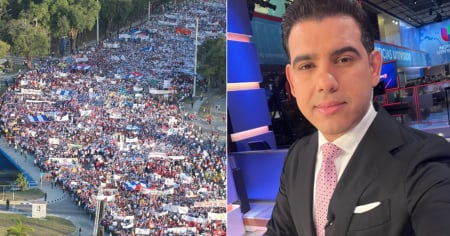
A Cuban who participated in the May Day parade in the city of Matanzas stated that marching made her feel "great," not for political or union reasons, but because it was a way to distract herself from everyday difficulties.
“I see that people are not thinking about their problems, they are thinking about the work they are doing, about what the country is doing for us”, he commented during an interview aired on the official channel TV Yumurí.
According to his testimony, the atmosphere in Matanzas was festive and emotional. “I was with a group of young people and there was one who stood very tall and said: ‘I march because I want to, because this is my country, this is my Cuba!’. That fills you with joy, with happiness, to see how my people, despite all the shortcomings and difficulties, continue to move forward. Because, look, we are Cuba!”
These statements have been celebrated by state media as an example of patriotism and commitment, but they have also raised questions about the true meaning of the mobilization. For many, the enthusiasm displayed is not a reflection of the majority sentiment, but rather a learned response in a context of ideological control, fear of being singled out, or simple emotional evasion.
Another participant reinforced the official discourse by stating that the march was a demonstration of resistance against the U.S. sanctions. “This year we have once again shown, with a strong response from the people of Matanzas, our stance against the blockade in our country”, she declared.
This type of argumentation aligns with the narrative promoted by the regime, which attributes most internal hardships to the economic embargo. However, this explanation fails to convince a growing portion of the population, who see the State as the main culprit for poor management, economic stagnation, and political repression.
The idea that marching “responds to the blockade” turns the parade into a political performance. In a society where there is little room for public dissent without consequences, that “strong response” appears to be a scene directed from above, rather than a genuinely popular stance.
In line with this vision, Jorge Luis Broche Lorenzo, a member of the Secretariat and head of the Economic Productive Department of the Central Committee of the Communist Party, insisted that the massive attendance at the march was entirely spontaneous.
"To develop and see expressions of such joy and passion, coming from the hearts of people, that speaks for itself. What obligation will there be for a people in this? They say they won’t go to the march, but that’s in our blood, that’s in our hearts!"
Broche argued that participation is a “conscious attitude”, even in the midst of material shortages. “This is meant to express what we feel, each person regardless of the difficulties we have to face,” he stated.
This speech, which refers to the epic of resistance and voluntary sacrifice, aims to keep alive the narrative of a people united around socialism. However, it can be seen as an attempt to disguise an increasingly unsustainable reality under triumphalist rhetoric.
The May Day parade, traditionally a propaganda showcase for the Cuban regime, has ceased to be a celebration of labor for many, transforming into a mandatory ritual. While some participants experience it with genuine enthusiasm, others attend out of inertia, institutional pressure, or simply to avoid trouble. The official exaltation of joy and jubilation contrasts sharply with the everyday testimonies of frustration, shortages, and weariness.
As it has been for several years, the parade took place amid a severe economic crisis, characterized by prolonged power outages, food shortages, and a collapsed transport system.
The government organized the mass transportation of workers and students to ensure attendance at the political event, despite the fuel shortage affecting public transport. Refusing to participate may result in repercussions in workplaces or educational institutions.
While the state television showcased images of waving flags and rehearsed choreographies, thousands of users on social media reported the disconnect between the official narrative and the harsh daily reality. “The only thing that can be felt in Cuba is blackouts”, commented an internet user in response to the leader's post.
Frequently Asked Questions about the May Day Parade in Cuba and Social Discontent
Why does the May Day parade in Cuba generate so much discontent?
The May Day parade in Cuba is seen more as a form of political propaganda than as a genuine celebration of workers. Despite the severe economic crisis the country is experiencing, the government allocates resources to these marches, which generates discontent among a population facing blackouts, food shortages, and a lack of basic services.
What is the reason behind the massive turnout at the marches in Cuba?
The massive turnout at the May Day marches in Cuba is largely attributed to institutional pressure and fear of workplace reprisals. Many workers and students feel compelled to participate to avoid sanctions, loss of benefits, or warnings in their workplaces and educational institutions.
How does the current economic and energy crisis affect Cubans?
The economic and energy crisis in Cuba has led to prolonged blackouts, food shortages, and a collapse of basic services. These conditions have intensified social unrest and the desire of many Cubans to emigrate in search of better opportunities, reflecting a deep sense of hopelessness and frustration.
What does the international community think about the marches in Cuba?
The international community views the marches in Cuba with skepticism and criticism, considering them propaganda strategies that do not address the country's structural problems. The marches are seen as a tactic by the government to divert attention from the internal crisis and project an image of unity that does not align with reality.
Filed under: