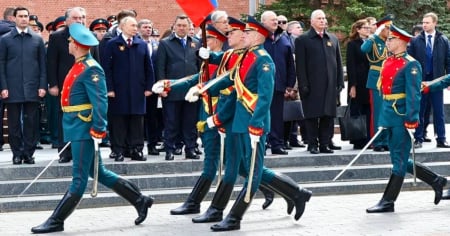
The president of Russia, Vladimir Putin, received Miguel Díaz-Canel this Wednesday at the Kremlin, in a ceremony that reinforces the ties between Moscow and Havana and highlights the sustained political support of the Russian government for the Cuban regime amidst a severe economic crisis shaking the island.
The visit of the Cuban leader coincides with the 80th anniversary of the Soviet victory over Nazi Germany in World War II, known in Russia as the Great Patriotic War, and with the 65th anniversary of the restoration of diplomatic relations between the two countries, which took place on May 8, 1960, following the rise to power of Fidel Castro and Cuba's closer ties with the Soviet bloc.
During the meeting, Putin emphasized Cuba's role in the fight against Nazism, mentioning the participation of Cuban volunteers in battles alongside the Red Army, particularly near Leningrad. He sought to strengthen the narrative of historical brotherhood between the two countries, united by geopolitical interests.
Díaz-Canel expressed his gratitude for the invitation from his Russian counterpart and deemed it "very significant" to participate in the commemorations. "The Russian people deserve credit for saving humanity from fascism," he stated while condemning attempts to "downplay the leading and heroic role" of the Soviet Union in the Allied victory.
Beyond the ceremonial gestures and speeches laden with historical symbolism, the meeting reaffirms Russia's strategic support for its Caribbean ally, whose economic and political model is going through one of its worst phases.
Havana is facing a productive collapse, high inflation, chronic shortages of food and medicine, and an unprecedented exodus. In this context, Moscow has become one of the main supporters of the regime, with agreements on energy, military, and financial cooperation aimed at bolstering the Cuban government.
Díaz-Canel took advantage of his visit to inaugurate an exhibition on the 65 years of bilateral diplomatic relations and to hold talks with senior Russian officials.
According to statements from the Cuban leader, both sides "updated cooperation issues that are advancing steadily," and he emphasized that Cuba and Russia share positions "on the fundamental problems of the international agenda."
Díaz-Canel's presence in Moscow reinforces an alliance that remains vital for the survival of the Cuban regime, at a time when the island's population is facing an increasingly unbearable reality and internal social pressure is rising.
Frequently asked questions about the meeting between Putin and Díaz-Canel in the Kremlin
What was the main purpose of Díaz-Canel's visit to Russia?
The main objective of Díaz-Canel's visit to Russia was to seek economic and political support. Amid an economic and humanitarian crisis in Cuba, the meeting with Putin and other high-ranking Russian officials aimed to secure cooperation in areas such as energy, biotechnology, and artificial intelligence. Additionally, Díaz-Canel participated in historical commemorations to strengthen the symbolic ties between both countries.
How is the relationship between Cuba and Russia reflected in geopolitical terms?
The relationship between Cuba and Russia reflects a strategic and dependent alliance. Russia has become a crucial support for the Cuban regime, both economically and politically, at a time when Havana is facing international isolation. This relationship allows Moscow to maintain its influence in Latin America, while Cuba seeks support to mitigate its internal crisis.
What historical symbolism was highlighted during Díaz-Canel's visit to Russia?
During the visit, the historical symbolism of the brotherhood between Cuba and Russia was emphasized. Díaz-Canel participated in the commemorations of the 80th anniversary of the Soviet victory over Nazism and the 65th anniversary of diplomatic relations between the two countries. The involvement of Cuban volunteers in battles alongside the Red Army during World War II was also highlighted.
What challenges is Cuba currently facing that motivated this visit to Russia?
Cuba is facing a productive collapse, high inflation, chronic shortages of food and medicine, and an unprecedented exodus. Díaz-Canel's visit to Russia aims to secure support amidst this severe economic and social crisis, seeking agreements to improve the internal situation through energy, military, and financial cooperation.
What was the official reception of Díaz-Canel upon his arrival in Russia?
Díaz-Canel was welcomed by the Deputy Foreign Minister of Russia, Sergey Ryabkov, upon his arrival in Moscow. This level of reception suggests that, despite the rhetoric of "historical brotherhood," Cuba occupies a peripheral position on the Kremlin's priority list, reflecting an asymmetrical relationship between the two countries.
Filed under: