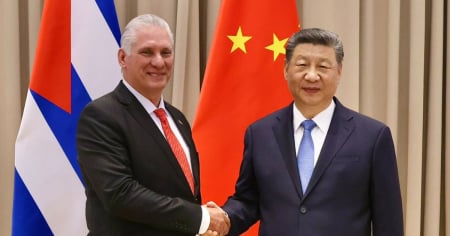
While the majority of Cubans survive on scraps, juggling to obtain food or medicine and facing the widespread collapse of basic services, the leader designated by the Castro family, Miguel Díaz-Canel, strolls around the world as if he were a millionaire from a luxury magazine.
His recent trip to Russia not only confirmed his unconditional subservience to the autocrat Vladimir Putin, but also once again revealed his addiction to expensive watches, French silks, and the luxurious lifestyle he so vehemently denies, yet flaunts without shame.
In the official events held in Moscow —as part of Victory Day and during bilateral meetings where investments for the struggling Cuban economy were solicited— the person responsible for the collapse of public services and the economy in Cuba was seen wearing an exclusive Rolex GMT-Master II “Batman,” which retails on the market for between 14,000 and 18,000 euros.
During the same visit, he was also photographed wearing an elegant Hermès tie (Faconnée H), made of silk and valued at 285 dollars. He did so without the slightest modesty, as if representing an impoverished and defenseless people granted him the right to adorn himself with symbols of privilege, absolute power, and capitalist success.
In the images shared from the tour, the wrist of the also First Secretary of the Communist Party of Cuba (PCC) “shines” with a stainless steel and ceramic watch featuring a black and blue bezel, the same one that collectors and executives from the First World admire for its precision and status.
Next to him, the "not first lady" —an expert in the art of accompanying the “dictator of her heart” on international trips— did not fall behind and showcased a series of accessories and outfits that also sparked comments on social media. The official from the Ministry of Culture (MINCULT), Lis Cuesta Peraza, has been photographed on other occasions with watches and accessories that exceed the annual salary of any Cuban professional.
On social media, the reaction was immediate. Hundreds of Cuban users, both on the island and abroad, questioned how it is possible for an official who urges his people to “resist creatively” to flaunt luxury items so shamelessly. “The wastefulness of Díaz-Canel and Lis Cuesta knows no bounds,” wrote the user @Taoro8, sharing images of the Swiss watch and the expensive Parisian tie.
What is Miguel Díaz-Canel's salary?
The question looms large amid all the scandals: what salary does Díaz-Canel use to maintain this lifestyle? According to official information, which has never been disclosed transparently, the Cuban president receives a symbolic amount that would not even account for the cost of his Hermès tie.
And if those objects weren't purchased with their salary, were they gifts? If so, another Pandora's box opens.
In advanced democracies like Spain, legislation prohibits senior officials from accepting high-value gifts, specifically to avoid conflicts of interest and acts of corruption [Transparency Law, Access to Public Information, and Good Governance (Law 19/2013)]. In fact, there have been scandals and even legal proceedings for accepting watches, suits, or paid trips.
But in Cuba, where the leadership is accountable to no one, this type of behavior has become customary. It is the 21st century "state capitalism": the people endure and resist, while the communist leaders enjoy Rolex watches, fine wool coats, private jets, and lavish receptions.
Lis Cuesta, "not the first lady" of etiquette and velvet
The wife of Díaz-Canel, Lis Cuesta, does not fall behind. Since she took on a public role—in a country where there has never been a tradition of visible first ladies—she has showcased a wardrobe that seeks to emulate the displays of Chanel or Louis Vuitton, often without success despite the expensive or exclusive nature of her outfits.
In academic and official events she has been photographed with luxury watches, designer accessories, and salon-style hairstyles. Her image as a "protocol accomplice" is a subject of constant mockery, but it is also offensive in a country where thousands of women have to choose each month between buying soap or milk for their children.
In relation to her ambiguous role within the institutional framework and the power of the regime, one might also question the salary of this official, and whether it enables her to acquire such luxury items. "For Cuban women, it is beneficial to resist and advance," Cuesta Peraza stated in late March, also participating in the orgy of luxury and hypocrisy that is gaining followers among the leaders of the Cuban regime.
Beyond the double standards of those in the Palace, the question that continues to linger regarding the presence of the MINCULT official in the official Cuban delegations is: Is Cuesta Peraza or is she not finally the first lady of the regime?
The stepson of luxury
And if there is something that completes this portrait of a ruling class detached from the suffering of the people, it is Lis Cuesta's son and alleged advisor to his stepfather, Manuel Anido Cuesta, known for his comfortable lifestyle outside of Cuba, in the company of actress Ana de Armas, a star from La Colmenita who has made it to the big screen in Hollywood.
According to press releases and social media posts, Anido Cuesta lives in an upscale neighborhood of Madrid and, along with his partner, frequents circles of high purchasing power. His profile, more akin to that of an influencer than to that of a son from a "revolutionary family," has sparked harsh criticism for embodying everything that the regime's propaganda condemns: luxury, leisure, and privilege.
A mockery of the people's misery
While Díaz-Canel smiles alongside the war criminal Putin and signs agreements that are unlikely to alleviate the daily catastrophe facing Cubans, the population remains mired in a situation of blackouts, collapsing hospitals, paralyzed transportation, and increasing poverty.
The contrast is so stark that it borders on the obscene: in Havana, a mother begs for antibiotics for her feverish child; in Moscow, the president signs books with a Montblanc pen while wearing a steel and ceramic Rolex.
This is not an isolated case. The ostentation of the Cuban elite has become commonplace. Rather than hiding it, they seem to display it with pride. The "presidential image" that Díaz-Canel aims to construct is based more on the visual marketing of a tropical monarch than on popular legitimacy.
And every time he adjusts his Hermès tie or checks the time on his Swiss Rolex, all he does is remind Cubans who is above, who is below… and who foots the bill.
Filed under: