
Related videos:
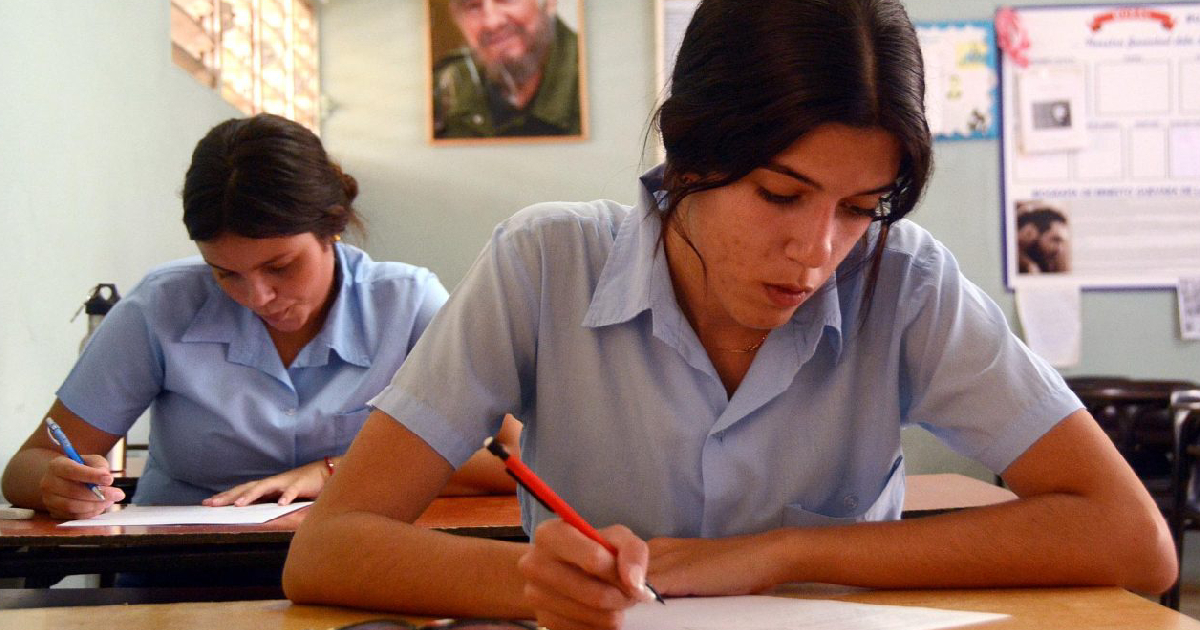
With less than half of the students passing, the results of the exam for Mathematics for admission to Higher Education in Guantánamo confirm that the crisis the country is experiencing has also reached the educational system.
What was once a demanding yet attainable goal has now become an insurmountable barrier for hundreds of young people, amidst a national landscape marked by institutional deterioration, a lack of teachers, and a neglect of education.
However, to that equation, we must add the motivational factor, as the regime previously announced that it would allow access to university degrees and higher technical programs even for those who fail or do not attend the exams.
According to the official newspaper Granma, the entrance exams for the 2025-2026 school year were scheduled to take place on May 6, 9, and 13 for Mathematics, Spanish, and History, respectively. However, the expectation of available slots for those who do not pass had already been announced, undermining the competitive nature of the process and further eroding the culture of academic effort.
The Doctor of Economic Sciences and Tenured Professor at the University of Guantánamo, Javier Pérez Capdevila, conducted a critical analysis on his Facebook profile, where he attributed the massive failure not only to the structural deterioration of the educational system but also to the extreme conditions under which the exam was conducted.
With a promotion rate of only 47.2%, Pérez Capdevila warned that this result is not just an alarming figure, but a symptom of a deeper crisis affecting mental health, academic performance, and equity in the process.
According to their analysis, the frequent power outages in the days leading up to the exam hindered many students' ability to prepare adequately, and the physical conditions during the test, with stifling heat and unlit classrooms, undermined any real chance of demonstrating knowledge.
From an educational psychology perspective, it was explained that chronic stress caused by energy uncertainty raises cortisol levels and affects memory, while fatigue resulting from blackouts impacts overall cognitive functioning.
He also criticized the pedagogical aspect of the process: an exam cannot be considered valid if what it measures is not knowledge, but the ability to endure heat and darkness.
The expert also referred to school hygiene, reminding that international standards establish minimum conditions for temperature, ventilation, and lighting that were clearly not met in Guantánamo, which, in his view, makes the process more akin to punishment than to assessment.
Finally, he proposed that the possibility of retaking the exam be considered as a measure of fairness and technical rigor, rather than as a "favor."
Repeating it would not be, in his words, "giving out passes," but rather correcting a structural error that distorted the evaluation process.
“No young person should be judged by their ability to endure dark, suffocating classrooms, but rather by what they truly know,” he concluded.
However, these results are not the result of coincidence or an isolated fact. By 2024, clear signs of educational deterioration were already evident in other provinces of the country.
In Ciego de Ávila, for example, the pre-university students who took the entrance exams for Higher Education performed critically on the Cuban History exam: only 65.01% passed, according to data published by the state newspaper Invasor.
Out of approximately 500 students examined, more than a third did not achieve the minimum passing grade, highlighting that the educational collapse is progressive, sustained, and structural.
Frequently Asked Questions about the Massive Failure in the Mathematics Exam in Guantánamo
Why did more than half of the students in Guantánamo fail the Mathematics exam?
Students in Guantánamo faced extreme conditions during the Mathematics exam, such as frequent power outages and a lack of adequate lighting in the classrooms, which impacted their academic performance. Additionally, the shortage of teachers and the deterioration of the educational system contributed to these negative results.
How does the energy crisis in Cuba affect the education system?
The energy crisis in Cuba has negatively affected the education system, as constant blackouts disrupt adequate exam preparation and hinder students' ability to study under optimal conditions. This situation has created chronic stress that deteriorates academic performance.
What measures does Professor Javier Pérez Capdevila propose in response to the widespread failure in Guantánamo?
Professor Javier Pérez Capdevila proposes to retake the Mathematics exam as a measure of fairness and technical rigor, and not as a "gift." He believes that students should be evaluated based on their knowledge, not on their ability to endure adverse conditions during the exam.
What is the Cuban regime's position on students who fail their entrance exams?
The Cuban regime has decided to permit access to university degrees for students who fail the entrance exams, or even for those who do not attend the tests. This measure diminishes the competitive nature of the admission process and reflects the decline of academic merit in the country.
Filed under: