
Related videos:
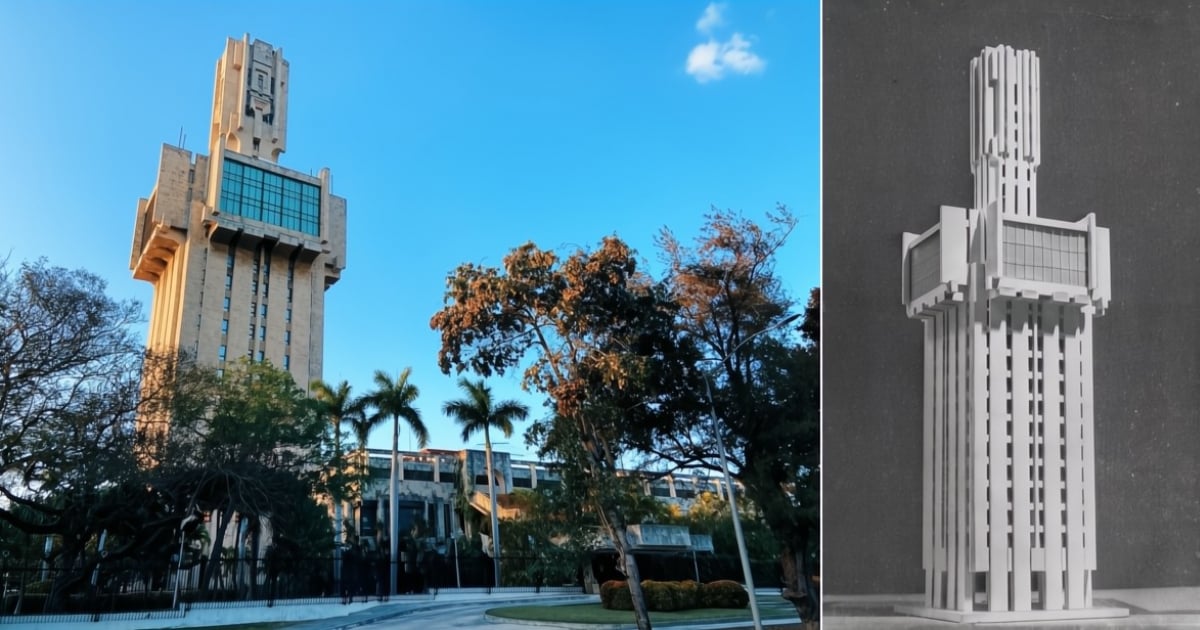
In the very heart of the Havana neighborhood of Miramar, where Fifth Avenue winds through gardens of mansions that were once owned by millionaires in Cuba, stands a structure that seems to have come straight out of a science fiction movie: the former embassy of the Soviet Union.
Since 1991, this building has been the diplomatic headquarters of the Russian Federation. Its vertical, sharp, and monumental silhouette has been compared to a watchtower, a spaceship, and even a concrete sword plunged into the Havana landscape.
The impressive "dagger" building was designed by the Soviet architect Alexander Grigoryevich Rochegov along with his wife María Alexandrovna Engelke.
This brutalist construction began to rise in December 1978, during the height of the alliance between the now-defunct USSR and the Cuban government. It spans more than four hectares and was inaugurated in November 1987.
Its architecture stands out in the urban landscape with a clear message of power that can be perceived from great distances. The main tower breaks away from any tropical aesthetic, characterized by its stark lines, protruding blocks, beams, and covered passageways.
A post from the Embassy of Russia about the building explains that the façade is covered with Cuban limestone and emphasizes that the architect incorporated specific details into the design to respond to the country's warm climate, despite its appearance as a bunker.
Among these design adjustments, they mention the numerous windows with glass to take advantage of light, highlight the areas of shadows projected by overhangs, and the structures that channel air circulation.
The buildings tell stories of our history as a country and as a civilization. The socialist camp no longer exists, but the relations between Cuba and Russia have strengthened in recent years, and they have done so amidst growing asymmetry.
Havana, in a deep economic crisis, increasingly relies on the support of Moscow. In this context, the former Soviet embassy also becomes a symbol of an uncomfortable reality: the blade of the sword remains stuck in Cuban soil, even though the face of the one who holds the hilt bears another name.
Filed under: