
Related videos:
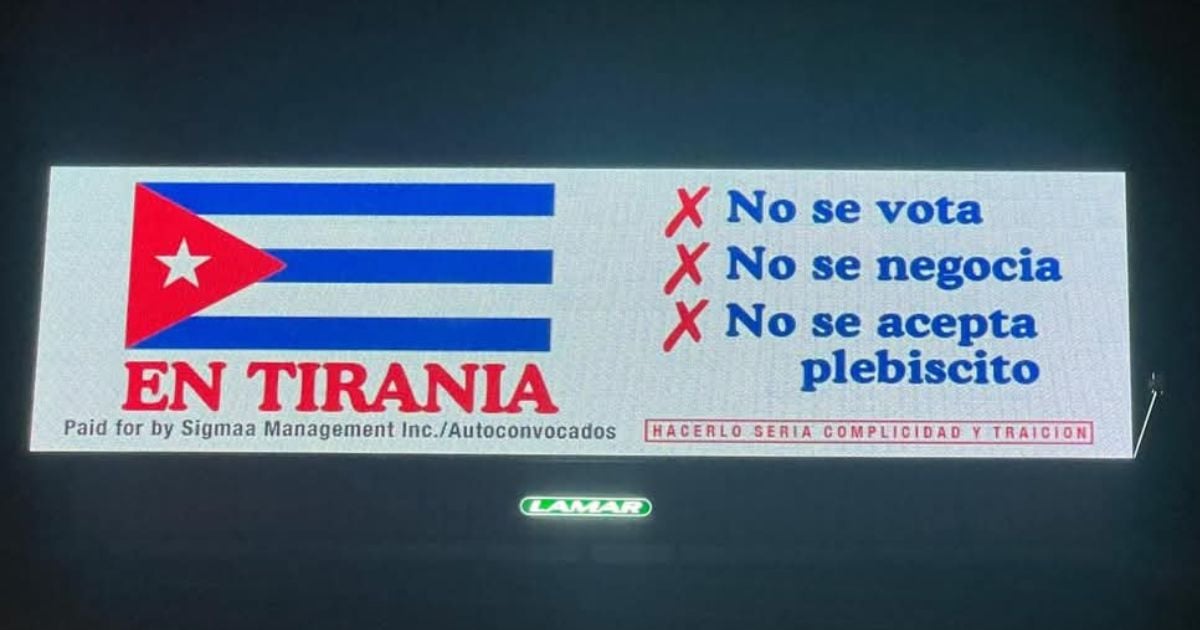
A billboard placed on the Palmetto Expressway, in the Miami-Hialeah area, has caught the attention of the Cuban exile community with a strong message directed at the regime on the island: "Under tyranny, one does not vote, negotiate, or accept a plebiscite."
The message is complemented by a powerful prayer and call: “To do so would be complicity and betrayal.”
The initiative has generated various reactions on social media, where users have shared images of the billboard and expressed support or criticism of the message.
Among the first reactions is that of activist Ariel Álvarez, who identifies on the social network X as Coordinator of United Exile Now.
Álvarez reaffirmed the message with the same text displayed on the billboard: "In tyranny, one does not vote, negotiate, or accept a plebiscite."
Also on X, activist Claudio Fuentes responded to the message with an equally strong stance: "Neither Castroism nor the plebiscite of the snitch-chusma otaolism," clearly expressing his opposition to both the Cuban regime and sectors of the exile community that advocate for a negotiated solution through plebiscites or agreements.
The profile The Cuban Show, dedicated to informative analysis of the current socio-political international situation —according to its own description on X— also reacted to the message on the banner with unequivocal support.
"It is already a reality, free voices cannot be silenced! Cubans from the right-wing movement #Autoconvocados rise up with a strong declaration from the heart of exile: NO pacts, no dialogues, no plebiscite with the Castro tyranny. Whoever does so is a traitor," they affirmed, aligning themselves with the most radical stance of the anti-Castro exile community.
Another one of the most heated reactions came from activist Eddy Maidique, who published on X a direct criticism of those who, according to him, pretend to be opponents but do not advocate for a complete break with the system.
"These communists do not talk about overthrowing, getting rid of the communist tyranny once and for all (...) they talk about improving the laws of the tyranny, making it look better in front of the world," he wrote.
Recently, a controversial billboard on the Palmetto highway triggered a series of reactions in the Cuban-American community, accusing Marco Rubio, María Elvira Salazar, Carlos Giménez, and Mario Díaz-Balart of being “traitors” for not defending the immigration status of thousands of immigrants.
The initiative was driven by the Hispanic Democratic Caucus of Miami-Dade, which criticizes them for not opposing the immigration measures promoted by Donald Trump.
In response, over 180 Cubans with I-220A status funded another billboard in Hialeah, this time featuring the faces of Fidel Castro, Raúl Castro, Díaz-Canel, Maduro, Chávez, and Ortega, with the slogan "The Real Traitors."
For the promoters, this was a way to counter what they see as a partisan use of migration pain, defending Republican congress members as allies in their legal fight.
Amid this "cartel war," Congresswoman María Elvira Salazar reacted firmly, describing the campaign against her as "cheap propaganda in the Castro style."
He also criticized the attempt to place the responsibility for restrictive immigration policies on his party, asserting that he has always defended immigrants from the communist regime.
Frequently Asked Questions about the Fence in Miami Against the Cuban Regime
What is the message of the billboard placed in Miami against the Cuban regime?
The message on the billboard is "In tyranny, one does not vote, negotiate, or accept a plebiscite." This message is directed at the Cuban regime and warns that any attempt to vote, negotiate, or accept a plebiscite with the regime would be viewed as complicity and betrayal by the Cuban exile community.
What reactions has the billboard generated in Miami among Cuban activists?
The banner has generated various reactions among Cuban activists. Some activists, such as Ariel Álvarez and Claudio Fuentes, have expressed strong support for the message, reaffirming their opposition to the Cuban regime and any attempts at dialogue or plebiscite. Other activists have criticized those who promote a negotiated exit, considering them complicit with the regime.
What is the context of the billboards in Miami related to Cuba?
In Miami, there has been a series of billboards related to Cuban politics, as part of a "billboard war" that reflects the tensions between different political groups and Cuban exile activists. These billboards have addressed issues such as opposition to the Cuban regime and criticisms of Cuban-American politicians regarding their stance on immigration.
What do Cuban exiles think about the negotiations with the Cuban regime?
Many Cuban exiles maintain a critical stance on negotiations with the Cuban regime. Most believe that negotiating with the dictatorship is an act of betrayal and that no form of plebiscite or dialogue that legitimizes the regime should be accepted. This opinion is reflected in the message of the billboard in Miami.
Filed under: