
Related videos:
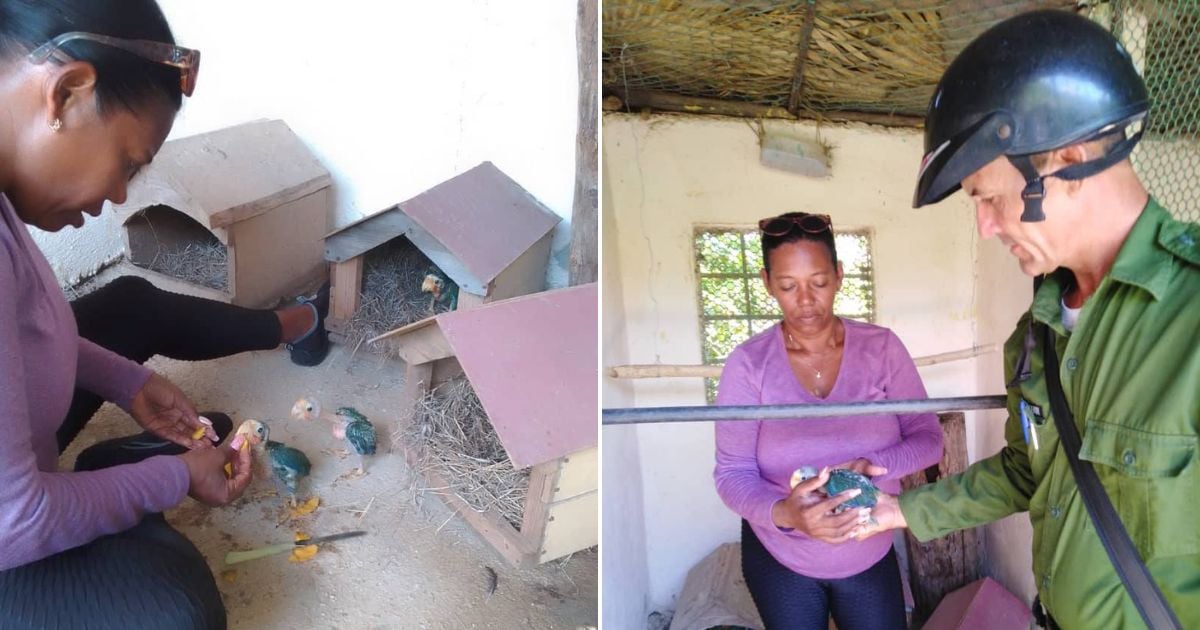
Two men were arrested in Villa Clara after attempting to traffic 10 parakeet chicks that were meant to be sold in Havana.
According to a post on social media by Quiala Armenteros, director of the Office of Environmental Regulation and Safety (Orsa Citma) in the province, the operation was carried out jointly with the Forestry Corps and a patrol from the National Revolutionary Police (PNR), which intercepted the offenders at kilometer 259 of the National Highway.
At that point, two individuals would meet: one from Sancti Spíritus and the other from the Cuban capital.
After the detention, both were taken to a PNR unit, and the corresponding violations were applied, in accordance with current environmental regulations.
The rescued chicks were taken to the aviary of the Sabana de Santa Clara Protected Area, where they will remain in custody for their later reassignment within the controlled natural environment.
In a later post, Armenteros recalled that the Cuban parrot (Amazona leucocephala) is listed as an endangered species according to the Red List of the International Union for Conservation of Nature (IUCN), which prohibits its commercialization.
"Removing the chicks from their natural environment to be raised in captivity is an illegal act punishable under Cuban and international laws," he warned.
Additionally, he urged the public to report to the PNR any attempts to sell this species on social media, as it is considered a potential crime against biodiversity.
A publication offering at least 12 Cuban parakeet chicks for 5,000 pesos each recently raised alarms about the illegal trafficking of protected wildlife in Cuba, highlighting the open and uncontrolled sale of an endemic species that is in a vulnerable state.
The complaint was made by activist Ana Belkys Hernández Millán through her profile on Facebook, in an open letter where she harshly criticized the fact that this illegal activity not only persists but is also carried out openly in social networks, with visible photographs, prices, and contacts, as if it were a legitimate business tolerated by the authorities.
Recently, the group Bienestar Animal Cuba (BAC), in its Havana chapter, reported the illegal sale of an injured aura tiñosa, which was offered as if it were a common merchandise in a WhatsApp group.
According to a post by BAC-Habana on their Facebook page, the protector Avril Gutiérrez detected on April 30, 2025, at 4:10 PM, an advertisement in the group “Compra y Venta Güinera,” where a user identified as Mirelsy was offering a bird, a wild species identified as Cathartes aura, locked in a cage and in a state of evident mistreatment.
Similarly, in April, a social media post showing an owl that was captured and offered for sale in Havana generated outrage and condemnation among internet users and animal advocates.
The incident took place this Tuesday, when a user identified as Marlon Enmanuel Fernández shared a reel in the Facebook group "Alamar el barrio," where the bird can be seen confined inside a metal bucket, covered with a wooden board.
Recently, the organization Animal Protection SOS – PASOS reported through their social media account the death of an owl that was rescued after being illegally offered for sale on a page of the same social media.
The bird, allegedly captured for religious purposes, was bought by activists from the group for 5,000 Cuban pesos, after negotiating down the initial price of 10,000, the organization emphasized on Facebook.
Frequently Asked Questions about the Illegal Trafficking of Parrots in Cuba
Why were two men arrested in Villa Clara?
They were arrested for attempting to traffick 10 young parrots that were intended to be sold in Havana, violating the current environmental regulations in Cuba.
What is the situation of the Cuban parrot and why is it protected?
The Cuban parrot (Amazona leucocephala) is classified as a threatened species according to the International Union for Conservation of Nature (IUCN) Red List, which prohibits its trade and makes it a subject of protection to preserve Cuban biodiversity.
What actions are the Cuban authorities taking against illegal wildlife trafficking?
The authorities, in collaboration with the Forest Rangers and the National Revolutionary Police (PNR), have intensified operations to intercept and penalize offenders. Violations are being enforced and animals are rescued, which are taken to protected areas for their safekeeping and eventual reintegration into their natural habitat.
How can Cuban citizens contribute to the protection of wildlife?
Citizens are urged to report any attempts to illegally sell protected species to the PNR, especially on social media, to help combat wildlife trafficking and preserve the country's natural heritage.
Filed under: