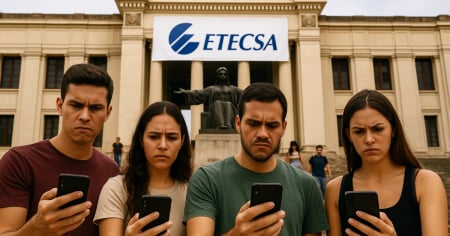
The official newspaper Granma recalled that the Cuban regime has established a punitive framework to imprison Cubans who express critical opinions on social media.
In the context of public discontent over the recent tariff increase by the state monopoly ETECSA, Granma published a piece titled “Outburst of Anti-Cuban Terrorism on the Internet”, penned by Francisco Arias Fernández, which reproduces the familiar rhetoric of the besieged plaza, mercenaries, and imperialist aggression.
"Many are the offenses specified in the Cuban Penal Code that can occur in the context of digital social networks, for which there is a sanctioning framework applicable to each act," reminds Granma.
Arias Fernández goes on to list a series of crimes with which the regime commonly accuses critical voices: “Enemy propaganda, defamation of institutions and organizations, threats, sexual assault, corruption of minors, defamation, slander, insult, extortion, and fraud.”
While the monopolies that own digital internet platforms censor and shut down sites, profiles, pages, or content advocating for an end to the genocide against the Palestinian people or the cessation of the maximum pressure economic war against Cuba
“Disobedience is also a criminal offense included in the crimes against administration and jurisdiction, similar to Assault and Resistance, with the difference that the latter extend to physical space, and have been expressed through social media,” adds the author of the article, perhaps making a veiled reference to the recent accusation against the thinker and activist Alina Bárbara López Hernández.
The official organ of the Communist Party refers to the censorship of "the monopolies that own digital internet platforms," overlooking the surveillance by State Security on critical voices in social media
"The conspiratorial rhetoric manipulates, recycles fake news, seeks to confuse and amplify shortcomings, social issues, and the consequences of the economic war in the daily lives of Cubans to increase discontent, sow demotivation, and divide and confront the Government," the text reads.
The text published this Friday coincides with the announcement of a new set of measures that severely restricts the use of the Cuban peso (CUP) for mobile top-ups and promotes, instead, data packages in U.S. dollars.
Beyond the immediate perplexity and outrage caused by the announcement, the reaction that the new measures provoked in the Cuban digital ecosystem was surprising, particularly on the regime's official portal Cubadebate, where the news sparked a wave of comments that expressed their anger, overflowing the usual boundaries of criticism on the island.
The decision to limit top-ups in CUP to a maximum of 360 pesos per month and to offer data plans in foreign currencies was seen by many as the formalization of the dollarization of mobile services in Cuba.
The announcement, which came with a technocratic language and promises of technical "improvements," was met with a public reaction rarely seen in official voices or state media. Within hours, over 1,300 comments flooded the official page of Cubadebate. And this time, the tone was not one of resigned approval, but of unfiltered outrage.
A reader summed it up with bitter irony: “Let's be serious. This is not an offer, this is armed robbery. Another attack on those who already have very little.”
Spokespersons for the regime, such as Ernesto Limia and the singer from Buena Fe, Israel Rojas, have also reacted against the rate hike.
Also on Friday night, shortly after the measure was announced, the Ministry of Interior (MININT) launched a national surveillance exercise in communities across the island under the name "Popular Exercise for Security and Order."
Frequently Asked Questions about the Phone Rate Hike in Cuba and Censorship on Social Media
What measures has ETECSA taken and how have they affected Cubans?
ETCSA has limited the use of the Cuban peso for mobile top-ups to a maximum of 360 pesos per month and has promoted data packages in US dollars. This measure has sparked outrage because, in practice, it formalizes the dollarization of mobile services in Cuba, excluding many Cubans who earn their salaries in Cuban pesos and do not have access to foreign currency.
How has the Cuban population reacted to ETECSA's announcement?
The reaction to ETECSA's announcement was one of outrage and surprise, especially on the official portal Cubadebate, where more than 1,300 critical comments were recorded. Many Cubans see this measure as a disconnection from the country's economic reality and a direct assault on their already limited resources.
What threats does freedom of expression face on social media in Cuba?
The Cuban regime has established a punitive framework that includes the possibility of imprisonment for expressing critical opinions on social media. According to the newspaper Granma, multiple offenses outlined in the Penal Code can be applied to online activities, severely limiting freedom of expression in the digital environment.
What actions has the Cuban regime taken to control information on the Internet?
The Cuban regime has implemented laws such as Decree Law 35 and the Social Communication Law to restrict freedom of press and expression on the Internet. These regulations allow the government to regulate and control information on social media, imposing fines and prison sentences for opinions that contradict state guidelines.
Filed under: