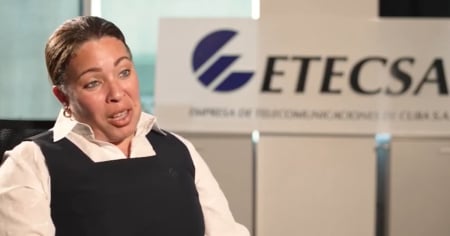
A young Cuban residing in the United States expressed her outrage against the so-called "tarifazo" by ETECSA, accusing the company of exploiting Cubans on the Island to blackmail those abroad and seize their money.
Identified on TikTok as Esencia Dramática, the girl expressed the feelings of many of her compatriots, a cry of protest that goes beyond the fee and touches the core of the economic injustice of the system.
"Your family needs more information, as you know, pay from abroad," he began his reflection in a sarcastic tone, before dismantling the official narrative with precision: "This is not a commercial strategy, it’s a well-thought-out trap, it’s economic repression, it’s planned dependency, it’s another dirty trick to keep squeezing those who have already left."
The young woman targets the real aim of the rate hike: not only the Cuban on the Island, who is left practically without connection, but also that of those in exile, who feel "emotionally blackmailed to put dollars in the pockets of the dictatorship."
And he concludes with a phrase that is already circulating as a slogan on social media: "Once again, he tightens the one inside so that the one outside pays."
According to the new policy, while residents in Cuba have a ridiculous monthly cap in national currency, ETECSA only offers mobile data plans in U.S. dollars.
This disparity is perceived by most as a means of social control and economic repression masked as modernization.
"This is a need for dollars. It is a broken, desperate dictatorship using the people's needs as a hook," denounces Esencia Dramática.
Finally, the young woman suggests that Cubans living abroad suspend the remittances to their relatives. "The same dictatorship is providing you with the tools to use against it."
From exile, voices like that of activist Saily González Velázquez support the same approach, promoting a "total halt" of top-ups as an act of civic protest.
"They extort us with meal combos, hotels for leisure, and now mobile data for communication. Enough is enough," he wrote on social media.
"Today it's the top-ups, but tomorrow they're going to start charging even for water in dollars. (...) And if we don't do something now, we will also be complicit in digital apartheid, in the gag that this measure represents, and in the extreme inequality in Cuba," he emphasized.
Also in Cuba, some dignified citizens have decided to reject any recharges from abroad.
"I will not accept a single peso being charged in my name to ETECSA. I don't want any top-ups. I want ETECSA to go hungry even if I never use a cell phone again," stated lawyer Manuel Viera.
For his part, art critic Jorge de Mello announced his forced withdrawal from social media, as he could not afford the new price imposed by the Cuban telecommunications monopoly.
"I refuse to ask my emigrated friends to pay a single dollar to an inefficient state company that engages in digital hustling protected by the lack of freedoms," he wrote.
A measure that deepens inequality
The recent decision by the company ETECSA to dollarize its main mobile internet services and drastically limit access in national currency makes internet access in Cuba a privilege of the elite.
With prices in CUP that are equivalent to two to four times the average monthly salary, access to the network is reserved for those who receive remittances or have access to dollars.
"The only thing they are doing is creating more division within Cuban society. The new wealthy are those who have family abroad or the few who have access to USD," denounced a Havana resident on social media.
In addition to the financial blow, the measure has a clear repressive component: by limiting connectivity, access to information, digital work, education, and—above all—the ability to voice complaints is also restricted.
"Who just limited communication with the captives on the Island and extorted the family while holding a gun to your family's head?" asks Esencia Dramática, with a rawness that reflects the suffocating feelings of the Cuban people.
The official silence and the noise of discontent
While ETECSA justifies the measures as necessary to "maintain the network," many Cubans remember that for years the company collected millions from abroad without investing a cent in real improvements. "They gathered millions of dollars and didn't invest in anything," commented a resident from Pinar del Río.
The general feeling is that the Cuban government has crossed a new line by turning connectivity— a basic right in the 21st century— into a tool of coercion. And while the regime aims to isolate the protesting Cuban, it seems to be achieving the opposite effect: discontent is growing, both within and outside the country.
Frequently Asked Questions about the New Rates from ETECSA and Their Impact in Cuba
Why has ETECSA imposed a limit of 360 CUP for recharges per month?
ETECSA justifies the recharge limit in CUP as a measure to sustain and develop the country's telecommunications network. However, many citizens view this restriction as a form of economic exclusion that benefits only those who can pay in dollars. The measure has been criticized for severely limiting access to the Internet in a country where the average salary is insufficient to cover the new rates.
What are the new prices for ETECSA's data plans in dollars?
The new dollar data plans from ETECSA are: 4 GB for 10 USD, 8 GB + 75 minutes + 80 SMS for 20 USD, and 16 GB for 35 USD. These plans include an additional 300 MB for national browsing. Accessing these plans requires payment via international cards or the MiTransfer Wallet, which excludes many Cubans who do not have access to foreign currency.
How does the ETECSA rate hike affect Cubans living on the island who do not receive remittances?
The ETECSA price hike has turned Internet access into a luxury that only those receiving remittances or having access to dollars can afford. The plans in CUP are unaffordable for the majority, as the prices exceed several times the average monthly salary. This not only limits connectivity but also impacts access to information, digital work, and education, increasing social and economic inequality in the country.
What reactions has ETECSA's new pricing policy provoked among Cubans?
The new tariff policy of ETECSA has generated a widespread rejection and discontent among Cubans both on the island and abroad. Many citizens have expressed their outrage on social media, describing the measure as unfair and exclusionary. Furthermore, there have been calls from the exile community for a "total halt" to top-ups as a form of protest. The situation has been seen as an exacerbation of inequality and a form of economic coercion by the Cuban government.
Filed under: