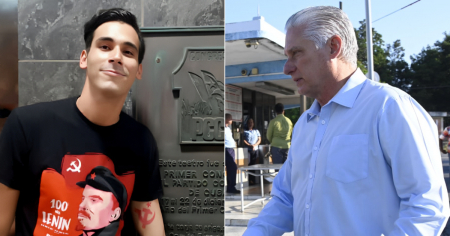
The national president of the University Student Federation (FEU), Ricardo Rodríguez González, on Monday blamed alleged "enemies of the revolution" for manipulating the recent expressions of discontent in universities across the country, following the rate increases announced by the state-owned ETECSA.
During his speech on the official television program Mesa Redonda, Rodríguez stated that student protests have been manipulated by external actors with "very bad intentions" to misrepresent the legitimate stance of university students, who, he claimed, have maintained an attitude of respect and dialogue in the face of unpopular measures.
"Something has happened that we also anticipated, which is that the enemies of the revolution, with very ill intentions, have twisted that stance, that sense of unease that has arisen in the university student community, and they have tried to manipulate that perspective to provoke a confrontation," he pointed out.
Rodríguez defended that the FEU has acted “within the revolution” and asserted that there have been multiple exchange spaces among students, ETECSA executives, representatives of the Communist Party, ministers, and leaders of the Union of Communist Youth (UJC) to address grievances.
The student leader reported that meetings took place in the faculties of the University of Havana starting the Friday before the program, along with telephone conversations with high-ranking state officials and a national videoconference to discuss the impact of rising prices on academic life.
"From all levels of the organization, a vision of respect has been maintained (...) and the intention has been to seek the perspective on how to engage in dialogue and reach consensus on solutions," he insisted.
Rodríguez also emphasized that the protests reflect real concerns among the student body, but clarified that the organization has not distanced itself from the government.
In his remarks, he defended the role of the FEU as a valid interlocutor in the process of "training men of science and thought."
Despite the demagogic claims made by the regime's spokesperson, the reality is that the new rates announced by ETECSA have sparked a wave of criticism on social media and statements from various university centers across the country, which questioned the negative impact of the prices on internet access and, therefore, on academic development.
Although the intervention by the president of the FEU aimed to reinforce the official narrative that dialogue has been the predominant path, his statements confirm the extent of the discontent generated by the so-called "tarifazo" in sectors traditionally aligned with the government, such as the university student body.
Despite the statements made by student leader Ricardo Rodríguez, who accused "enemies of the revolution" of manipulating university discontent, the reality is significantly different from the official narrative.
The protests and public statements from various faculties and student groups in Cuba reflect a genuine and coordinated rejection of the price hike imposed by ETECSA.
This Tuesday, CUJAE students demanded viable alternatives from ETECSA that do not jeopardize internet access in higher education.
In an institutional letter, they warned about the impossibility of maintaining academic life with the new rates, deeming the justifications provided by the state company as "insufficient."
This Monday, the national presidency of the FEU faced massive criticism after retracting an initial statement that questioned the price increase.
This shift was perceived as an attempt to align with the official stance, causing deep discontent among students, who denounced the lack of genuine representation of their interests.
During the weekend, the Faculty of Economics of the University of Havana publicly expressed its critical stance, indicating that the tariff hike directly threatens academic equity.
The statement issued by the local FEU called for greater student inclusion in decision-making processes and expressed concern about the disconnect between the actual needs of the student body and the measures being implemented.
Previously, the Faculty of Psychology of the same university had expressed similar sentiments, making it clear that the opposition to the increase in fees was widespread.
His statement warned about the negative impact of these policies on the quality of the educational process and denounced institutional silence as a form of symbolic violence against the student body.
Frequently asked questions about student protests and ETECSA's price hike in Cuba
Why does the FEU blame "enemies of the revolution" for the protests?
The FEU asserts that student protests have been manipulated by external actors with "malicious intent." The president of the FEU, Ricardo Rodríguez González, claims that these actions aim to distort the legitimate position of university students regarding the increase in ETECSA’s fees. According to him, these protests have been used to incite confrontation, even though dialogues have been maintained with the government and the state-owned company to seek solutions.
What has been the response of the FEU to ETECSA's rate hike?
Initially, the FEU expressed its opposition to the tariff hike by ETECSA. However, after meetings with ETECSA and the government, they issued a statement that softens their stance and emphasizes the importance of dialogue. This shift has drawn criticism from students and users on social media, who accuse the FEU of opportunism and of not truly representing the interests of the student body.
What measures has ETECSA proposed to address the criticism following the rate hike?
ETECSA has offered university students a second data package of 6 GB for 360 CUP. This allows students to have a total of 12 GB per month for 720 CUP. Additionally, more than 40 educational sites have been made available for free access, although these measures do not eliminate the limitation of 360 CUP on monthly recharges, which has been widely criticized.
How has the student community reacted to ETECSA's price hike?
The student community has expressed strong opposition to ETECSA's rate increase. Various faculties of the University of Havana, as well as other institutes, have issued statements denouncing that the new rates restrict access to the internet, negatively impacting their academic development. The criticisms focus on the lack of transparency and the perception that these measures favor those who can pay in foreign currency.
Filed under: