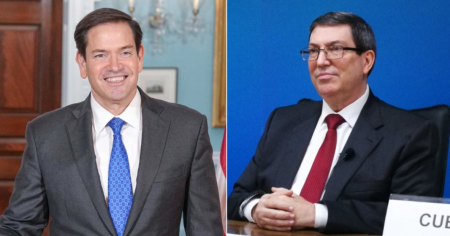
The United States government announced on Tuesday the imposition of visa restrictions on several officials from Central American governments, accused of participating in programs for hiring Cuban doctors that, according to Washington, are part of forced labor schemes orchestrated by the regime in Havana.
The announcement was made by Secretary of State, Marco Rubio, who stated that these sanctions aim to promote accountability for those who "exploit Cuban medical professionals under coercive practices."
"Visiting the United States with a visa is a privilege, not a right. We are committed to combating human trafficking, including forced labor," stated Rubio.
"These medical missions enrich the Cuban regime, while depriving the people of Cuba of essential medical care and exploiting the workers involved in them," emphasized the high-ranking Cuban-American official.
The sanctions described in an official statement from the Department of State include entry restrictions to the United States for both the involved Central American officials and their immediate family members, although the entity has not published the names or specific countries affected.
It is known that the restrictions apply to individuals involved in the implementation or facilitation of the so-called "Cuban medical missions," which have been operating in various Latin American countries for decades.
According to the Department of State, the export of Cuban medical personnel program represents a form of forced labor, as professionals are sent abroad under strict control conditions, unable to keep their passports and with a significant portion of their salaries withheld by the Cuban government.
"These practices not only economically benefit an authoritarian regime, but they also represent a modern form of labor slavery," the text stated.
Cuban medical missions, present in more than 60 countries at various times, have been praised for their impact on communities without access to medical services, but they have also been the subject of complaints from human rights organizations and governments such as that of the United States, which describe them as diplomatic and economic tools of the Havana regime.
The measure, celebrated by Congresswoman Maria Elvira Salazar, also seems to send a message to other countries that maintain close relations with Cuba, especially in sectors such as health, education, and security.
In the words of the Assistant for Western Hemisphere Affairs, "the United States raises its voice in support of the Cuban people in their pursuit of freedom and dignity," reaffirming its intention to apply diplomatic pressure against the allies of the Cuban government who, according to Washington, benefit from abusive labor practices.
In March, the Cuban regime claimed to have the support of Caribbean leaders, who reportedly expressed their willingness to lose access to U.S. territory rather than forgo Cuban medical assistance, which they consider essential for their healthcare systems.
Filed under: