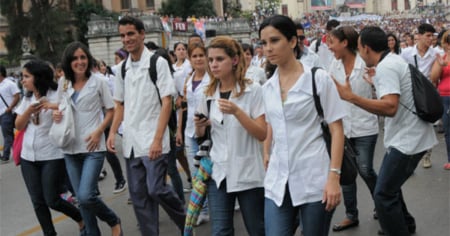
A professor at the University of Medical Sciences of Cienfuegos has been reported for intimidating students following a peaceful protest regarding the poor conditions in the dormitories and the extensive power outages.
The incident, captured on video and shared on social media, has sparked a wave of criticism and concern over the increasing harassment of university students in Cuba.
In the images sent to CiberCuba by a young man who requested to remain anonymous, a man is seen on the rooftop of a university building wielding a stick and shouting in a threatening tone: "Up! Is there desire? Homeland or Death, we will overcome!".
The gesture has been interpreted as a direct provocation to the students, especially following the recent protests.
The user identified as Patria y Libertad on the social media platform X highlighted the issue, claiming that the teacher acted out of "fear of a ticket booth," a form of protest popularized by students during the blackouts: hitting pots and pans to make themselves heard amid the silence enforced by the lack of electricity.
Screenshots shared by the user San Memero reveal that the young woman who recorded the video was forced to delete it and was subsequently reportedly detained by State Security agents, according to unconfirmed reports.
"The students were banging on pots because the power was cut off in the dormitories; furthermore, they removed the teacher's electrical outlets, which are on a different circuit and always have power, and they were protesting against ETECSA's rates," explains a disseminated message.
In response, the communist professor reportedly arrived at the scene shouting political slogans and threats, before the electricity was restored and security agents appeared.
"When university students discover their power, the show is over," warned the user San Memero on social media, capturing the sentiment of a generation that is beginning to lose its fear.
An atmosphere of intimidation
This episode occurs days after students from Cienfuegos and Guantánamo peacefully protested against the living conditions at their universities: power outages, lack of drinking water, spoiled food, and deteriorated infrastructure.
Far from receiving solutions, many of them have been targets of threats from university officials and repressive forces.
"They threatened to kick us out of the scholarship. They are trying to instill fear as they have done since 1959," denounced Camila Hernández, one of the affected students, on Facebook.
"When we demand what is rightfully ours, when we raise our voices, then they all come in droves to silence us," he/she added.
The regime's response
While university students are demanding minimal conditions for studying, the official discourse continues to focus on delegitimization.
In episode 30 of his podcast From the Presidency, the leader Díaz-Canel accused the protesters of being "manipulated from abroad" and labeled them as "antisocials" and "criminals".
These statements have created a stark contrast with the reality many students face: dilapidated facilities, collapsed basic services, and an environment of censorship and repression.
University students, especially those pursuing careers in healthcare, insist that their demands are not political but rather human.
They cry out for light, water, decent food, and respect, while facing an institutional apparatus that seems more interested in silencing them than in listening to them.
Filed under: