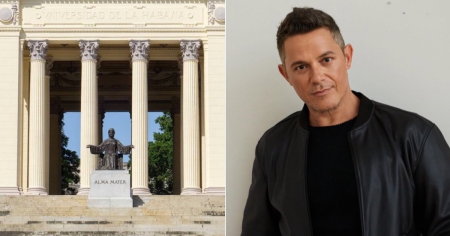
A medical student raised her voice this Thursday in Havana to firmly question the Cuban Telecommunications Company (ETECSA) following the recent imposition of restrictions on national top-ups and the increase in the dollarization of its services.
The words of the young woman, shared on social media and which have quickly gone viral, reflect the growing discontent among many Cubans regarding the policies of the state company.
"With the respect that the Telecommunications Company of Cuba, founded on December 1, 1994, deserves, I remind you that its function was to modernize and expand telecommunications services in the country," began the student, before launching a series of direct criticisms towards ETECSA's management, pointing out the high rates and limited accessibility for most Cubans.
The young woman not only questioned the quality of the service but also the use of the millions in revenue generated by the company over the years. In a segment that has garnered significant attention, she asked:
"Where has all the money raised over this time been allocated, and why does the public have to take responsibility for its mismanagement, poor administration, and bad investments?"
With a firm tone and clear language, he denounced the social impact of the new restrictions that limit top-ups from within the country, leaving thousands of families without an accessible way to communicate, while the options in foreign currency are presented as the only viable alternatives.
The student also pointed out that measures such as offering free wifi in schools or granting access to virtual classrooms do not represent real solutions to a structural problem, and criticized ETECSA's lack of vision for not prioritizing these actions since the introduction of the internet to the island.
"Providing free Wi-Fi in schools or making the virtual classroom free is not the solution," he stated.
"Today, I am not only FEU, I am every elderly person whose pension is not enough for their basic needs—just imagine with these prices—I am that family member whose only means of communication is a video call, I am this student who knows how many doors the internet opens. We are a country facing various difficulties, and please, let this not be one more," he expressed in another part of his speech.
His words highlighted a reality shared by many young Cubans, who see connectivity not just as a right, but as a vital tool for their personal and professional development.
Reactions on social media came swiftly.
Many Cubans publicly supported the young woman's intervention, acknowledging the importance of her message and the absence of such questioning in the official media.
“The questions posed by the student were forceful and precise, my respects. Those questions should have been asked by the Cuban press, and they were not”, wrote an internet user.
“Why, why? That's how you speak. You all think that young people don’t think. That's how you speak”, added another commentator in a show of support and admiration.
The official response: More repression than solutions
The academic strike, which began on June 4, has spread to universities across the country, with its epicenter at the University of Havana. In response to the growing student movement, the government has chosen to stand united.
During his weekly podcast "Desde la Presidencia," Miguel Díaz-Canel, accompanied by the director of ETECSA, Tania Velázquez, made it clear that there will be no reversal of the rate increase.
According to Díaz-Canel, suspending the measures would be equivalent to "giving up revenue to maintain the service", and he warned that the country could face a "technological collapse" if unpopular decisions are not implemented.
"When a technological collapse occurs, we will also be held accountable," he asserted.
Tania Velázquez detailed the implications of that hypothetical collapse: the inability to make calls, send messages, or access workplaces and educational institutions.
The government maintains its inflexible stance, reiterating that it is necessary to "take a step back in order to gather what we need."
A movement that does not stop
Despite the regime's attempts to deny and discredit the academic strike -accusing students of being manipulated from abroad- the student movement continues to articulate clear demands: fair fees, equitable access to the internet, and the resignation of the president of the FEU, Ricardo Rodríguez González, whom they accuse of defending the interests of the government rather than those of the students.
“ETECSA is a socialist state company” and “is acting against the people,” warned another of the many students who in recent days have raised their voices in the pursuit of building a fairer university and a more transparent society.
In the face of censorship, apathy, and fear, Cuban students are showing that they do not want to remain spectators of deterioration, but rather protagonists of change.
Her struggle not only calls out ETECSA or the university authorities but also resonates with an entire country that has learned to resist in silence and is now starting, little by little, to speak up.
Filed under: