
Related videos:
In the midst of a wave of widespread discontent over the recent price hike imposed by the state-owned ETECSA, the Communist Party of Cuba (PCC) released a message that adopts the confrontational and repressive tone previously used during critical moments.
The statement, published on social media by the PCC, called to “defeat extreme reaction,” clearly referring to the recent protests primarily led by university students.
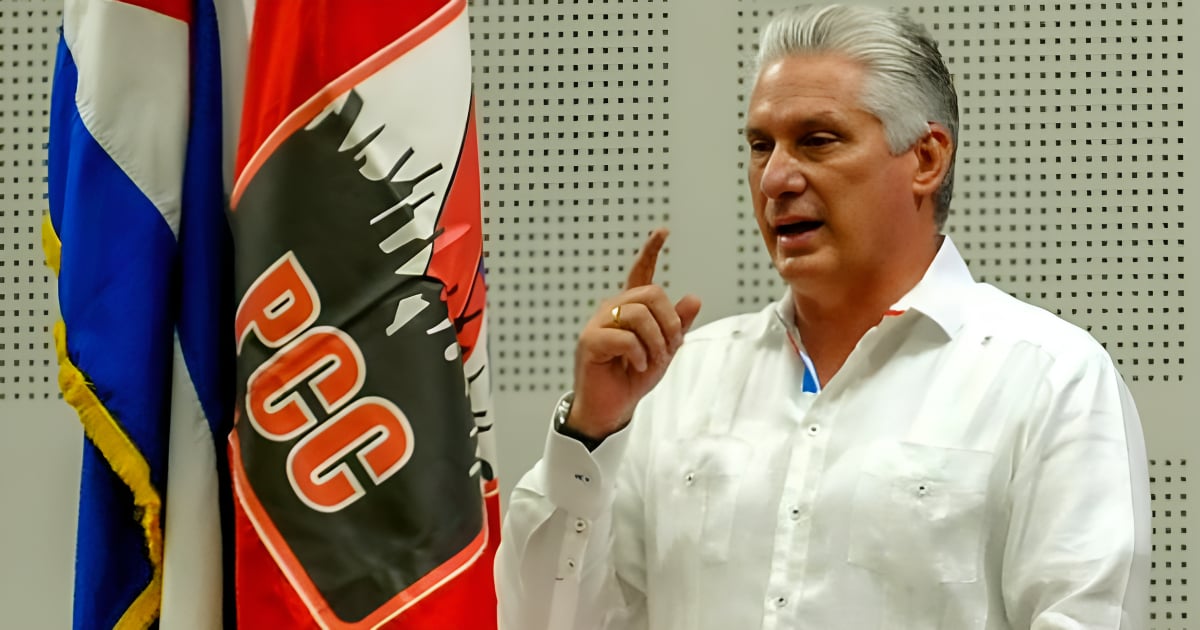
Behind the message stands Miguel Díaz-Canel himself, in his capacity as the first secretary of the single party, which lends the statement the character of a direct political line from the power and connects it with previous "combat orders" issued by the ruler.
“And remember this that history teaches us: that these revolutionary processes have no middle ground, and that they either fully triumph or are defeated,” reads the message, excerpted from the dictator Fidel Castro, whose intent is unmistakably a call to action against any expression of dissent.
By stating that "rest assured that we will not be counted among the defeated," Díaz-Canel revived a logic of internal confrontation that criminalizes dissent, excludes the possibility of dialogue and consensus, divides the landscape into "winners and losers," and reinforces ideological and physical repression against those who challenge the regime's decisions.
This new call recalls the "combat order" issued by Díaz-Canel himself on July 11, 2021, when Cuba experienced the largest citizen protests in its recent history.
On that occasion, the ruler publicly urged the "revolutionaries" to take to the streets to confront the people who were peacefully protesting against the economic crisis and the lack of freedoms.
"The combat order has been given, the revolutionaries to the streets," he declared then on national television, directly labeling the protesters as provocateurs and "confused."
The scenario repeats itself under new circumstances
In recent days, the population, especially the youth, has reacted with outrage to the price hikes implemented by ETECSA, which directly impacts access to the internet and communication, essential pillars for social and political expression in the current context.
The new rates are perceived as abusive and disproportionate in relation to the purchasing power of the citizens, who are mired in a deep economic crisis. However, instead of reconsidering the measures, the Cuban regime has chosen to mobilize its repressive apparatus, deploying State Security agents to the universities across the country.
Furthermore, instead of recognizing the discontent as a warning sign and correcting unpopular policies, the government has chosen to reactivate its internal war rhetoric machinery, once again blaming the "counterrevolution" for instigating the protests.
At the same time, it has showcased a series of gestures, such as the promotion to General of the Army Corps of the current Minister of the Interior, Lázaro Alberto Álvarez Casas, during an event where the nonagenarian dictator Raúl Castro appeared once again.
This framing not only delegitimizes the citizens' demands but also enables a repressive response under the guise of "defense of the revolution."
The seriousness of the message from the PCC lies in the fact that it is not merely an ideological statement, but rather a line of political action that has historically been followed by the state's repressive apparatus. First, there comes an agitated militant or a state-run media outlet shouting "machete that they are few", and then the repressive machinery is unleashed.
When the first secretary of the PCC—the figure with the most political power in Cuba and the leader of the only legally recognized party under the regime's Constitution—issues a call to confront those expressing discontent, the immediate outcome is often an increase in surveillance, police repression, arbitrary detentions, and harassment of activists, journalists, and ordinary citizens.
The lack of a direct reference to the ETECSA price hike in the message does not prevent it from being understood as a straightforward response to the wave of protests that has begun to emerge in universities and social media.
The use of warlike and ideologized language by the leader of the so-called "continuity" confirms that, for the regime, criticism is not part of public debate, but a threat that must be silenced.
The scenario that is unfolding is alarming: faced with a increasingly informed citizenry tired of empty promises, power responds with trench slogans, shutting down dialogue and reinforcing social control.
Instead of rectifying, the Cuban totalitarian regime once again resorts to fear and state terrorism.
Filed under: