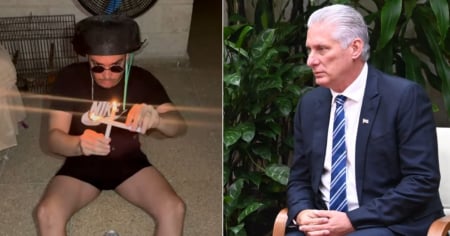
The Cuban leader Miguel Díaz-Canel stated this Friday that he is confident they will "overcome" the "challenges" of the economy, as reported during his participation in the closing of the ninth Congress of the National Association of Economists and Accountants of Cuba (ANEC).
In the closing session, the Cuban leader, without detailing the issues the country is facing, expressed his optimism regarding the recovery of the economy.
"I am increasingly convinced that we will overcome it and that we can overcome it," said Díaz-Canel after praising the report on the "process of correcting distortions" and "boosting the economy," which included recommendations generated during the sessions of the ANEC.
In his opinion, the proposals are "interesting" and arise in a "complex," "tough," "challenging," "daunting" context.
"I believe that this document serves as a work guide and, above all, as a support guide for the government program for its implementation, that is, the government program to eliminate distortions in the economy and to relaunch and reinvigorate our economy," he stated.
With the same triumphant tone in which he calls for resilience and creativity to face challenges, Díaz-Canel emphasized the necessity of not "allowing oneself to be defeated."
"Here, no one is defeated, here, no one is vanquished", he stated, reiterating that we must "resist by advancing and leveraging the talent present among economists."
According to reports from the state media, among the agreements of the ANEC were to strengthen applied scientific research to address economic challenges, support government policies with grassroots proposals, promote the development of young talents and their connection to territorial development, and combat misinformation by fostering an economic culture among the people.
Díaz-Canel continues with his tired argument of a "heroic resistance" of the Cuban people in the face of the economic and social crisis the island is experiencing. At the same time, he insists on blaming the U.S. embargo as the main culprit for the country's critical situation, while defending the socialist model and unity as key pillars to overcome adversity.
The Deputy Foreign Minister Carlos Fernández de Cossío also recently accused the United States of leading a "ruthless economic war" against Cuba.
The official stated that the embargo is the main obstacle to economic development, as it prevents access to markets, technology, financing, and fuels, in addition to having a deterrent effect on tourists and international companies.
Fernández de Cossío accused analysts and critics of making "superficial or deliberately biased" observations by failing to place the embargo at the center of any analysis regarding the Cuban situation.
Cuban economists believe that the crisis is also a result of management errors and ineffective economic policies of the regime itself.
Ineffective internal policies, extreme centralization, the lack of structural reforms, political repression, the absence of economic freedoms, and the state's inability to ensure a decent life are internal factors that have exacerbated the situation on the island.
Frequently Asked Questions about the Cuban Economy and Díaz-Canel's Statements
What did Díaz-Canel state about the ability to overcome economic challenges?
Díaz-Canel stated that he is convinced they can overcome the "challenges" of the Cuban economy. During the closing of the ninth Congress of the ANEC, he expressed optimism about economic recovery, although he did not specify the particular issues facing the country.
What are the causes of the economic crisis in Cuba according to the government?
The Cuban government, led by Díaz-Canel, primarily blames the U.S. embargo, calling it a "relentless economic war." The government asserts that the embargo is the main obstacle to the country's economic development. However, economists and critics argue that it is also a result of management mistakes and ineffective economic policies of the regime itself.
What is the "distortion correction process" mentioned by Díaz-Canel?
The "distortion correction process" is a plan to eliminate distortions in the Cuban economy and relaunch its development. Díaz-Canel views it as a work guideline and support for the government program, although he did not provide specific details about the measures to be implemented.
How has the Cuban population reacted to Díaz-Canel's statements about the economy?
The Cuban population has expressed skepticism and discontent regarding Díaz-Canel's statements. Many citizens feel that the promises of improvement lack a clear action plan, which has been reflected in criticisms on social media and a growing social discontent.
What are the criticisms of the economic management of the Cuban regime?
Critiques of the economic management of the Cuban regime focus on the lack of structural reforms, extreme centralization, and ineffective economic policies. Economists emphasize that these internal factors have worsened the situation on the island. Furthermore, it is noted that the government's approach avoids acknowledging these problems and instead focuses on blaming the U.S. embargo.
Filed under: