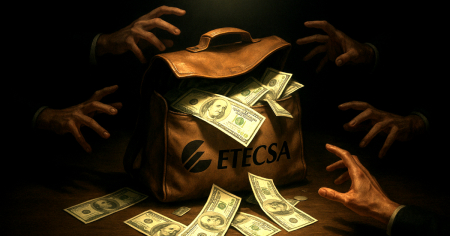
The Territorial Division of the Telecommunications Company of Cuba (ETECSA) in Guantánamo has reported being a victim of a wave of digital fraud and vandalism that further deteriorates its network, creating a multifaceted crisis that directly impacts schools, hospitals, and entire communities.
Despite the millions in losses and the decline in service, the authorities of the state-run and sole telecommunications company in the country have not presented concrete solutions, and the population continues to be both a victim and hostage of an inefficient service.
According to a note from the official newspaper Venceremos, digital fraud has alarmingly increased in the easternmost province of Cuba. In 2023, only four cases were reported, but in 2024 the number jumped to 54, with losses exceeding 170,000 pesos.
Only in the first few months of 2025, 24 new cases have already been recorded, in a trend that shows no signs of decreasing. The scams range from fraudulent top-ups to the use of equipment that simulates telephone exchanges to evade payments, employing increasingly sophisticated and hard-to-track methods.
According to the media, one of the most concerning aspects is the use of elderly individuals as a facade to contract multiple lines, and, “taking advantage of their technological ignorance, they are used as front figures to acquire multiple phone lines that are later allocated to these illegal activities.”
In these cases, when Etecsa detects and blocks these services, it "faces the dilemma of taking action against the contract holder, who is often another victim of the deception," he emphasized.
At the same time, the province has recorded 12 acts of vandalism so far in 2025, most of which are in the provincial capital, including the theft of cables, damage to telephone equipment, and impacts on the outdoor plant.
However, it is no longer just about copper theft. The cuts to fiber optic cables in remote areas, where there seems to be no apparent gain, reveal a deliberate intent "that seeks to cause as much damage as possible, rather than just theft out of economic necessity," and to destabilize vital services, noted Venceremos.
He noted that the damages affect everything from school facilities to hospitals and entire neighborhoods. Each outage entails an economic loss, but also an additional burden for a system that relies entirely on imported parts, which are often impossible to replace quickly. A simple cut wire can mean weeks of disconnection due to a lack of screws, terminals, or specialized technical equipment.
Vandalism is also intertwined with structural issues. In some illegal settlements, between 30 and 50 homes are clandestinely connected to electricity using wires stolen from the ETECSA network, revealing not only a technical crisis but also a social one, characterized by a lack of urban planning control, precariousness, and community disintegration, “a deeper social issue that requires comprehensive attention,” stated the source.
The state-owned enterprise acknowledges that community surveillance is inadequate and that the maintenance of the network is hindered by a lack of resources, particularly in rural areas. The public's perception of risk is minimal, allowing the looting of infrastructure to continue unchecked and without visible consequences for those responsible.
In light of this situation, the proposed solutions are as vague as they are ineffective: strengthening citizen reporting and improving public communication. But in practice, the state monopoly on telecommunications remains unable to protect its infrastructure or guarantee basic service. Once again, the population is left disconnected.
During the past few weeks, authorities have confirmed the occurrence of vandalism in ETECSA's networks. In the case of Havana, these actions have left hundreds of customers without phone service. The causes may also include short circuits and lack of maintenance.
In the province of Artemisa, there is also a reported increase in assaults on telecommunications infrastructure, while officials have raised concerns about the illegal use of the radio spectrum through mobile network repeaters or amplifiers imported by some citizens, which promise to enhance WiFi and mobile phone signals.
In Holguín, there have been so far 12 attacks on external infrastructure, resulting in disrupted services and users without connection.
In Las Tunas, ETECSA reported 19 acts of vandalism against its infrastructure during 2024, in addition to the theft of cables that sell well on the black market and even the Theft of the perimeter fences of its facilities.
Telecommunications authorities hold accountable individuals who use illegal equipment, as well as social indiscipline and vandalism, for the decline in the quality of telephone and mobile network service, in a context of severe economic and financial tensions.
The president of ETECSA stated that in the last four years, the entity lost 60% of its revenue due to fraud in international top-ups, one of the justifications put forward for implementing the recent price hike and moving towards the dollarization of the service, while its potential customers are paid in Cuban pesos.
Frequently Asked Questions about the crisis at ETECSA and vandalism in Cuba
What is the current situation of ETECSA in Guantánamo?
The situation of ETECSA in Guantánamo is critical due to a wave of digital fraud and vandalism that has impaired its infrastructure. These issues directly impact essential services such as those for schools, hospitals, and entire communities, with no concrete solutions provided by the authorities.
What types of vandalism affect ETECSA?
Vandalism against ETECSA includes cable theft, fiber optic cuts, and damage to telephone equipment. These acts have been reported in several provinces, affecting the continuity of telecommunications services and causing significant economic losses.
How does Cuba's economic crisis affect ETECSA?
The economic crisis in Cuba has negatively impacted ETECSA by reducing its foreign currency income, which has limited its ability to invest in modernization of infrastructure. Despite having a growing number of users, the company faces challenges in maintaining stable service due to a lack of financial resources.
What measures has ETECSA taken to address vandalism?
So far, ETECSA's measures have primarily been calls for citizen reporting and public awareness. No concrete strategies have been implemented to strengthen the security of the infrastructure or to improve monitoring systems, leaving the company and its users in a vulnerable situation.
Filed under: