
Related videos:
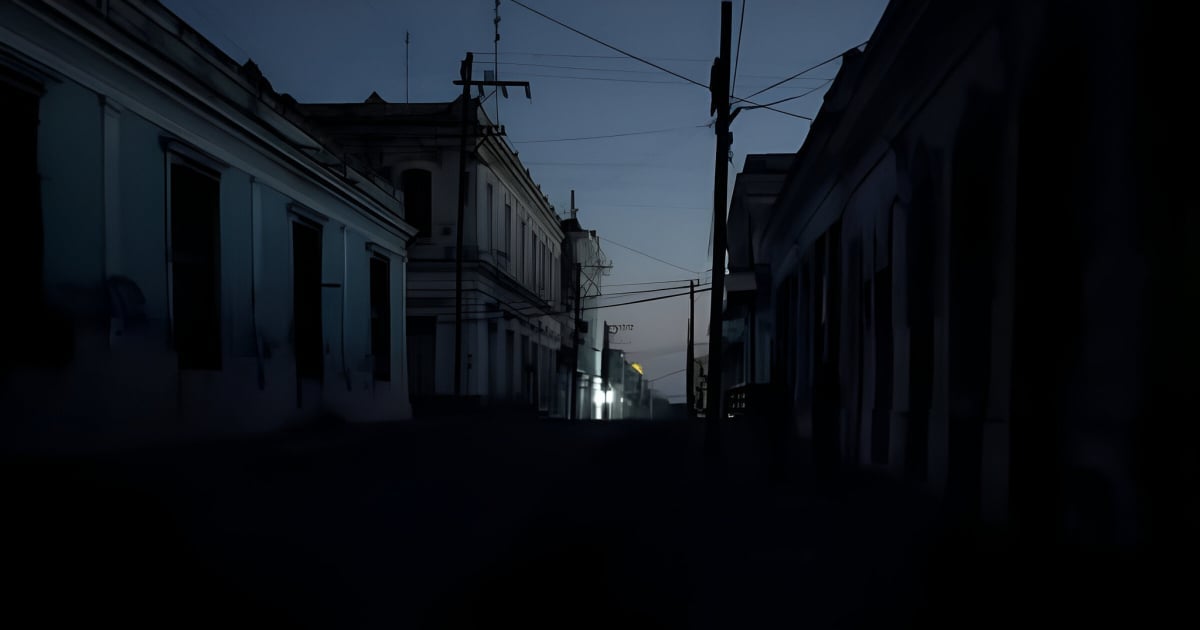
As blackouts become routine, the darkness enveloping the city of Sancti Spíritus goes beyond electricity, casting a deep shadow over cultural life, security, and the future of its young people.
This is how Sayli Alba Álvarez described it through her Facebook profile, a mother who recounts how one night she was loaded with bags with her son to a friend's house near the pediatric hospital, seeking light, because the following day the boy had his final Math exam “and he needed to sleep and sleep well.”
In her testimony, the employee of the Provincial Center for the Book and Literature described a scene that seems straight out of a horror movie: empty streets, devoid of lights, sounds, or life. Only the faint murmur of a few neighbors on the sidewalks.
There is no sound of a television or radio, the entire city is silent. A dark, black silence. Only in a small park, in front of the School of Economics, were there young people and couples with motorcycles and lovers kissing... but even they were in the dark. Some were lit up by lamps or equipment, and reggaeton and chatter could be heard, without any subtlety,” he recounted.
The scene is not an exception; it is the norm. According to Álvarez, there is no cultural center open, nor is there a bar, café, or cinema, nothing. In a city that has just celebrated its 511th anniversary, there are no nightlife options beyond a dark park that smells of beer and fear. It is the same place where a mother does not want her son to end up going when he is able to go out on his own.
And he asked, “What do young university students want to study for, if the only fulfillment will have to do with the spirit? Where can youth go at night in a mysterious, narrow, dark, dangerous city?... What is here for when my child grows up? I have never seen or felt the darkness as deeply as today, as I have wandered the city in search of light.”
However, the reflection is not just on a blackout, but on a city shrouded in darkness in every sense.
“What can we offer our son, a musician and a teacher? Defeat, we only have the overwhelming defeat of reality, of darkness, the genius of the 240 pesos for daily bread. We have nothing to keep him here beyond the love that does not satisfy physical hunger. My city cannot be seen. My city is erased. I didn't see its park, nor my library. My city has died and I have run to hide,” Álvarez declared.
Hundreds of testimonies on social media document how daily life in Cuba has turned into an exercise of resilience in the face of the prolonged absence of electricity and a reality marked by precariousness, frustration, and a lack of prospects.
Elderly individuals attest to the “terrible sense of hopelessness” that comes with living in Cuba at their age, amidst blackouts, food shortages, and lack of medications.
Others young people sleep on the plates of their homes due to the lack of electricity at night, a reflection of the daily struggle faced by hundreds of thousands of people amid the energy crisis.
During a visit on Thursday to Granma and Camagüey, President Miguel Díaz-Canel that impact entire communities.
The energy crisis in Cuba has unleashed an unprecedented wave of public outrage, as power outages, which in some areas of the country have already exceeded 24 continuous hours, have driven the population to the brink of physical and emotional exhaustion.
Cuba is going through this Friday, June 20, a new day of energy emergency, marked by massive blackouts across the country. The UNE estimates a maximum demand of 3,500 MW with only 1,910 MW available, resulting in a deficit of 1,590 MW.
Frequently asked questions about the energy crisis and the situation in Sancti Spíritus, Cuba
Why is the city of Sancti Spíritus experiencing an energy crisis?
The energy crisis in Sancti Spíritus is due to frequent blackouts that not only affect the supply of electricity but also impact cultural life, security, and the future of the youth. The situation reflects a widespread problem in Cuba, where energy demand far exceeds the available generation capacity, leading to blackouts of up to 24 hours or more in some areas.
How does the lack of electricity affect daily life in Cuba?
The lack of electricity disrupts daily routines, affects security, and alters cultural life. Cities are plunged into darkness, which increases insecurity and limits nighttime activities. Furthermore, the lack of electricity impacts food preservation, communication, and access to basic services, exacerbating the frustration and emotional strain of the population.
What alternatives do young people in Sancti Spíritus have in light of the current crisis?
In Sancti Spíritus, the options for young people are limited due to the lack of cultural and recreational spaces. With the city silent and in darkness, young people are forced to gather in dark parks or stay at home. This situation raises concerns about the future of the youth, as the lack of opportunities can lead to demotivation and emigration.
What is the Cuban government's response to the energy crisis?
The response from the Cuban government has been insufficient and ineffective. Although President Díaz-Canel has acknowledged the situation, the measures taken have not succeeded in alleviating the blackouts or improving the energy infrastructure. The lack of investment and the scarcity of fuel worsen the problem, and the population remains without clear answers or effective solutions.
Filed under: