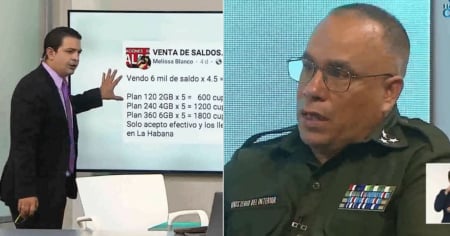
The official spokesperson Humberto López, a familiar face in the propaganda spaces of the Cuban regime, asserted this Wednesday on the program Hacemos Cuba that the revenues of ETECSA, the only telecommunications company on the island, are essential not only to sustain the health system and other sectors of the country but also to confront the deep energy crisis that keeps Cuba in the midst of endless blackouts.
According to the presenter, the money collected from international top-ups can help reduce the frequency of blackouts. "Who wants a blackout? No one, right? But that money, this money that is being scammed, can it be used or not to alleviate a bit of what we are experiencing?" said López, referring to the losses that ETECSA would be facing due to alleged fraud with international top-ups.
López linked phone top-ups to the stability of the national electric system, stating that the money lost due to these scams could also be used to "continue investing in an electro-energy system that is in crisis".
In a country where ETECSA's rates are high and access to the internet remains limited and expensive, linking the quality of electrical service to phone top-ups can be, at the very least, provocative.
While millions of Cubans deal daily with power outages of up to 12 hours and even longer, they are asked to ensure the purity of the channel through which their balance comes in.
In its latest Father's Day promotion, ETECSA offered a top-up of 1,500 CUP for a price of 65.99 USD. In return, the user in Cuba receives 25 GB and unlimited nighttime browsing for 35 days.
The offer was presented as a "special gift," but what it provoked was a wave of indignation. For many, this is not connectivity: it is an emotional blackmail with a patriotic label, squeezing the pockets of emigrants while digital exclusion remains in Cuba.
“Where is the business?”, wondered a user on social media. “I might as well take that money and buy food”, said another. The promotion, which was supposed to celebrate a family occasion, became the most evident symbol of the exhausted state model: raising foreign currency at all costs, even if it means manipulating emotions.
And now, in the height of absurdity, it is suggested that this type of income, already controversial in itself, could be a way to mitigate power outages. As if topping up your father's phone credit suddenly meant that the lights wouldn't go out that night.
For its part, during Hacemos Cuba, which included representatives from the Ministry of the Interior, the Prosecutor's Office, and officials from ETECSA, it was stated, through Colonel Marcos Yobany Rodríguez González, the second chief of the specialized body for economic crimes at MININT, that the scams involve a network of operators based both inside and outside of Cuba who simulate recharge promotions similar to the official ones, but funnel the funds outside of the country, leaving the foreign currency beyond state control.
Cuban customers receive the balance, but as if it were a national recharge, which, according to the authorities, implies millions in economic damage to the company.
During a recent operation in Havana, authorities seized over 40 million pesos in cash, antennas, money counting machines, and documents related to the network.
Fraud and sabotage: the new crimes of reloads
The Chief Prosecutor of the Criminal Processes Directorate of the General Prosecutor's Office, José Luis Reyes Blanco, warned that these acts could even be classified as sabotage, due to the impact they have on "sensitive infrastructures of the country," such as telecommunications and the electrical system.
Those responsible face charges of fraud, illegal currency trafficking, and economic crimes, and precautionary measures such as pre-trial detention, asset seizures, and travel bans have been imposed.
The State, in the words of Humberto López himself, considers the citizens who receive these top-ups to be victims, as they are unaware that they come from an illegal scheme, although it urges them to report the incidents.
Filed under: