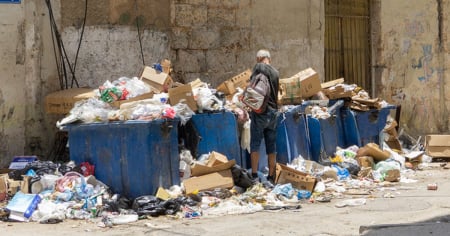
In the midst of a deep supply crisis, authorities from the provincial government of Santiago de Cuba admitted this week to the drastic reduction in the availability and distribution of rationed products through the ration book, a situation that directly impacts thousands of families in the eastern part of the country.
During an informative segment on the local broadcaster Tele Turquino, officials from various state-owned companies highlighted the existing limitations in key sectors such as energy, food, sanitation, baking, transportation, and water distribution.
In terms of food supply, it was reported that the distribution of rice and sugar from previous months is only possible thanks to international donations.
The rice, intended for the month of May, will only be available for age groups of 0 to 13 years and those over 60, while the sugar will partially cover the quotas for the month of March in some municipalities.
The oil, for its part, begins to be distributed in sections in Santiago de Cuba, coming from the province of Camagüey.
Regarding personal care products, only bar soap and detergent are available, and in minimal quantities, and deliveries are made partially with still some districts pending completion.
In the case of cigars, municipalities outside the provincial capital have already received their quota up to May, but in the city of Santiago de Cuba, products from March are still being distributed.
Normed bread, an essential food in the daily diet, is also facing serious limitations: the province receives only two trucks of flour on alternate days, while the province consumes 25 tons daily; hence, deliveries are made on a rotating basis and with delays.
Regarding liquefied gas, the resumption of service has been announced at 32 prioritized sales points, with an emphasis on areas with multi-family buildings.
However, no date was specified for the normalization of the service, after many people did not receive the product that was supposedly guaranteed in the previous delivery.
Access to drinking water remains one of the major challenges: in coastal areas, the distribution cycles exceed 25 to 30 days, due to the shutdown for maintenance of the main pumping system.
The company Agua Santiago indicated that solar and electric wells have been activated to cover part of the deficit.
Regarding urban transportation, it was announced that starting in July, 20 new vehicles with air conditioning will be added, along with the expansion of routes using electric tricycles and additional bases.
The authorities claim that this will improve mobility in short trips and areas with low slopes.
The First Secretary of the Party in the province, Beatriz Johnson Urrutia, and Governor Manuel Falcón Hernández called for improved communication with the public and for contextualizing information to “achieve a greater understanding among the population.”
Meanwhile, shortages and rationing continue to impact the daily lives of thousands of households in Santiago de Cuba, where each rationed product has become a rarity and the delivery schedule an uncertain promise.
Frequently Asked Questions about the Shortages in Santiago de Cuba
Why is there a drastic reduction in the supply of regulated products in Santiago de Cuba?
The drastic reduction in the supply of regulated products is due to a deep supply crisis that affects key sectors such as energy, food, sanitation, and transportation. This situation has been acknowledged by the authorities of the provincial government of Santiago de Cuba.
How does the shortage of regulated products affect the population of Santiago de Cuba?
The scarcity severely affects thousands of families in Santiago de Cuba, where every regulated product has become a rarity and the delivery schedule an uncertain promise. Basic products like rice, sugar, oil, and bread face serious limitations, and deliveries are made partially and with delays.
What measures are being taken to improve the distribution of regulated products?
Authorities have attempted to implement an emergency logistics system and have activated wells powered by solar and electric energy to address the water deficit. However, no specific dates have been provided for the normalization of liquefied gas services, nor are there effective solutions for the distribution of food and other basic products.
Filed under: