
Related videos:
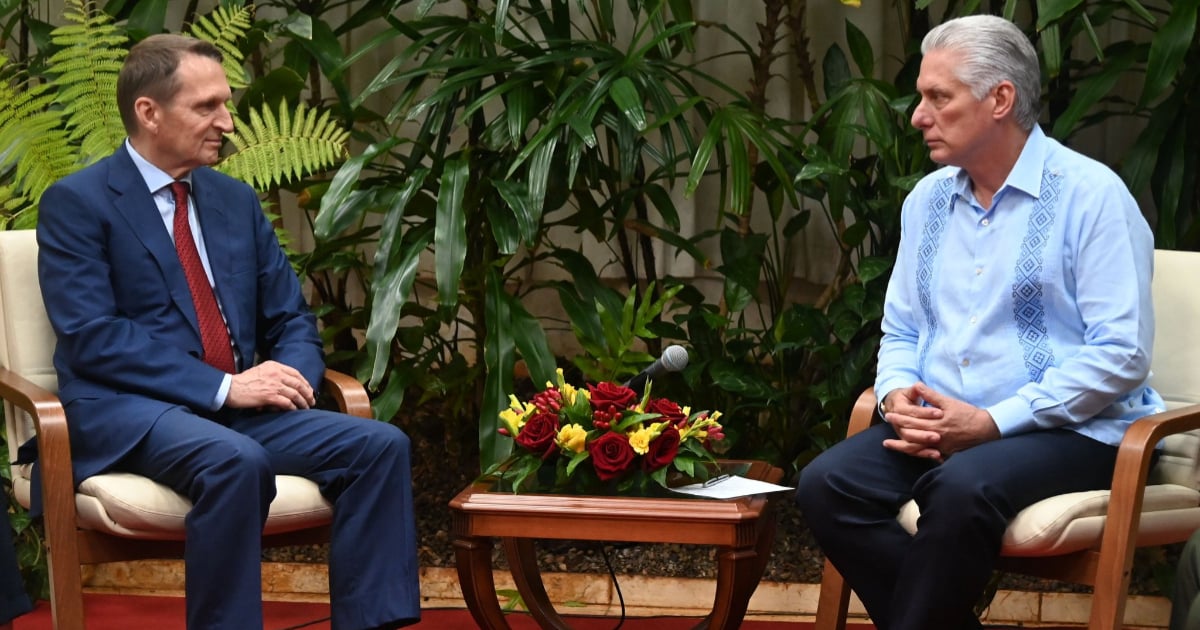
The Cuban leader, Miguel Díaz-Canel, received on Monday at the Palace of the Revolution in Havana the head of Russia's Foreign Intelligence Service (SVR), Serguéi Naryshkin, in a meeting that strengthens the close political and strategic alliance between the two countries, amidst rising tensions with the United States and new sanctions announced by Washington against the Cuban regime.
During the meeting, Díaz-Canel stated that the visit from the high-ranking Russian official demonstrates the "excellent state" of bilateral relations and expressed gratitude for Moscow's support against the economic embargo imposed by the United States, as well as the efforts to remove Cuba from the list of countries that "allegedly sponsor terrorism."
"It is a pleasure for us to welcome you to Cuba, along with the delegation accompanying you," expressed the Cuban leader, who also conveyed a greeting from Raúl Castro to the visitor and sent a message to his counterpart, Vladimir Putin.
The meeting took place in a symbolic context, marked by the 80th anniversary of the Soviet victory over Nazi Germany in World War II and the 65th anniversary of the resumption of diplomatic relations between the two countries. Díaz-Canel emphasized that these ties have "deep political and historical motivations."
The meeting also included Army Corps General Lázaro Alberto Álvarez Casas, Minister of the Interior, as well as other high-ranking officials from the Cuban security apparatus.
In an institutional post on X, the Presidency of Cuba stated that the visit "demonstrates the excellent state of relations between our governments," expressed gratitude for "Russia's unwavering support in the fight against the blockade," and emphasized that the meeting took place on a "date of historical significance."
Frequent visits and Russian support
It is not the first time that Naryshkin has traveled to Cuba as the head of Russian espionage. In December 2018, he was also received by Díaz-Canel and Raúl Castro, during a visit that occurred shortly after Russia granted a loan of 50 million dollars to Havana for the purchase of armaments. At that time, issues related to intelligence and security cooperation were discussed, although the details of the exchange were not publicly disclosed.
In recent years, Russia has increased its political and economic presence on the island. Just in the past year, Russian Deputy Prime Minister Dmitri Chernishenko has visited Havana several times, promising multi-million dollar credits, energy support, and diplomatic backing. Moscow has allocated over 120 million dollars in funding for fuel, electrical parts, and humanitarian aid, although these promises have not translated into visible improvements for the Cuban population, which continues to face massive blackouts and widespread shortages.
During one of those visits, Chernishenko promised that Russia would "rescue the Cuban economy" and bring "prosperity" to the island, without specifying concrete deadlines or visible conditions.
Military cooperation under surveillance
The strategic approach between Cuba and powers such as Russia and China has raised concerns in Washington. In May of last year, satellite images revealed the presence of Chinese military installations at various locations in the country, including Bejucal, El Salao, and Wajay, areas historically linked to intelligence activities. U.S. lawmakers have denounced a growing surveillance operation against the U.S. from Cuban territory, an accusation that the regime has categorically denied.
Just 24 hours before the meeting between Díaz-Canel and Naryshkin, President Donald Trump signed a new presidential memorandum that tightens the economic embargo and prohibits U.S. tourism to Cuba. The document also bans any financial transactions with entities controlled by the Armed Forces and intelligence services of the regime, in a shift in policy aimed at further isolating the Cuban government and strengthening support for independent civil society.
As Havana strengthens its ties with Moscow, Washington is hardening its stance. The visit of the head of Russian intelligence not only reaffirms the alliance between the two governments but also takes place at a time of heightened geopolitical tension, with Cuba positioned as a pawn in the confrontation between major powers.
Frequently asked questions about the meeting between Díaz-Canel and the head of Russian intelligence
What was the purpose of the Russian intelligence chief's visit to Cuba?
The purpose of the visit was to strengthen the political and strategic alliance between Cuba and Russia, in a context of increasing tensions with the United States and new sanctions against the Cuban regime. The meeting underscores Russia's support for Cuba in the face of the U.S. economic embargo and its exclusion from the list of countries that sponsor terrorism.
What other topics were discussed during the meeting between Díaz-Canel and Serguéi Naryshkin?
During the meeting, the excellent state of bilateral relations was discussed and gratitude was expressed to Russia for its unwavering assistance in the fight against the U.S. blockade. The meeting coincided with the 65th anniversary of the restoration of diplomatic relations between the two countries, reinforcing the historical and political ties they share.
How has the relationship between Cuba and Russia impacted the economic situation in Cuba?
The relationship with Russia aims to provide economic and political support to Cuba, especially during times of economic crisis. However, despite promises of loans and assistance, there have been no significant improvements in the daily lives of Cubans, who continue to face blackouts and widespread shortages.
What concerns does the strategic alliance between Cuba and Russia raise in the international community?
The strategic cooperation between Cuba and powers like Russia and China has raised concerns in Washington, which denounces the presence of Chinese military installations on the island. The United States believes that this rapprochement could enhance surveillance operations against its country, which has led to a tightening of sanctions and restrictions on Cuba.
Filed under: