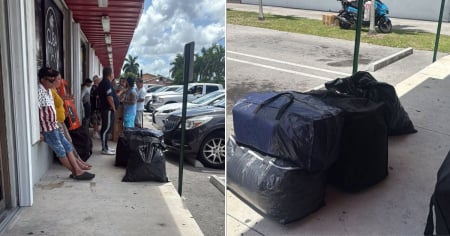
Starting January 1, 2026, a new federal tax approved by the U.S. Senate will mark a significant change in the dynamics of sending money abroad, especially for millions of immigrants residing in Florida.
The tax will be 1% on remittances sent in cash, money orders, or cashier's checks, and could have a direct impact on a community that represents more than 22% of the state's population.
The tax is part of the ambitious Republican legislative package called One Big Beautiful Bill, approved by a narrow margin this Tuesday in the Senate, although it will still have to go back to the House of Representatives.
The measure would, obviously, also affect immigrants of Cuban descent. Only U.S. citizens and nationals would be exempt.
What does the new tax on remittances imply?
The law establishes a federal tax of 1% on remittances sent exclusively in cash, money orders, or cashier's checks. Transfers made through the following will be exempt from this tax:
-Bank accounts.
-Debit or credit cards issued in the United States.
-Financial institutions such as banks, credit unions, and national brokerage firms.
This means that the impact of the tax will depend directly on the method chosen by the sender.
The use of electronic or banking channels will prevent the payment of this tax, whereas cash transfers will incur an additional fee that is added to the commissions already charged by services such as Western Union or MoneyGram.
Who will pay for it and how will it be charged?
The new tax will not be paid directly by the sender, but will be collected by the shipping service provider—such as exchange houses or money transfer agencies—and sent to the Department of the Treasury on a quarterly basis.
However, if the provider does not collect the tax at the time of the transaction, the responsibility will fall on them, not on the user.
In addition, providers must have agreements with the Department of the Treasury to verify the sender's status.
In theory, U.S. citizens and nationals using qualified providers will be exempt from the tax, but there is still uncertainty about how this verification will be implemented in practice.
Who will it affect the most?
A study by the FDIC indicates that nearly 42% of Latino immigrants in the United States regularly send remittances, highlighting the importance of this practice for communities such as those living in Florida.
Although there is no specific data by state or type of transfer, it is known that a significant portion of remittances is still conducted in cash, whether due to lack of knowledge about digital tools, limited access to banking, or distrust of financial institutions.
This puts immigrants with lower purchasing power in a vulnerable situation, especially those who do not have bank accounts or regular documentation.
Florida, a migration epicenter and a key sender of remittances
Florida is home to nearly five million immigrants, with Cuban, Colombian, and Mexican communities topping the list.
These groups, historically connected to their countries of origin, maintain strong economic ties through remittances, a vital mechanism for millions of families in Latin America and the Caribbean.
According to the American Community Survey (ACS) by the Census Bureau, in 2023, foreign-born residents in Florida accounted for 22.1% of the state's total population.
Among the main recipient countries of remittances from Florida are: Cuba, with 21.2% of the immigrant population; Colombia, with 6.7%; and Mexico, with 5.1%.
These communities, deeply rooted in the state, are some of the main sources of funding toward the southern part of the continent.
A tax that may still change
Although the Senate approved a version that sets the tax at 1%, this figure has been subject to negotiation.
The House of Representatives initially proposed a 5% tax, later reduced it to 3.5%, and the Senate ultimately adjusted it to 1%.
The bill must still return to the House of Representatives, where new amendments could be made before it is signed by President Donald Trump.
Therefore, the final amount of the tax and the exemptions are still to be determined.
International reactions: the case of Mexico
One of the most significant responses comes from Mexico.
President Claudia Sheinbaum announced that her government will reimburse 1% of the tax on Mexican migrants, as long as they use the Financial Institution of Well-Being (FINABIEN) as their sending channel.
This mechanism aims to cushion the economic impact of the new tax while simultaneously channeling remittances through official and secure means.
Sheinbaum also celebrated the reduction of the tax compared to previous versions, attributing this achievement to the pressure from migrants and the diplomatic efforts of Mexican lawmakers.
The role of remittances in the Latin American economy
Remittances are a vital source of income for many economies in the Global South.
In 2024, remittances to Latin America and the Caribbean reached a record of $161 billion, with an annual growth of 5%, according to the Inter-American Development Bank (IDB).
In this context, any obstacle, no matter how small it may seem—such as a 1% tax—can have a multiplying effect on entire communities that rely on remittances from the United States.
One of the indirect effects that this measure could generate is a greater digitalization of remittances.
Being exempt from tax, electronic transfers become the most attractive and cost-effective alternative.
This could encourage millions of immigrants to open bank accounts, use apps like Wise, PayPal, or Zelle, or register on mobile money transfer platforms.
However, this change could exclude older individuals, those with lower digital literacy, or those without access to documentation, who will continue to rely on cash.
Filed under: